- Pharmaceutical wastewater carries active pharmaceutical ingredients (APIs) at trace to low-microgram-per-litre concentrations, which need biological treatment designed for that duty
- Dissolved oxygen monitoring is the most direct control handle on aerobic biodegradation kinetics
- DO control systems improve removal of biodegradable APIs mainly by keeping the biology inside its operating window, and they cut aeration energy at the same time
- Aeration is the largest single energy load at most biological treatment plants, so real-time DO monitoring is where the operating savings come from
- Continuous monitoring produces the operating record that compliance reporting needs
Table of Contents
Introduction: Pharmaceutical Contaminants in Industrial Wastewater
Pharmaceutical residues are a well-documented category of emerging contaminants in industrial wastewater. Manufacturing facilities discharge API-containing process water at concentrations that vary enormously with the product and the process — from trace levels in wash water to hundreds of micrograms per litre in fermentation or synthesis effluent. The literature on municipal and industrial treatment plants reports API removal efficiencies ranging from roughly 20 to 85%, depending on the compound and the treatment technology.
Biological treatment offers the most practical removal pathway for the biodegradable fraction, but it needs monitoring and control to work. Dissolved oxygen (DO) sensors provide the real-time data that optimising biodegradation kinetics requires while keeping aeration cost under control.
The Role of Dissolved Oxygen in Biodegradation Processes
Biochemical Mechanisms of Pharmaceutical Degradation
Aerobic biodegradation of organic compounds, including many APIs, depends on microbial enzymatic activity that requires oxygen. The DO thresholds conventional activated sludge design works to are well established:
- 0.5-1.0 mg/L — enough for maintenance respiration of the existing biomass
- 2.0-4.0 mg/L — the range where active degradation proceeds without oxygen limitation
- 4.0-6.0 mg/L — no further kinetic benefit for most systems; the extra oxygen is wasted
The practical implication is that “more oxygen” stops helping somewhere around 2 mg/L for most aerobic systems, and everything above that is energy spent for nothing.
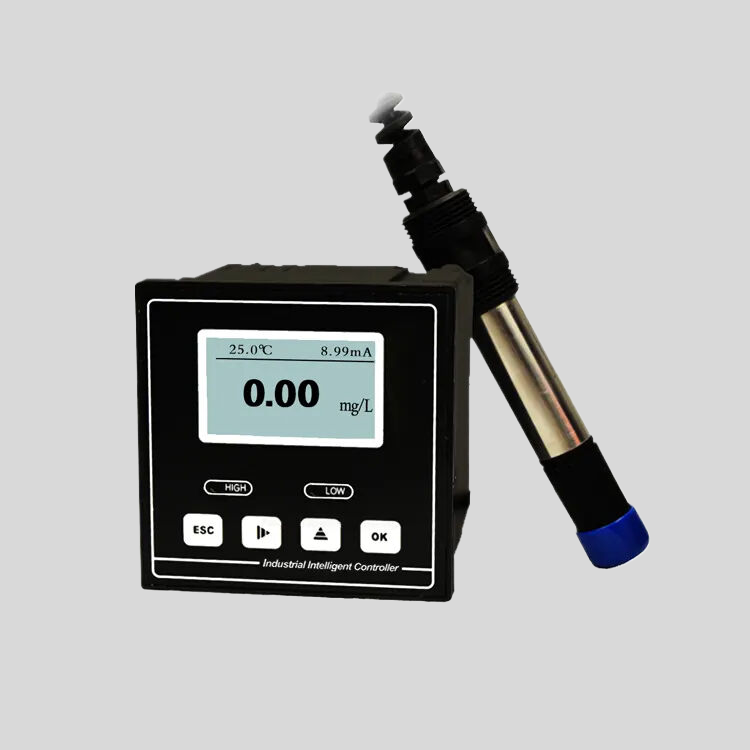
ChiMay DO transmitters provide ±0.1 mg/L accuracy across ranges from 0-20 mg/L, supporting real-time monitoring in aeration basins, automated aeration control that holds DO setpoints within about ±0.3 mg/L, and event detection that identifies inhibition conditions within 90 seconds.
DO as a Proxy for Biodegradation Kinetics
DO is not a measurement of pharmaceutical concentration, and it should not be treated as one. What it does is tell you whether the biology is oxygen-limited. Below about 1 mg/L, removal rates fall off sharply for most biodegradable compounds. Between 2 and 4 mg/L, removal is essentially at its maximum. Above that, no further improvement.
That relationship is why DO is such a useful control variable. Holding DO at 2 mg/L instead of 4 mg/L halves the aeration energy with no measurable loss of removal efficiency — which is exactly the trade-off a well-tuned plant makes.
Two caveats matter. First, not every API is biodegradable: compounds such as diclofenac and several other anti-inflammatories are removed poorly in conventional biological treatment regardless of how well DO is controlled, and they need advanced treatment instead. Second, some industrial streams carry compounds that are inhibitory to the biomass, and the DO signature of inhibition — a rise in DO at constant aeration, because the biology has stopped consuming oxygen — is one of the most useful early warnings an operator has.
Sensor Technologies for Pharmaceutical Applications
Optical DO Sensing Technology
ChiMay DO transmitters use optical luminescence technology, which has become the default for wastewater duty. Key specifications include a measurement principle of dynamic luminescence quenching (per ISO 17289), a detection limit of 0.02 mg/L, response time under 30 seconds (T90), no sensitivity to sulfide, pH, or salinity variation, and calibration drift of under 1% over 180 days.
Optical versus electrochemical sensors — the trade-off is familiar:
| Characteristic | Optical | Electrochemical |
|---|---|---|
| Maintenance interval | Months | Weeks |
| Flow sensitivity | Minimal | Significant |
| pH/sulfide cross-sensitivity | Minimal | Significant |
| Sensor lifetime | Several years | Under a year typically |
For pharmaceutical wastewater, which is dirty, variable, and expensive to send someone into, the lower maintenance burden of optical sensors usually decides the question.
Adaptive Aeration Control Systems
Fixed-setpoint control holds DO at a single value through the whole cycle. It is simple and reliable, and it also wastes energy whenever the biological demand is lower than the setpoint implies.
Adaptive control varies the DO setpoint with treatment stage and organic loading. Aeration typically accounts for half or more of a biological plant’s energy consumption, so this is the single largest controllable cost at the site. The achievable saving depends on how oversized the blowers are and how much the load varies — a plant with steady loading has less headroom than one with a large diurnal swing — but the direction is always the same: lower average DO at the same removal efficiency.
Case Studies in Pharmaceutical Wastewater Treatment
Antibiotic Manufacturing
Antibiotic production effluent is typically high-strength, with COD in the thousands of mg/L and API residuals in the low hundreds of μg/L. The treatment constraint is usually inhibition of the biomass rather than oxygen supply. Facilities that get this right use DO as an inhibition indicator: when the DO setpoint can no longer be held at constant aeration, the biomass has been suppressed and the incoming stream needs dilution or pre-treatment. Optimising DO control in that setting improves removal efficiency and reduces aeration energy at the same time.
Analgesic and Anti-inflammatory Compound Removal
The anti-inflammatory class shows why DO control is necessary but not sufficient. Ibuprofen and naproxen are reasonably biodegradable and respond to proper aeration. Diclofenac is not — conventional activated sludge removes it poorly at any DO level, and it is the compound most often cited as a marker for what biological treatment cannot do. Plants facing diclofenac limits end up adding an advanced treatment stage, which is a capital decision rather than a control decision.
Economic Analysis
The cost structure of a DO monitoring investment is straightforward:
- Capital: DO transmitters, mounting hardware, and integration with the aeration control system. A multichannel setup covering several basins costs more than a single point.
- Annual maintenance: sensor caps or membranes, calibration solutions, and site labour for verification.
- Instrument lifetime: optical sensors typically run several years before the sensing element needs replacement.
Where the returns come from:
- Energy savings from aeration control — usually the largest and most reliable benefit
- Chemical savings from better process control, particularly coagulant use
- Lower sludge disposal cost from a more stable biological process
- Avoided compliance penalties — the largest potential benefit, and the hardest to attribute to any single instrument
Payback is typically driven by the energy line. Facilities with expensive power and oversized aeration see the fastest returns; facilities with low power costs and tight process control see less.
Closing Notes: DO Monitoring as Essential Infrastructure
Dissolved oxygen monitoring provides the foundational data for optimising pharmaceutical wastewater biodegradation. Through precise aeration control, these sensors from established manufacturers like ChiMay help facilities improve removal efficiency for biodegradable pharmaceutical compounds, cut operational cost through optimised energy consumption, strengthen regulatory compliance with a reliable monitoring record, and stabilise the process through real-time adaptive control.
For environmental engineers designing or operating pharmaceutical wastewater treatment systems, DO monitoring is the instrument that makes the rest of the control strategy possible.