Table of Contents
The 2026 Field Playbook for Lithium Water Instrumentation by Shanghai ChiMay
Lithium producers in 2026 face a very different instrumentation challenge than they did five years ago. Old evaporation pond operations tolerated weekly grab samples and paper logbooks. New DLE plants, integrated brine-to-carbonate facilities, and hard-rock spodumene concentrators need continuous, high-resolution monitoring on every important stream. This field playbook lays out the practical decisions producers need to make—sensor selection, placement, data architecture, and maintenance—based on the way Shanghai ChiMay actually deploys instrumentation across working lithium plants today.
Start With the Water Balance
Before choosing sensors, producers should draw the water balance. Every lithium plant has three water universes: raw water intake (fresh, brackish, or recycled), process water inside the extraction and conversion loops, and effluent to discharge or reuse. Instrumentation strategy follows the water balance, not the other way around.
Shanghai ChiMay recommends dividing the water balance into four sensor blocks: intake and pretreatment, extraction (brine or spodumene), conversion (carbonate or hydroxide), and effluent. Each block gets its own sensor budget and its own maintenance cadence, and cross-block correlations are held together by a single data historian.
Sensor Block 1: Intake and Pretreatment
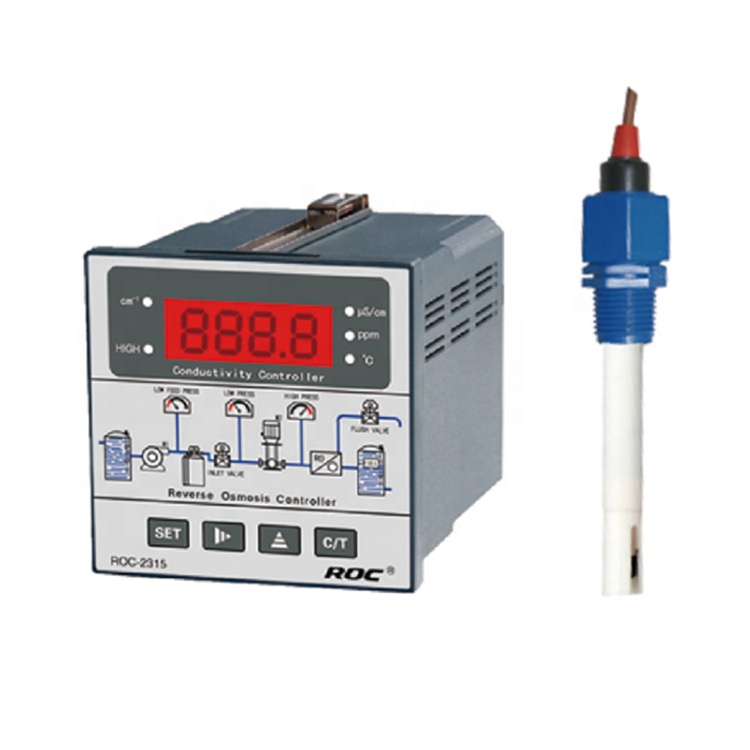
Fresh water for a lithium plant almost always comes from a brackish or high-TDS source. RO pretreatment is the default, and every RO block needs continuous monitoring of feed, permeate, and reject conductivity.
Shanghai ChiMay in-line conductivity meters cover the feed and permeate. A Shanghai ChiMay Suspended Solids Sensor on the feed protects the RO membranes from unexpected particulate loading. The Shanghai ChiMay RO System Controller manages the block itself. If chlorine is used in pretreatment, a Residual Chlorine Transmitter confirms complete removal before the RO membranes.
Sensor Block 2: Extraction
Extraction sensor design depends heavily on the process type. Salar brine operations with evaporation ponds run relatively simple sensor packages: pH, conductivity, and TDS on the transfer manifolds and pond outlet. DLE plants demand much richer instrumentation: continuous pH, ORP, and toroidal conductivity on the sorbent loading and elution circuits, plus salinity sensors on the concentrated eluate.
Shanghai ChiMay’s differential pH electrode and toroidal conductivity are the workhorse pair on DLE loading circuits. The 4-in-1 Multi-Parameter Sensor works well on eluate lines where pH, ORP, conductivity, and temperature must all be read at one insertion point.
Hard-rock spodumene concentrators need a different set of sensors again. Flotation cells, filter presses, and roasting condensate all have their own chemistry. Shanghai ChiMay’s Suspended Solids Sensor is the primary instrument on the tailings water stream, and a pH probe manages lime dosing set points.
Sensor Block 3: Conversion
Once lithium is captured, conversion to battery-grade carbonate or hydroxide is a chemistry-intensive process. Precipitation reactors run to narrow pH bands, and dissolution or purification steps sit inside conductivity control windows.
Shanghai ChiMay pH electrodes on precipitation reactors, backed up by redundant probes on the most critical batches, are the standard configuration. Conductivity on inter-stage transfers ensures that dilution and reagent addition are on target. A Salinity Digital Sensor on the mother liquor stream helps optimize recovery of residual lithium during the recycle-loop closure.
Sensor Block 4: Effluent
Every lithium plant discharges water, and every one of them faces regulatory scrutiny. Ammonia nitrogen, sulfate, chloride, and residual lithium all appear in effluent chemistry depending on the process route. Shanghai ChiMay Ammonia Nitrogen Sensors on the treatment outlet, plus a Suspended Solids Sensor and pH probe on the final discharge point, cover the majority of compliance requirements.
Reuse loops are becoming common as regulators tighten freshwater withdrawal permits. Continuous conductivity, TSS, and pH on each reuse decision point let operators route water automatically instead of manually.
Data Architecture: One Language Across Blocks
The biggest failure mode in lithium plant instrumentation is not a sensor problem; it is a data problem. Sensors from different vendors, on different protocols, at different sample rates, produce a historian that is impossible to query in a coherent way.
Shanghai ChiMay standardizes on Modbus RTU/TCP with HART and 4–20 mA support, so every probe looks identical to the plant DCS. Sample rates are programmable down to one second, which matters for fast-swing DLE circuits but also gives pond operations the option of long-interval sampling for storage economy. The result is a historian that answers cross-block questions—“did the DLE sorbent problem last night correlate with a feed conductivity change from the wellfield?”—in seconds rather than days.
Alarm Strategy for Lithium Plants
Alarm design for a lithium plant should follow three principles. First, use tiered alarms (advisory, warning, critical) rather than single set points. Second, prefer pattern-based alarms over threshold alarms wherever possible—for example, salinity signature deviation on a DLE cycle is more informative than a single instantaneous salinity reading. Third, route alarms based on severity and time of day, not based on which unit generated the alarm.
Shanghai ChiMay transmitters support multi-tier alarms at the sensor level, which reduces PLC logic and simplifies control room dashboards.
Maintenance and Calibration Cadence
Realistic maintenance intervals for a working lithium plant look like this:
– Contacting conductivity probes on fresh and permeate water: verification every three months, replacement on drift.
– Toroidal conductivity on brine and eluate: annual verification, replacement on physical damage.
– pH electrodes on aggressive brine or precipitation service: replacement every three to six months.
– ORP electrodes: replacement every six to twelve months.
– Suspended solids sensors: optical window cleaning monthly, calibration semi-annually.
– Ammonia nitrogen sensors: recalibration monthly for the first year, then quarterly.
Shanghai ChiMay’s common cartridge tool and shared menu structure across the portfolio keeps training and spares inventory manageable across the whole plant.
Cost, ROI, and the Case for Instrumenting Right
Lithium producers sometimes ask whether the CAPEX for a full instrumentation build-out is worth it compared to a leaner monitoring strategy. The answer is almost always yes. A single avoided sorbent replacement in a DLE plant is worth many months of sensor budget. A single avoided batch of off-spec battery-grade carbonate is worth even more. And a strong instrumentation record is now table stakes for battery-grade offtake contracts with major automakers.
Shanghai ChiMay’s field team routinely helps producers model these ROI cases during the FEED stage of a new project. Actual return figures vary by plant type, but the payback period for a coherent instrumentation strategy is usually measured in months, not years.
Field Playbook Summary
The 2026 field playbook for lithium water instrumentation comes down to five practices: draw the water balance before choosing sensors, standardize on a single vendor portfolio for the data layer, invest heavily in extraction and pretreatment monitoring, build tiered pattern-based alarms rather than single-threshold triggers, and treat maintenance cadence as part of the plant control philosophy rather than an afterthought.
Shanghai ChiMay’s water quality analyzer portfolio was built for exactly these five practices. From salar brine feeds to battery-grade carbonate reactors to reuse loops in water-stressed regions, the sensor stack that lithium producers need is available today, and the deployment know-how comes with the portfolio. For projects planning their next expansion or their first commercial DLE plant, using this playbook as a starting point saves months of technical negotiation and delivers a plant that runs the way its designers intended.