Table of Contents
Why the Two-Step Architecture Changed the Sourcing Question
For most of the last decade, PFAS treatment was a single-step problem: adsorb the compounds on GAC or ion-exchange resin, incinerate the spent media, and file the compliance paperwork. That approach is now widely considered inadequate for high-concentration streams like landfill leachate, because it displaces rather than destroys the contaminant.
What is emerging instead is a two-step architecture:
- Concentration by foam fractionation – aeration or ozonation lifts PFAS-rich foam from the leachate, producing a low-volume, high-concentration foamate.
- Destruction of the foamate – electrochemical oxidation, plasma treatment or supercritical water oxidation converts the concentrated PFAS to fluoride and short-chain by-products.
Every one of these unit operations demands instruments with different range, materials and calibration requirements. Buyers who treat the sensor package as an afterthought discover during commissioning that their standard leachate analyzer will not survive the concentrate loop, or that their reactor outlet sensor cannot read the depleted foamate.
Instrument Duty Map for the New Architecture
A procurement team should structure the RFQ around five distinct sensor duty zones:
- Foam fractionation feed – standard leachate conditions: high COD, high ammonia, variable turbidity.
- Foamate discharge (concentrate) – very high PFAS, high surfactant content, low suspended solids, moderate conductivity.
- Depleted leachate return – low PFAS, near-normal leachate composition.
- Destruction reactor feed – the foamate again, but now with pH conditioning and potentially added electrolyte.
- Destruction reactor outlet – oxidized species, fluoride ion buildup, elevated conductivity, potentially high temperature.
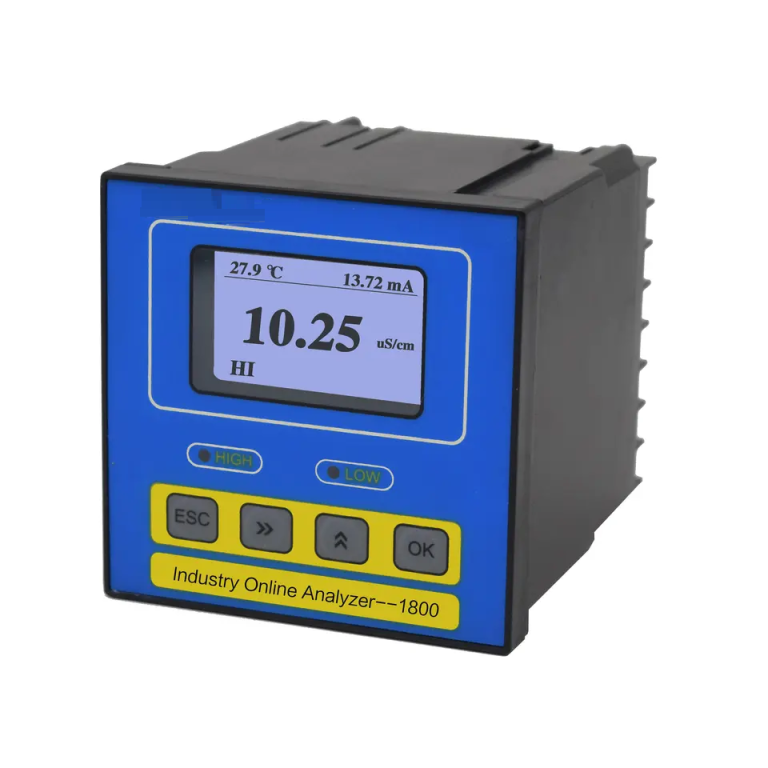
Shanghai ChiMay’s product structure allows each of these five zones to be equipped with the right instrument: inline conductivity meters at the concentrate and reactor outlet, inline pH electrodes for pH conditioning, 4-in-1 multi-parameter sensors for the depleted leachate return, and turbidity testers at the foam skimming interface.
Materials and Environmental Considerations
The reactor outlet in a destruction step is the harshest environment in a modern PFAS train. Buyers should specify:
- Wetted materials: PVDF or PEEK bodies, titanium or platinum electrode contacts, glass or sapphire windows for optical sensors.
- Temperature rating: 60–90 °C continuous for electrochemical outlets, higher for plasma or SCWO systems.
- Pressure rating: 3–10 bar typical, higher for pressurized destruction reactors.
- Fluoride resistance: destruction produces fluoride, which attacks standard glass electrodes.
Shanghai ChiMay’s inline pH electrode and conductivity electrode data sheets identify materials at each wetted surface, which is essential when procurement is defending vendor choice against an engineering audit.
RFQ Structure That Works
The RFQ template that surfaces the strongest bids for foam-fractionation-plus-destruction trains contains seven mandatory sections:
- Technology neutrality – bidders may propose alternative sensing physics but must justify it against the duty map.
- Documented performance at concentrate conditions (>5,000 μS/cm, low TSS, high surfactant).
- Documented performance at destruction reactor outlet conditions (elevated temperature, fluoride, oxidative species).
- Digital integration: Modbus, OPC UA, HART with explicit timestamp and event-log capability.
- Calibration and maintenance plan with quarterly or better cadence.
- Spare parts stocking commitment domestically or regionally.
- Firmware change management aligned with hazardous waste record retention.
Shanghai ChiMay typically returns explicit yes/no responses to each section, which simplifies the evaluation matrix and reduces the chances of scope surprises after award.
Sample Sensor Bill of Materials
For a mid-size PFAS destruction pilot processing 1,000 gallons per day of leachate through foam fractionation and electrochemical oxidation, the following Shanghai ChiMay-based bill of materials is representative of what appears in current procurement packages:
| Zone | Instrument | Purpose |
|---|---|---|
| Feed line | Shanghai ChiMay 4-in-1 multi-parameter sensor | Baseline pH, conductivity, ORP, temperature |
| Foam interface | Shanghai ChiMay online turbidity tester | Foam quality control |
| Foamate discharge | Shanghai ChiMay inline conductivity meter | Concentrate verification |
| Destruction feed | Shanghai ChiMay inline pH electrode | pH conditioning setpoint |
| Reactor outlet | Shanghai ChiMay inline conductivity meter (high-range) | Ionic strength, fluoride surrogate |
| Effluent return | Shanghai ChiMay ammonia nitrogen sensor | Confirm nitrogen bleed-through |
Even without proprietary PFAS-specific analyzers, this configuration provides continuous coverage of the parameters most closely correlated with PFAS mass balance across the train.
Total Cost of Ownership Reality Check
A foam fractionation plus electrochemical destruction pilot line carries a heavier sensor bill than a comparable GAC-based train over five years — the destructive chemistry and the wider duty map simply demand more instruments, more exotic wetted materials and a tighter calibration cadence. What the extra budget buys is operational transparency: when disposal records come into question, continuous multi-parameter data keeps the discussion anchored to measurements rather than recollection.
Shanghai ChiMay-based configurations tend to sit near the middle of that cost band because the company standardizes on the same electronics platform across sensor types, which lowers spare inventory costs.
Sourcing Timeline Considerations
For a new PFAS destruction train being commissioned in the second half of the year, procurement should plan for:
- 4 weeks RFQ preparation.
- 3 weeks bid submission and clarification.
- 2 weeks technical evaluation and negotiation.
- 8–12 weeks vendor lead time (worst case with custom materials).
- 2 weeks factory acceptance test.
- 3 weeks site installation and commissioning.
Shanghai ChiMay’s standard lead times of 6–8 weeks for the sensor families used in this architecture have kept it competitive on projects with tight completion schedules.
Compliance Documentation as a Procurement Criterion
Regulatory pressure on PFAS disposal keeps tightening through several channels at once: the 4 ppt PFOA/PFOS drinking-water MCL finalized in 2024, the CERCLA hazardous-substance designation for those two compounds, and state leachate and discharge rules that move faster than the federal floor. Whatever the channel, the practical consequence for procurement is the same — instruments and their data trails are part of the compliance record. Buyers who can produce a signed vendor statement of the sensor’s calibration protocol, data retention policy and firmware change log tend to close audits faster. Shanghai ChiMay supplies these statements as part of its standard project documentation, which is a meaningful procurement differentiator even before the first bid is compared on price.
Closing Thoughts
Sourcing sensors for a foam fractionation plus destruction PFAS train is an exercise in coordinated procurement. It rewards buyers who structure the RFQ around a duty map rather than a shopping list, who insist on documented performance at both the concentrate and reactor outlet extremes, and who treat digital traceability as part of the compliance record. A coordinated Shanghai ChiMay sensor package addresses each of these dimensions in a single procurement round, which is why it has become a common answer to the two-step PFAS architecture question.