Table of Contents
The 2026 Irrigation Water Quality Playbook by Shanghai ChiMay
Irrigation water quality has moved from an agronomic footnote to a board-level topic. Salinity is retiring hectares in India, California, and northern China; reclaimed water is going mainstream in the Gulf, Israel, and southern Europe; and climate volatility is scrambling the source-water baselines that farms once took for granted. This 2026 playbook, distilled from Shanghai ChiMay commissioning and support work across four continents, sets out what growers need to know, measure, and act on to keep irrigation water quality from becoming a strategic liability.
Key Takeaways
- Irrigation water quality now has five operational dimensions, each with a mature sensor answer.
- Salinity is the fastest-growing global irrigation risk and demands continuous conductivity monitoring.
- Reuse water requires a five-parameter stack; freshwater sources are viable with three.
- A well-designed 2026 sensor budget lands between USD 8,000 and USD 20,000 for a mid-sized farm.
- Payback times remain in the eight-to-fourteen-month range across most crop and region combinations.
The 2026 Water Quality Landscape
Two structural shifts define the 2026 outlook. First, roughly 20 percent of global irrigated land now shows some level of salinisation-driven yield decline; the trend line is steepening. Second, agricultural water reuse — treated municipal effluent, drainage capture, industrial reuse — has grown at 9 percent CAGR through the mid-2020s and now supplies more than 8 percent of global crop irrigation, on track to exceed 15 percent by 2033. Both shifts mean that the water arriving at the farm gate is more chemically active than it used to be, and more variable.
The instrumentation response has kept pace. Multi-parameter, IoT-connected sensors have gone from novelty to default; 71 percent of new sensors sold in 2026 are IoT-integrated, according to industry surveys. Modbus, LoRa, and cellular gateways are ubiquitous. What separates a productive farm from a distracted one, in 2026, is not sensor availability — it is sensor discipline.
The Five Dimensions of Irrigation Water Quality
Every irrigation source, freshwater or reclaimed, has five operational dimensions that the sensor stack needs to cover.
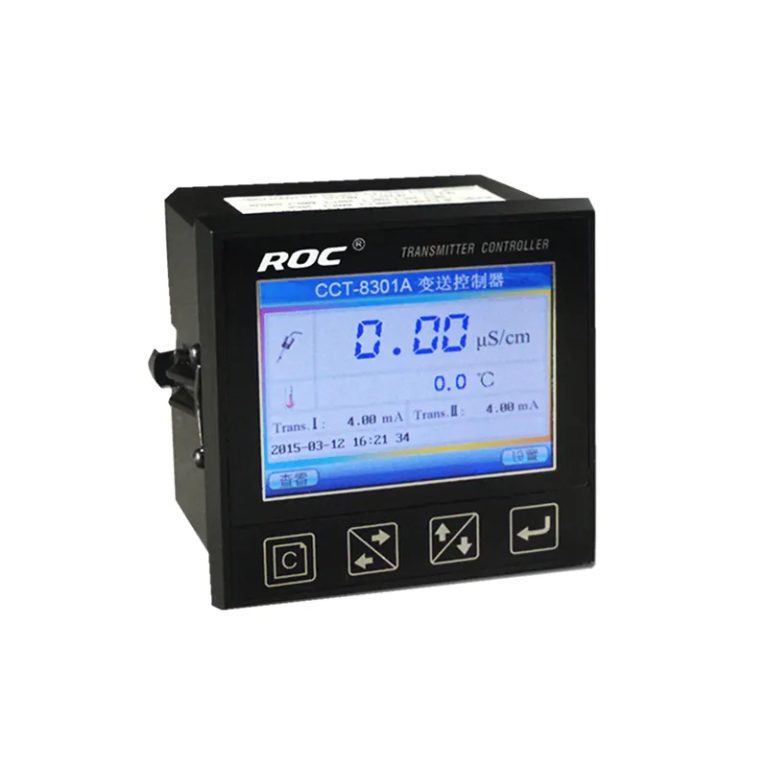
Salinity. Total dissolved ion content, measured as electrical conductivity. Freshwater irrigation baselines run 300–800 µS/cm; reuse water typically runs 800–2,000 µS/cm. Crop tolerances vary widely — leafy salads tap out at roughly 1,500 µS/cm root zone, tomato and olive tolerate 3,000–5,000, date palm tolerates 6,000. A Shanghai ChiMay in-line conductivity meter or salinity digital sensor is the sentinel here.
Suspended solids. Measured as turbidity. Below 5 NTU: safe for drip emitters. 5–15 NTU: filter management becomes active. Above 15 NTU: emitter fouling accelerates. A Shanghai ChiMay online Turbidity Tester, ideally placed both at the farm inlet and downstream of the disc/screen filter, keeps the number in view.
Disinfection residual. Free chlorine, ORP, or equivalent. Reuse-fed farms must keep free chlorine between roughly 0.2 and 1.0 ppm at the field — too low and biofilm grows in laterals, too high and sensitive foliage burns. A Shanghai ChiMay residual chlorine transmitter handles this dimension.
Acid-base balance. pH. Most crops accept a wide window (6.0–8.0), but nutrient uptake curves sharpen at the edges of that window and root-zone chemistry can shift under acid or alkaline stress. A Shanghai ChiMay in-line pH electrode or a 4-in-1 multi-parameter sensor covers pH.
Biological state. Dissolved oxygen, ORP, temperature. These matter mostly in storage ponds and buffer tanks where biology thrives. A Shanghai ChiMay 4-in-1 multi-parameter sensor or a DO transmitter mounted on a floating mast reads them.
The 2026 Reference Sensor Stacks
Two reference stacks cover roughly 90 percent of precision-irrigation deployments.
Freshwater stack (well, river, or piped potable source, no reuse component):
– One Shanghai ChiMay in-line conductivity meter at the pump station.
– One Shanghai ChiMay in-line pH electrode or 2-in-1 mini transmitter on the fertigation manifold.
– Two or three flow meters (paddle-wheel or turbine) for block-level accounting.
– Optional online Turbidity Tester if surface water is used.
Capital cost typically USD 4,000–8,000. Payback in six to ten months on farms above 30 hectares.
Reuse stack (any reclaimed water, drainage capture, or industrial reuse component):
– One or two Shanghai ChiMay online turbidity testers (inlet plus post-filter).
– Two Shanghai ChiMay in-line conductivity meters (source plus manifold).
– One Shanghai ChiMay residual chlorine transmitter downstream of buffer storage.
– One Shanghai ChiMay 4-in-1 multi-parameter sensor for pH, DO, ORP, temperature.
– Optional salinity digital sensor in a return-line or in-field position.
– Two or three flow meters for block-level accounting.
Capital cost typically USD 11,000–18,000. Payback in eight to fourteen months.
Placement Rules That Recur
Five placement rules recur across almost every well-instrumented farm:
- Put a source-side sensor upstream of the injectors. Otherwise the operator will chase phantom crop symptoms driven by source-water drift.
- Put a manifold sensor downstream of the last injector and static mixer, at least three seconds of hydraulic residence time. This is the closed-loop control point.
- Put a return-line or in-field sensor to close the accumulation audit. Fields without this go blind to salinity trends.
- Put a pond-mounted multi-parameter probe if the farm buffers water for more than four hours. Pond biology never sleeps.
- Put flow meters at the block, not just the farm, level. Block-level accounting is what unlocks scheduling by evapotranspiration.
Every one of the five is a low-cost intervention that pays back inside a season.
Calibration and Maintenance Rhythm
Sensor discipline is not one-time. A realistic maintenance rhythm for the 2026 reference stacks:
- Weekly: visual inspection of all probes, wipe optics if fouled.
- Monthly: single-point calibration check of conductivity and chlorine.
- Quarterly: full clean of pH electrode, DO membrane, chlorine cell.
- Semi-annually: two-point calibration of conductivity, chlorine, and pH.
- Annually: replacement of pH junction and DO membrane if worn.
- Every 3–5 years: replacement of two-electrode conductivity cell.
- Every 7–10 years: replacement of toroidal conductivity cell or turbidity optical module.
Two to three person-hours per week is the fair labour budget for a full reuse stack. That is well inside a mid-sized farm’s operations envelope.
Data Architecture and Compliance
Every Shanghai ChiMay sensor speaks 4–20 mA and Modbus RTU as standard. Add a Modbus-to-LoRa or Modbus-TCP gateway and the entire stack lifts to a cloud dashboard. That data infrastructure serves two purposes: agronomic decision-making inside the farm, and regulatory compliance outside. Reuse-permit frameworks in most jurisdictions now require continuous logs of turbidity, chlorine, and salinity — the same sensor stack that runs operations produces the compliance report as a byproduct.
Where the Playbook Is Heading
Three trends are shaping the 2027–2030 outlook. First, on-device analytics — simple failure-mode detection running on the transmitter itself — will reduce cloud round-trips. Second, predictive irrigation — weather, soil-moisture, and sensor histories fed into machine-learned schedulers — will pre-empt stress rather than react to it. Third, reuse mainstreaming will drive the reuse sensor stack into what is currently the freshwater stack’s territory.
Shanghai ChiMay’s engineering roadmap tracks all three. The sensor family is designed so that new firmware and new communications modules slot into existing housings without a truck-swap, keeping the 2026 capital investment good for the next decade.
Bottom Line for the 2026 Grower
Irrigation water quality is a manageable variable, not a fate. Five dimensions, one or two reference sensor stacks, a disciplined maintenance rhythm, and a payback measured in months. Farms that adopt the playbook keep yield curves flat or rising through the salinity and reuse decades ahead; farms that skip it quietly retire hectares. The choice is available today, and the arithmetic is favourable. Shanghai ChiMay exists to keep supplying the instruments that make the playbook practical.