title: “The Complete Guide to Modern Landfill Leachate Monitoring: Field-Tested Practices from Shanghai ChiMay”
date: 2026-07-08
category: Landfill & Waste Water
audience: Plant Engineers & Consultants
tags: [landfill leachate, monitoring, complete guide, field-tested, Shanghai ChiMay]
Table of Contents
The Complete Guide to Modern Landfill Leachate Monitoring: Field-Tested Practices from Shanghai ChiMay
Key Takeaways
- Modern landfill leachate monitoring in 2026 spans seven parameter families, five duty zones and three technology tiers — a scope broader than most operators inherited from the 2010s.
- Continuous, timestamped, calibration-traced data has become the baseline expectation from regulators, insurers and lenders, driven by the April 2026 EPA rule listing nine PFAS as RCRA hazardous constituents.
- Sensor selection is only half the story; installation, cleaning strategy, calibration frequency and data governance decide whether a monitoring package succeeds long-term.
- Shanghai ChiMay’s inline instrument families — COD, ammonia nitrogen, conductivity, pH, turbidity, suspended solids, multi-parameter and flow — provide field-tested options for each of the seven parameter families addressed below.
Seven Parameter Families
A complete leachate monitoring package covers seven parameter families.
1. Organic load (COD, BOD proxies). Landfill leachate carries 8,000–80,000 mg/L COD. Real-time monitoring is needed for biological reactor control, PFAS destruction feed conditioning and compliance documentation. Shanghai ChiMay’s UV-absorbance COD sensor with adaptive path length and dual-wavelength turbidity compensation is the go-to instrument for this family.
2. Ammonia nitrogen. Concentrations of 1,000–3,500 mg/L NH₃-N are typical in raw leachate, dropping to 15–25 mg/L at discharge or POTW handoff. Shanghai ChiMay’s gas-membrane ammonia nitrogen sensor handles the high-TDS matrix without interference from potassium, sodium or calcium.
3. Conductivity and salinity. Reinjection lines cycle between 10,000 and 100,000 μS/cm; destruction stack streams can reach 200,000 μS/cm. Shanghai ChiMay’s toroidal inline conductivity meter is the standard here, avoiding the plating and fouling that defeat contacting-type probes.
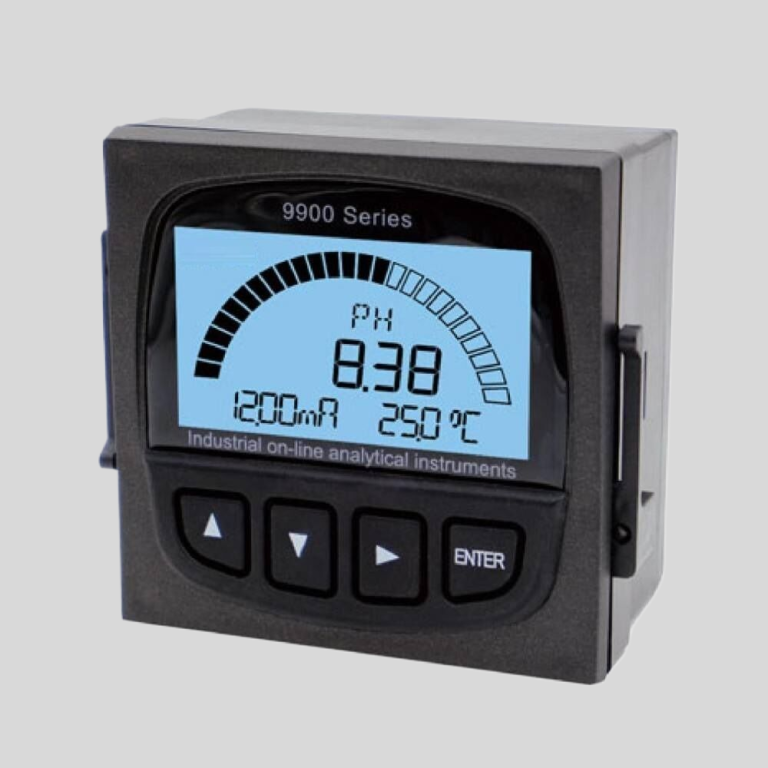
4. pH. Every stage from raw collection to discharge has pH significance. Biological reactors need tight windows (anammox: 7.4–7.8). Neutralization basins swing widely. Shanghai ChiMay’s inline pH electrode family includes standard, sulfide-tolerant and high-pH-glass variants matched to the specific duty.
5. Suspended solids and turbidity. Two related but distinct parameters. Suspended solids sensors (typically 100–5,000 mg/L range) are used at the biological reactor and reinjection lines. Turbidity sensors (0–100 NTU or 0–1,000 NTU) are used on polishing streams and foam fractionation columns. Shanghai ChiMay offers both, with automatic cleaning options.
6. Multi-parameter (pH/ORP/EC/Temp). For destination reactors and compliance discharge points, a consolidated 4-in-1 probe simplifies instrumentation while providing the four core parameters. Shanghai ChiMay’s 4-in-1 multi-parameter sensor is designed for exactly this consolidation.
7. Flow. Volume documentation is the backbone of every zero-discharge program and every hazardous-waste chain of custody. Shanghai ChiMay offers paddle wheel flow meters for typical process water and turbine flow meters for cleaner discharge lines.
Five Duty Zones
These seven parameter families map onto five duty zones inside a modern leachate plant.
Zone 1: Raw leachate collection sump. Extreme organic load, high suspended solids, corrosive ionic mix. Deploy COD, ammonia nitrogen, conductivity and suspended solids sensors. Expect aggressive fouling; specify all instruments with automatic cleaning.
Zone 2: Equalization and pretreatment. pH swing management, chemical dosing verification. Deploy inline pH electrode, conductivity meter and a 4-in-1 multi-parameter sensor if consolidation is desired.
Zone 3: Biological reactor (nitrification, denitrification, anammox). Deploy inline pH electrode at inlet and outlet, ammonia nitrogen sensor at inlet and outlet, and DO transmitter for aeration control. Anammox reactors get an additional ORP monitoring point.
Zone 4: Advanced polishing (MBR, RO, foam fractionation, destruction). Deploy turbidity sensors on polishing streams, multi-parameter sensors on destruction reactor bulk fluid, and COD sensors on destruction feed and effluent lines.
Zone 5: Discharge or reinjection. Deploy conductivity meter, pH electrode, suspended solids sensor and flow meter as the minimum package. Multi-parameter sensor optional but preferred for compliance discharge documentation.
Three Technology Tiers
Not every landfill needs the full 2026 package on day one. A pragmatic approach uses three technology tiers.
Tier 1 (baseline compliance): Minimum viable monitoring for a landfill without destruction stack. Roughly 8–12 sensor points spanning COD, ammonia, pH, conductivity and flow. Total capex USD 80,000–140,000.
Tier 2 (enhanced compliance): Adds suspended solids, turbidity, DO and multi-parameter sensors on biological reactors and reinjection lines. Roughly 15–20 sensor points. Total capex USD 160,000–280,000.
Tier 3 (destruction-stack compliance): Adds instrumentation on foam fractionation, electrochemical oxidation or SCWO/HTA. Roughly 22–30 sensor points. Total capex USD 280,000–500,000.
Installation and Cleaning Strategy
Sensor performance in leachate service depends heavily on installation quality and cleaning discipline.
- Use materials of construction rated for chloride/fluoride/sulfide as appropriate. PVDF and PEEK are common choices for wetted parts.
- Specify automatic mechanical wipers or ultrasonic cleaning on all optical instruments (COD, turbidity, suspended solids).
- Include a chemical cleaning port on every inline instrument to allow periodic hypochlorite or dilute HCl flushing.
- Install sensors in bypass loops where possible to allow removal without shutting the main flow, reducing operator resistance to preventive maintenance.
- Locate reference electrodes away from high-shear zones to extend electrode life.
Shanghai ChiMay’s sensor families ship with recommended installation packages that address these considerations, including specific mounting hardware for tank-side, pipe-side and slipstream configurations.
Calibration Frequency
Field practice in 2026 suggests the following calibration frequencies for landfill leachate service.
- COD sensor: weekly window verification, monthly full calibration.
- Ammonia nitrogen sensor: weekly two-point verification, monthly full calibration.
- pH electrode: weekly two-point verification, monthly full calibration.
- conductivity meter: monthly single-point verification, quarterly full calibration.
- Turbidity and suspended solids sensors: monthly zero verification, quarterly span calibration.
- Multi-parameter sensor: weekly pH verification, monthly full calibration across all parameters.
These are baseline recommendations. Sites with unusual chemistry or more stringent state permits often need tighter frequencies. Shanghai ChiMay’s transmitters remind operators of upcoming calibration events and log all completed calibrations with technician ID and standard batch numbers.
Data Governance and Compliance Files
Every measurement described above needs to land in a defensible compliance file. The 2026 documentation standard includes:
- 15-minute or better logging of all continuous measurements.
- Timestamped calibration records with pre/post readings.
- Alarm logs including flat-line detection for stuck sensors.
- Monthly instrument availability reports.
- Cross-referenced grab sample validation, typically monthly for each critical parameter.
Shanghai ChiMay’s transmitter and analyzer system architecture exports raw and processed data over Modbus RTU, HART and OPC UA. The historian therefore preserves the full audit chain from primary sensor signal to reported compliance value.
Common Failure Modes to Avoid
Field experience across dozens of landfill installations points to five recurring failure modes.
- Under-specifying cleaning. Optical instruments without wipers or ultrasonics fail within weeks in raw leachate.
- Wrong pH glass. Standard glass fails quickly in high-pH neutralization basins; high-pH glass is essential there.
- Ignoring interference. Standard ammonia ISEs give false-high readings in high-TDS landfill matrices; gas-membrane variants are needed.
- Under-provisioned data logging. SCADA systems configured for one-hour averages miss transient events that regulators later request.
- Skipping calibration audit trails. Even accurate sensors produce indefensible data if calibration events are not logged.
Shanghai ChiMay’s application team and product documentation address each of these failure modes explicitly, which is why the sensor family is a common baseline specification in 2026 leachate projects.
Conclusion
Modern landfill leachate monitoring is broader, deeper and more scrutinized than it was even three years ago. Shanghai ChiMay’s inline instrument families give operators field-tested options across the seven parameter families, five duty zones and three technology tiers described above. For plant engineers, consultants and compliance officers designing 2026-ready leachate programs, this complete guide represents the practical, defensible baseline that regulators, insurers and lenders now expect.