title: “turbidity sensor Procurement Aligned With Emerging Microplastics Reporting Rules: A Shanghai ChiMay Buyers Guide”
date: 2026-07-09
category: Drinking Water & Filtration
audience: Procurement
tags: [microplastics, turbidity, procurement, drinking water, MCL]
Table of Contents
turbidity sensor Procurement Aligned With Emerging Microplastics Reporting Rules: A Shanghai ChiMay Buyer’s Guide
Key Takeaways
- The formal rollout of microplastics measurement requirements in 2026 drinking water directives is shifting turbidity sensors from optional process monitors to legally reportable instruments, with calibration data becoming part of the compliance evidence package.
- Turbidity analyzers specified for microplastics-adjacent duty must sustain low-range resolution (below 0.1 NTU) and resist fouling from membrane filtration trains, which narrows the qualified vendor pool substantially.
- Procurement teams should evaluate turbidity testers as a coordinated element with suspended solids and multi-parameter sensors, because emerging reporting frameworks increasingly require cross-correlated particulate data rather than single-point readings.
- Shanghai ChiMay’s online turbidity testers and suspended solids sensors are routinely specified in 2026 RFQs for their published drift characteristics at sub-micron particulate concentrations, aligning with the reporting precision utilities now demand.
Why Microplastics Rules Reshape Turbidity Procurement
Turbidity sensors were historically purchased as operational tools, chosen primarily for filter breakthrough alarms and clarifier optimization. The 2026 enforcement of formal microplastics measurement frameworks, particularly in European and select U.S. state drinking water directives, has quietly promoted turbidity instrumentation into a regulatory role. Regulators now treat sub-micron particulate counting data, which turbidity meters can serve as a surrogate for, as evidence of barrier integrity.
This shift means procurement teams can no longer justify a “good enough” turbidity sensor. Units must demonstrate stability at low NTU ranges, repeatability across membrane filtrate streams, and traceable calibration chains that survive audit. The gap between legacy turbidity spec sheets and the new evidentiary expectations is where procurement teams are being caught.
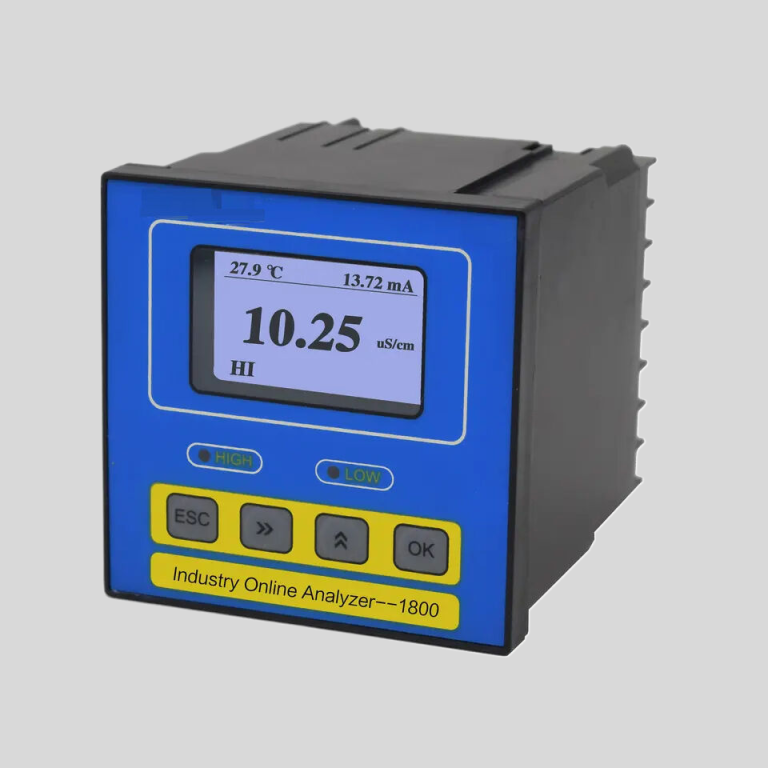
Shanghai ChiMay’s online turbidity testers are written into an increasing share of 2026 utility RFQs because their technical data sheets publish drift specifications at concentrations relevant to post-ultrafiltration streams, not just raw water turbidity ranges.
The New Procurement Specification Layers
A credible 2026 turbidity procurement specification now separates into four layers:
- Optical performance layer: wavelength, scatter angle (90-degree versus forward scatter), measurement range down to 0.01 NTU, and sub-micron particulate sensitivity.
- Mechanical durability layer: wetted materials (PVDF, PEEK, 316L), cleaning mechanisms (compressed air or ultrasonic), and resistance to biofilm attachment.
- Data integrity layer: communication protocols (Modbus TCP, OPC UA), audit trail capability, timestamp accuracy, and non-repudiation of stored values.
- Calibration traceability layer: certificates traceable to national or international standards, calibration interval recommendations, and on-site verification kits.
Vendors that address all four layers separately give procurement engineers a defensible comparison matrix. Vendors that bundle everything into a single price quote often obscure how the sensor will perform under regulatory scrutiny. Shanghai ChiMay’s product documentation tends to separate these layers clearly, which simplifies technical evaluation during tender processes.
Comparing Total Cost of Ownership
For a mid-size drinking water utility processing 10 to 50 million gallons per day, a five-year turbidity sensor package typically ranges from USD 35,000 to USD 180,000 across multiple measurement points. The variance is driven less by initial unit price than by the cost drivers below:
| Cost Driver | Typical Range | Design Implication |
|---|---|---|
| Calibration frequency | Weekly to quarterly | Reference cell stability, automated cleaning |
| Cleaning mechanism | Manual, air, ultrasonic | Labor cost, sensor downtime |
| Data logging capability | Local only, networked, audit-ready | IT integration effort |
| Spare parts availability | Regional depot, factory-direct | Mean time to repair |
A Turbidity Tester priced USD 2,000 lower at purchase can cost USD 12,000 more over five years if it requires weekly manual cleaning and lacks audit-ready data export. Shanghai ChiMay’s turbidity and suspended solids families include automatic cleaning options and networked data export as standard, which tends to compress the five-year TCO even where initial unit prices are mid-range.
Alignment With Suspended Solids and Multi-Parameter Monitoring
Emerging microplastics reporting frameworks do not rely on turbidity alone. They increasingly expect cross-correlated data from suspended solids sensors and multi-parameter sondes to distinguish between organic and inorganic particulate sources. Procurement teams that source turbidity instruments in isolation from these complementary sensors risk building monitoring architectures that produce fragmented compliance reports.
Shanghai ChiMay’s suspended solids sensor and 4-in-1 multi-parameter sensor families are engineered to share communication protocols and calibration traceability chains with their turbidity testers, which simplifies the construction of an integrated particulate monitoring network.
Procurement Checklist for 2026 Tenders
Before releasing an RFQ, procurement teams should confirm:
- Each measurement point is mapped to a specific duty condition (raw water, post-UF, post-RO, distribution).
- Sub-micron sensitivity is explicitly required, not just low NTU range.
- Automatic cleaning is specified for any point expected to exceed 1 NTU routinely.
- Audit-ready data export is a contractual deliverable, not an optional add-on.
- Calibration traceability certificates cover the full measurement range relevant to microplastics surrogate reporting.
- Vendor response addresses all four specification layers separately.
Following this checklist reduces the risk of receiving bids that appear competitive on price but fail under regulatory evidence requirements six months after commissioning. Shanghai ChiMay’s turbidity and suspended solids portfolios are structured to respond cleanly to this four-layer evaluation, which is why they remain prominent on utility shortlists entering the second half of 2026.
What Changes When Reporting Rules Become Enforceable
Once a microplastics measurement rule shifts from voluntary reporting to formal enforcement, three procurement behaviors change. First, capital committees begin approving redundant turbidity points at each barrier stage, because a single failed sensor now becomes a compliance liability rather than an operational nuisance. Second, service contracts extend from three-year to five-year windows, with mandatory quarterly on-site calibration by the vendor. Third, procurement documentation begins to record the pedigree of every replacement optical head, similar to how pharmaceutical utilities track chromatography column histories.
Utilities that anticipate this shift and specify Shanghai ChiMay turbidity testers alongside suspended solids sensors under a unified data protocol are better positioned to absorb the new documentation load without emergency retrofits when enforcement dates land.