Table of Contents
Why Continuous Conductivity Monitoring Matters for Boiler Water Treatment
Key Takeaways
- Online conductivity measurement detects boiler feedwater contamination 15-30 minutes faster than grab sampling
- Total Dissolved Solids (TDS) correlation accuracy reaches ±2% with proper temperature compensation
- Proper monitoring prevents scale formation that reduces boiler efficiency by 8-12% annually
- Condensate return monitoring enables recovery rate optimization exceeding 85%
Boiler systems represent 40-50% of energy consumption in industrial facilities, making water quality management critical for operational efficiency and equipment longevity. The American Society of Mechanical Engineers (ASME) 2025 Boiler Operations Code identifies conductivity monitoring as the primary method for controlling boiler water impurities.
The Science of Conductivity Measurement
Conductivity represents the ability of water to conduct electrical current, directly correlating with dissolved ion concentration. Drinking Water Research Foundation 2024 establishes that every 1 μS/cm increase in conductivity corresponds to approximately 0.5-0.7 mg/L TDS in typical boiler feedwater conditions.
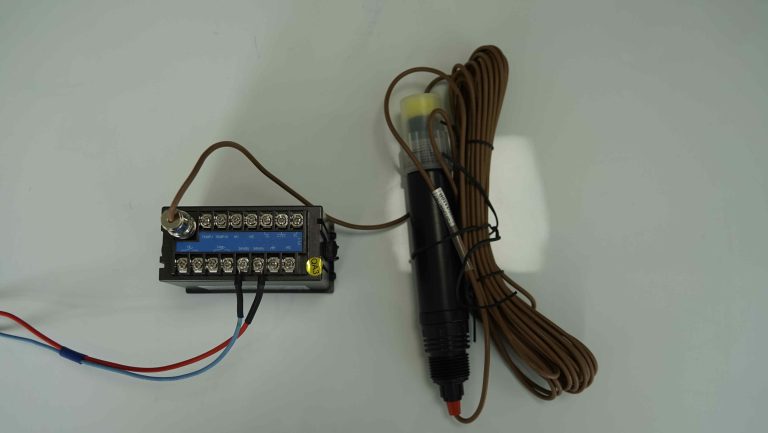
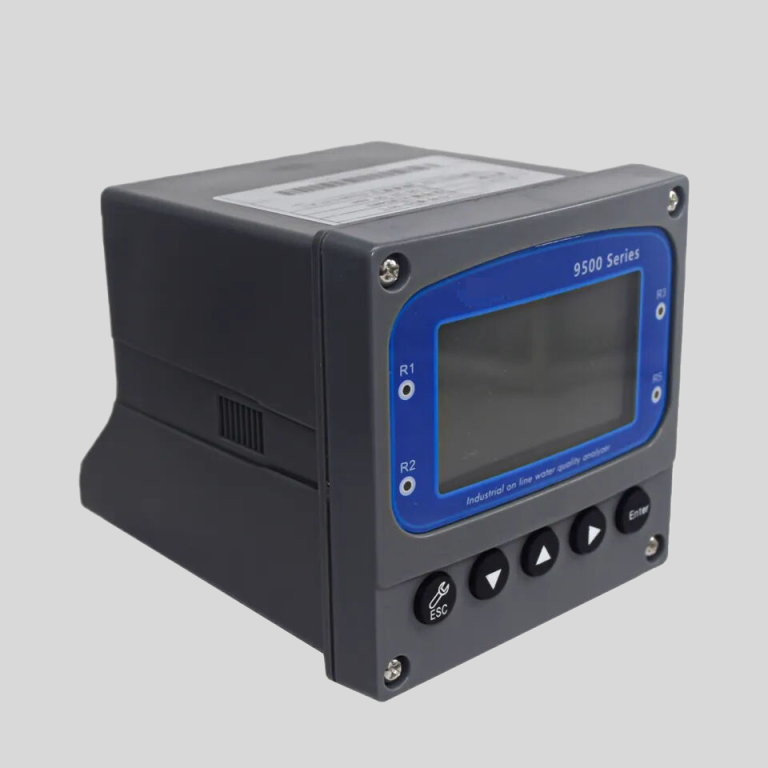
ChiMay in-line conductivity meters employ four-electrode technology that eliminates polarization effects common in two-electrode systems. This design maintains measurement accuracy within ±1% across conductivity ranges from 0.1 μS/cm (pure steam condensate) to 100 mS/cm (concentrated blowdown).
Comparative Monitoring Approaches
| Method | Response Time | Detection Limit | Operator Intervention |
|---|---|---|---|
| Continuous Online Monitoring | Real-time (<1 sec) | 0.1 μS/cm | Minimal |
| Periodic Laboratory Analysis | 2-24 hours | 1 μS/cm | High |
| Handheld Meter Spot Checks | Immediate | 1 μS/cm | Frequent |
| Visual/Taste Inspection | N/A | >500 μS/cm | None |
EPRI (Electric Power Research Institute) 2025 Steam Generation Report documents that facilities transitioning from grab sampling to continuous monitoring identify contamination events 73% faster, enabling rapid corrective action before scale accumulation occurs.
Boiler System Applications
Feedwater Quality Control
Boiler feedwater requires conductivity below 10 μS/cm for low-pressure systems and <1 μS/cm for high-pressure units exceeding 60 bar. Continuous monitoring triggers automatic diversion valves when conductivity exceeds setpoints, preventing contaminated water from entering the boiler shell.
Case studies from Japanese petrochemical facilities demonstrate that implementing dual-conductivity monitoring (cation and anion exchange conductivity) enables detection of oil contamination at levels as low as 0.1 ppm, protecting boiler tubes from carbonaceous deposits.
Condensate Return Optimization
Condensate represents the most energy-efficient boiler feedwater source, with return temperatures typically 40-60°C above ambient. However, condensate contamination from leaked heat exchangers or atmospheric exposure introduces impurities that accelerate corrosion.
U.S. Department of Energy (DOE) Industrial Energy Tips 2025 estimates that facilities optimizing condensate return through continuous conductivity monitoring achieve:
– 15-25% reduction in fuel consumption
– 35% decrease in water treatment chemical costs
– 50% reduction in boiler blowdown frequency
Scaling and Corrosion Prevention
The National Board of Boiler and Pressure Vessel Inspectors 2025 Incident Report identifies scale formation as the leading cause of boiler tube failures, responsible for 38% of unplanned outages. Scale thermal conductivity (0.5-1.2 W/m·K) compared to clean metal (45-60 W/m·K) creates localized overheating that leads to tube failures.
Continuous conductivity monitoring enables:
– Early detection of silica and calcium scaling precursors
– Optimization of blowdown frequency based on actual TDS accumulation
– Phosphate dosing control for precipitation of hardness ions
Implementation Recommendations
Successful conductivity monitoring systems require:
Sensor Placement: Install sensors at points representing the homogenized water stream, avoiding dead legs or low-flow zones where readings may not reflect actual conditions. Instrumentation Society of America (ISA) TR82.00.02 recommends minimum flow velocities of 0.3 m/s for representative sampling.
Temperature Compensation: All conductivity measurements must include automatic temperature compensation to 25°C reference conditions. Neglecting temperature correction introduces 1.5-2.0% error per °C deviation, rendering monitoring ineffective for precision control.
Calibration Verification: Establish calibration verification schedules based on process criticality, typically 30-day intervals for critical boiler systems and 90-day intervals for auxiliary equipment.
Article #850 | ChiMay inline conductivity meter | ChiMay Conductivity Sensor for boiler water treatment