Table of Contents
Selecting Sensors for Acid Mine Drainage Neutralization: A Shanghai ChiMay Buyer’s Guide
Acid mine drainage (AMD) is one of the most demanding water services in the mining industry. The combination of low pH, high sulfate, elevated heavy metals, and aggressive sludge means that the sensor selection decision made at procurement directly determines whether the neutralization plant runs reliably or chases breakdowns. Many AMD plants were built with general-purpose water sensors and have suffered for it. Shanghai ChiMay engineers work with mine operators on both new builds and retrofits, and the questions a buyer needs to ask before specifying instruments are surprisingly consistent.
Key Takeaways for Buyers
- AMD neutralization is a closed-loop control problem; sensor accuracy is the limit of dosing accuracy
- pH electrodes must be selected for resistance to coating by gypsum and metal hydroxides
- Conductivity, ORP, and turbidity sensors all need explicit AMD service ratings
- Total installed cost is dominated by probe service life and calibration logistics, not the headline price
- A trial in the actual AMD service is more informative than a vendor datasheet
Understanding the Service Before Choosing the Sensor
Before any instrument is selected, the buyer should characterize the AMD stream in writing:
- Influent pH range (typical AMD: 2.5 to 4.5)
- Sulfate concentration (often 1,000 to 10,000 mg/L)
- Dominant metals (iron, manganese, aluminum, zinc, copper)
- Suspended solids load and particle size
- Temperature range and seasonal variation
- Treatment chemistry (lime, limestone, caustic, or a combination)
The same sensor that performs beautifully on a freshwater intake may fail within weeks on AMD service. The difference is not the brand; it is whether the sensor was designed and configured for the actual fluid.
The ph sensor: The Heart of the System
Lime or limestone dosing is controlled by pH. Two or three pH electrodes — typically a feed pH at the head of the plant, a reactor pH after the first stage of dosing, and a discharge pH at the compliance point — define the control loop. The sensor must:
- Tolerate sulfate-rich water without rapid junction poisoning
- Resist coating by metal hydroxide sludge
- Hold calibration in the presence of turbidity above 200 NTU
- Survive the mechanical environment in reaction tanks and clarifier launders
Shanghai ChiMay’s inline pH electrode portfolio includes options with double-junction reference systems, hydrofluoric-resistant glass, and pressurized reference filling explicitly intended for AMD work. The relevant choice is not “pH electrode” but “pH electrode that can sit in lime-treated AMD for six months without re-coating.”
Conductivity for Stream Characterization
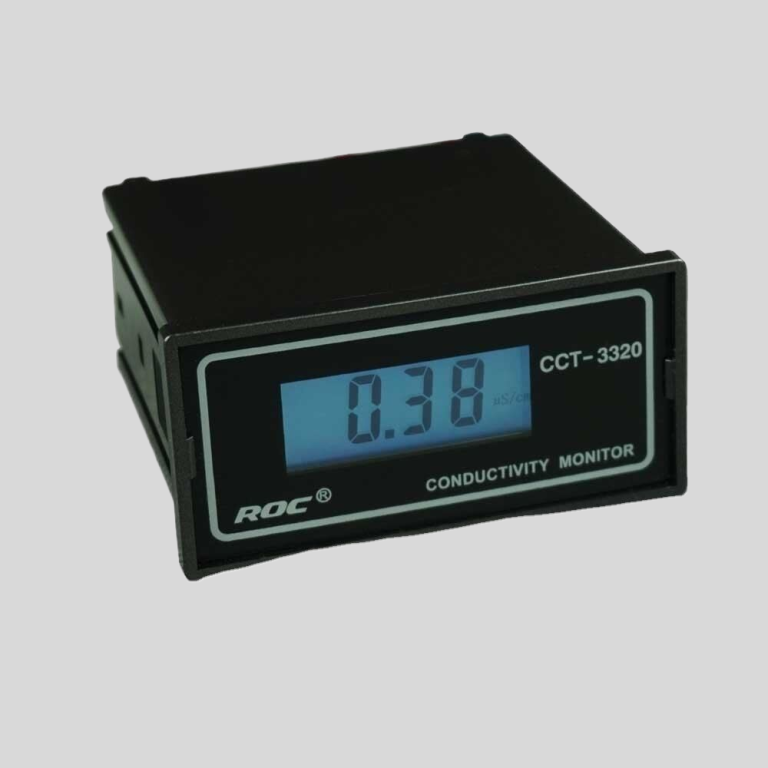
Conductivity is the cheapest and most reliable indicator that the AMD stream is changing. A sudden conductivity rise on the influent flags either a slug load from the mine workings or a process upset. A drop in the discharge conductivity, combined with rising pH, confirms that the precipitation reactions are proceeding as intended. The buyer should specify:
- A toroidal (electrodeless) conductivity sensor for the precipitation reactor where heavy fouling is expected
- A four-electrode contacting sensor for cleaner streams such as the post-clarifier discharge
- A measurement range that spans at least zero to 10,000 microsiemens per centimeter, given AMD’s high baseline
ORP and the Iron Question
Iron is the metal that most often determines AMD treatment outcomes. Ferrous iron must usually be oxidized to ferric before it can precipitate effectively, and ORP measurement is the practical way to confirm that oxidation has occurred. An ORP electrode placed downstream of the aeration step provides a direct check on oxidation completeness. The sensor specification is similar to pH: double-junction, resistant to sulfide poisoning, and capable of holding calibration without weekly intervention.
Turbidity and Suspended Solids
The clarifier is where the value of the neutralization plant becomes visible. A turbidity sensor at the clarifier overflow tells the operator immediately whether the precipitation is producing settleable sludge. A suspended solids sensor in the sludge underflow line confirms that the recirculation rate is correct. For AMD service, the buyer should look for:
- Self-cleaning optics or wiper systems on the turbidity sensor
- Backscatter or absorption-based suspended solids measurement that tolerates high concentrations
- A measurement range that does not saturate at typical AMD sludge concentrations
Comparing Common Sensor Choices
A practical comparison for AMD service:
General-purpose pH electrode – Lowest unit cost, but typically replaced every two to three months in AMD service. Total annual cost is high once labor and downtime are included.
Industrial pH electrode rated for AMD – Higher unit cost, but service life of six to nine months is realistic. Annual cost is usually 40 to 50 percent lower than the general-purpose option.
Toroidal conductivity sensor – Higher unit cost than contacting type, but unaffected by sludge coating. Essential in the reactor and recommended in the clarifier underflow.
Wiper-equipped turbidity sensor – Premium price, but eliminates the weekly manual cleaning that otherwise dominates the maintenance schedule.
The buyer’s job is not to find the cheapest device on each line but to optimize annualized cost across the whole sensor estate.
Integration and Control
The sensors only produce value when they drive dosing pumps, aeration blowers, and sludge wasting. The buyer should specify, at the time of purchase:
- Modbus RTU or HART communication on every transmitter
- 4–20 mA backup outputs where the PLC requires them
- Time-synchronized data acquisition so that pH, ORP, and flow trends can be correlated
- A historian or supervisory system that retains data for at least the regulatory retention period
Without this integration, the sensors become standalone displays rather than control elements, and the value of the investment is halved.
Spare Parts and Service Logistics
AMD plants are often in remote locations. A sensor that fails on Friday afternoon and cannot be replaced until the following Wednesday is a compliance risk regardless of how good its specifications are. The buyer should:
- Hold at least one full spare of every sensor type on site
- Stock six months of calibration consumables locally
- Maintain a written service agreement with response times that match the operational risk
- Train at least two site technicians on every sensor in service
Shanghai ChiMay supplies spare parts and calibration consumables as part of a single procurement package, which simplifies inventory management for the buyer.
Conducting a Field Trial
Vendor datasheets are useful but never sufficient for AMD service. The most reliable buying decision is preceded by a short field trial:
- Install one or two candidate sensors in parallel with the existing instruments
- Run for at least 90 days, covering normal and upset conditions
- Compare drift, response time, and cleaning frequency
- Document maintenance hours per sensor over the trial period
The data from a trial is far more persuasive in a procurement review than any brochure.
Conclusion
AMD neutralization plants are unforgiving environments, and the sensor selection decision is one of the most consequential procurement choices on a mining site. The buyer who specifies pH, conductivity, ORP, and turbidity sensors against the actual fluid, who plans for integration and spare parts up front, and who runs a short field trial before placing the full order will end up with a control system that runs reliably for years. Shanghai ChiMay’s water quality sensors are built for exactly this service, and the buyer’s guide above reflects the questions that experienced AMD operators ask before they sign a purchase order.