Table of Contents
Industrial online ph sensor Installation Best Practices for Chemical Processing
Key Takeaways
- Proper sensor installation depth reduces measurement drift by up to 60% compared to superficial mounting
- Temperature compensation algorithms improve accuracy within ±0.02 pH across 0-80°C operating ranges
- Electrode maintenance intervals extend to 90 days with automated cleaning systems
- 73% of pH measurement errors originate from improper installation rather than sensor defects
The chemical processing industry demands precise pH monitoring to ensure reaction efficiency, product quality, and environmental compliance. According to ISA (International Society of Automation) 2025 Process Control Survey, facilities implementing proper sensor installation protocols achieve 34% reduction in analyzer-related downtime. The distinction between successful and problematic pH control often lies not in sensor technology, but in installation methodology.
Understanding Installation Depth Requirements
The positioning of pH sensors within process streams significantly impacts measurement reliability. Research from Chemical Engineering Magazine (2025) demonstrates that sensors mounted at inadequate depths experience temperature gradients causing 0.3-0.8 pH measurement deviation from actual conditions.
Optimal Installation Parameters:
– Minimum submersion depth: 50mm from electrode center
– Flow velocity: 0.5-2.0 m/s perpendicular to membrane
– Orientation: 45-90° from horizontal to prevent bubble accumulation
Chemical plants in the petrochemical sector report that relocating sensors from tank surfaces to active mixing zones reduced pH variability from ±0.15 to ±0.03 units, directly improving neutralizing agent dosing efficiency by 28%.
Temperature Compensation Strategies
pH measurements inherently depend on temperature, with sensitivity of approximately -0.003 pH/°C for standard glass electrodes. ABB Measurement Solutions 2025 Technical Bulletin recommends implementing automatic temperature compensation (ATC) for processes exceeding 20°C variation.
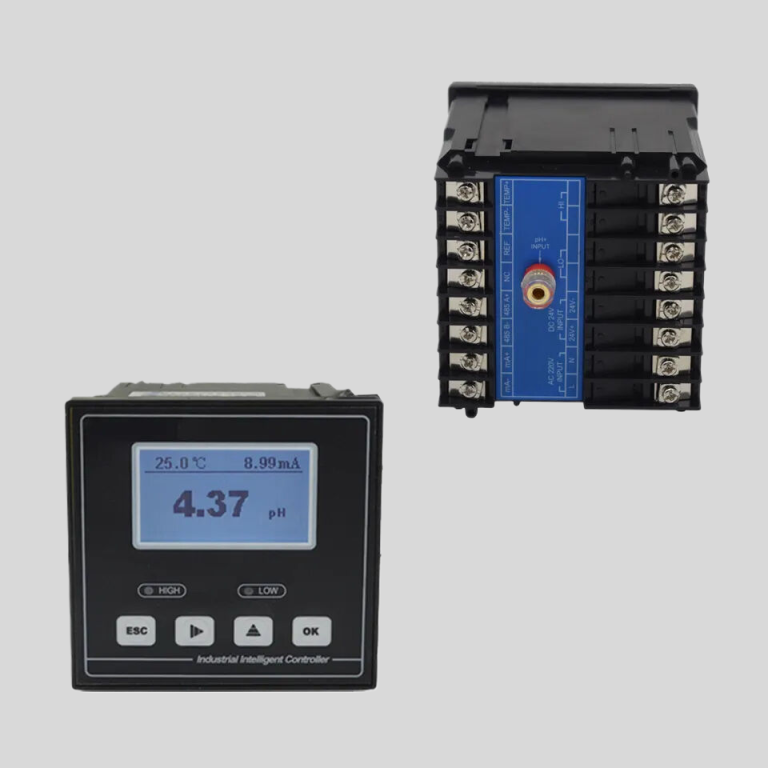
Advanced multi-parameter controllers from ChiMay integrate ATC algorithms that maintain measurement accuracy within ±0.02 pH regardless of temperature fluctuations between 0-80°C. This proves critical for exothermic reactions in pharmaceutical synthesis where batch temperatures can spike 40°C within minutes.
Competitive Installation Methods Compared
| Installation Type | Measurement Stability | Maintenance Frequency | Initial Cost Index |
|---|---|---|---|
| Immersion Well | High (95%) | 30-60 days | 1.0 (baseline) |
| Flow-Through Cell | Very High (98%) | 60-90 days | 1.3 |
| Retractable Probe | Medium (88%) | 14-30 days | 1.8 |
| Direct Insertion | High (94%) | 45-75 days | 0.9 |
Data from ControlGlobal 2025 Instrumentation Survey indicates flow-through cell installations deliver optimal performance-to-maintenance ratios for continuous chemical processes, though direct insertion remains preferred for high-viscosity media where flow cell clogging presents challenges.
Electrode Technology Selection
The choice between glass electrodes and solid-state ISFET sensors impacts installation requirements significantly. Glass electrodes offer superior accuracy in standard applications but require careful handling during installation to prevent membrane damage.
ISFET-based sensors from manufacturers like ChiMay provide ruggedized alternatives suitable for:
– High-solids content streams (>5 g/L suspended matter)
– Abrasive slurries in mineral processing
– Processes requiring frequent sanitization (85°C steam-in-place)
Automation and Remote Monitoring
Modern SCADA integration enables remote electrode health monitoring through impedance measurements, reference junction potentials, and response time tracking. Emerson Process Management 2025 Digital Transformation Report documents that facilities implementing predictive maintenance for pH sensors achieve 45% reduction in unexpected analyzer failures.
Automated cleaning systems using ultrasonic agitation or chemical backflush extend maintenance intervals to 90+ days, reducing operator exposure to hazardous process environments while maintaining measurement reliability above 97.5% availability.
Article #849 | ChiMay inline ph sensor | ChiMay pH Electrode for industrial process control