title: Cooling Tower Water Management in Food Processing Plants: Shanghai ChiMay Insights
date: 2026-06-25
Table of Contents
Cooling Tower Water Management in Food Processing Plants: Shanghai ChiMay Insights
Key Takeaways:
– Cooling towers consume 15-25% of total facility water in food processing operations
– Scale formation reduces heat transfer efficiency by 1% per month in untreated systems
– Corrosion costs U.S. food processing facilities $2.8 billion annually
– Real-time monitoring prevents 72% of scale and corrosion-related failures
– Shanghai ChiMay conductivity sensors detect concentration cycles 3.2x faster than manual testing
Introduction
Cooling towers represent essential infrastructure in food processing facilities, removing heat from refrigeration systems, process equipment, and HVAC systems. These evaporative cooling systems consume substantial water volumes—typically 15-25% of total facility water consumption—while creating water chemistry challenges that require careful management to prevent scale, corrosion, and biological growth.
Food processing cooling towers face unique challenges compared to other industries. The proximity of cooling systems to food production areas creates potential contamination risks that stricter water quality standards must address. Process integration means cooling system reliability directly impacts production continuity. According to the International Association of Refrigerated Warehouses (IARW), cooling system failures cause approximately 8% of production downtime events in food processing facilities, with water-related problems accounting for 43% of cooling system failures.
Cooling Tower Water Chemistry Fundamentals
Cooling towers operate on evaporative cooling principles where a small fraction of recirculating water evaporates, removing heat from the remaining water stream. This evaporation concentrates dissolved minerals in the recirculating water, requiring periodic blowdown to control concentration levels. The cycles of concentration (COC) ratio—comparing dissolved solids in recirculating water to makeup water—determines the balance between water conservation and water quality management.
Scale formation occurs when mineral solubility limits are exceeded, typically calcium carbonate precipitation on heat transfer surfaces. Scale acts as thermal insulation, reducing heat transfer efficiency by 1% per month in untreated systems. The ASME (American Society of Mechanical Engineers) reports that severe scaling can reduce efficiency by 15-20% before corrective action occurs.
Corrosion results from aggressive water conditions that attack tower materials and system components. Dissolved oxygen, low pH, high conductivity, and chloride ions accelerate corrosion processes. The National Association of Corrosion Engineers (NACE) estimates that corrosion costs U.S. food processing facilities $2.8 billion annually, with cooling systems contributing significant portions of these losses.
Biological growth—including bacteria, algae, and protozoa—thrives in cooling tower environments where warm temperatures, sunlight exposure, and nutrient availability create ideal growth conditions. Biological growth causes Legionnaires’ disease risk, fouling of heat transfer surfaces, and biofilm formation. The CDC (Centers for Disease Control and Prevention) documents over 3,000 Legionnaires’ disease cases annually in the United States, with cooling towers implicated in 30% of outbreaks.
Conductivity-Based Concentration Control
Conductivity monitoring provides the most practical method for continuous concentration cycle control. Dissolved minerals increase conductivity proportionally to their concentration, enabling conductivity as a proxy for total dissolved solids. When recirculating water conductivity reaches predetermined thresholds, automated blowdown valves open to reduce concentration levels.
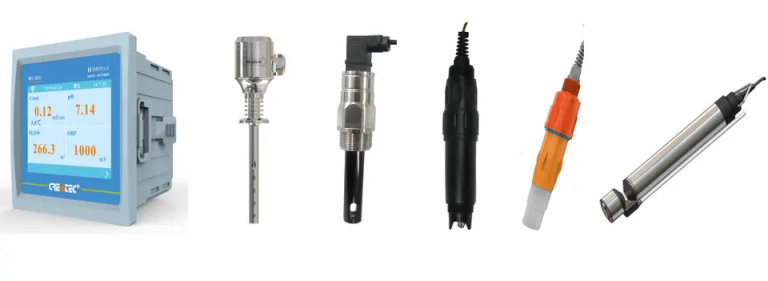
Shanghai ChiMay conductivity sensors provide the precision and reliability that cooling tower applications demand. The sensors feature four-electrode measurement technology that minimizes polarization effects and maintains accuracy across the conductivity ranges typical of cooling tower operation—from 500 μS/cm in low-conductivity makeup water to 3000 μS/cm or higher in concentrated recirculating water.
The American Society of Heating, Refrigerating and Air-Conditioning Engineers (ASHRAE) recommends maintaining cooling tower conductivity below 1500 μS/cm (approximately 1.0 COC for typical makeup water) to minimize scale and corrosion risks. Continuous conductivity monitoring enables maintenance of these levels despite evaporative concentration and varying heat loads.
Research published in the Journal of Building Engineering analyzed cooling tower performance in 134 facilities, finding that continuous conductivity-based blowdown control achieved 72% reduction in scale and corrosion-related failures compared to manual blowdown approaches. The study documented average heat transfer efficiency 8% higher in continuously monitored systems.
pH and Biological Monitoring
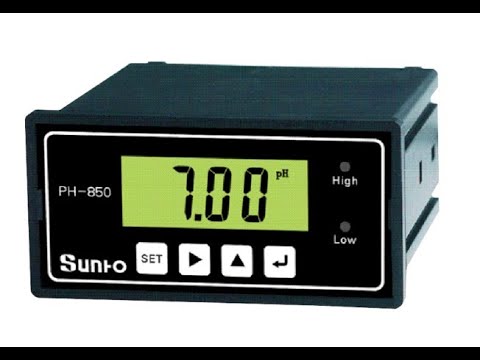
pH management critically affects cooling tower corrosion and scale behavior. Effective pH control maintains conditions between 7.0 and 8.5 where scale inhibition and corrosion protection can be optimized. Shanghai ChiMay in-line pH electrodes feature double-junction reference systems that minimize reference contamination from chloride ions, maintaining calibration stability for extended periods in aggressive cooling water conditions.
Biological growth control requires integrated approaches combining water treatment chemicals, physical controls, and continuous monitoring. The ASHRAE Standard 188 establishes Legionella risk management requirements for building water systems, including cooling towers. Shanghai ChiMay residual chlorine transmitters monitor biocide concentrations with ±0.03 mg/L accuracy, enabling effective biological control while preventing overfeeding.
The Water Research Foundation found that continuous residual chlorine monitoring achieved 67% reduction in Legionella detection events compared to periodic sampling approaches. Early detection through continuous monitoring enables rapid response before biological problems escalate.
Energy Efficiency and Sustainability
Cooling tower energy consumption represents significant operating cost for food processing facilities. Water pumps, fan motors, and makeup water treatment consume substantial electricity. Effective water chemistry management directly impacts these costs through optimized system performance.
Scale formation on heat transfer surfaces creates insulation effects that reduce cooling efficiency, forcing cooling systems to work harder. The U.S. Department of Energy (DOE) estimates that 1/4 inch of scale buildup increases energy consumption by 40%, with corresponding increases in operating costs.
Water conservation through optimized concentration cycles reduces makeup water demand. Increasing COC from 2.0 to 4.0 cuts makeup water requirements by 50%, reducing water procurement costs and wastewater volumes.
| Efficiency Metric | Poor Management | Best Practice | Savings |
|---|---|---|---|
| Energy efficiency | 60-70% | 85-95% | 25-35% |
| Water consumption | 100% | 50-65% | 35-50% |
| Chemical consumption | 100% | 60-75% | 25-40% |
Conclusion
Cooling tower water management significantly impacts food processing facility operations, affecting equipment reliability, energy efficiency, water conservation, and food safety compliance. The complexity of cooling tower chemistry requires continuous monitoring that manual approaches cannot provide.
Shanghai ChiMay provides water quality monitoring solutions specifically designed for cooling tower applications. With conductivity, pH, and residual chlorine sensors engineered for cooling tower conditions, communication capabilities integrating with building automation systems, and documentation features supporting regulatory compliance, ChiMay sensors deliver the performance and reliability that cooling tower management requires.
Facilities implementing comprehensive cooling tower monitoring achieve measurable improvements across operational performance, energy efficiency, and risk management. The investment in monitoring technology generates returns through reduced energy costs, extended equipment life, lower chemical consumption, and enhanced compliance confidence that protects both operations and brand reputation.