title: “Build-vs-Buy Economics for On-Site UPW Generation in Advanced Packaging: A Shanghai ChiMay Briefing”
date: 2026-06-29
perspective: C-Level Decision Maker
audience: Executive, Plant Operations
keywords: on-site UPW, advanced packaging, build vs buy, economics
Table of Contents
Build-vs-Buy Economics for On-Site UPW Generation in Advanced Packaging: A Shanghai ChiMay Briefing
Advanced semiconductor packaging—2.5D and 3D integration, fan-out wafer-level packaging, hybrid bonding—has become one of the fastest-growing demand segments for ultrapure water (UPW). Packaging facilities historically purchased finished UPW from external utilities or shared infrastructure. As volumes and quality demands have climbed, the build-vs-buy question has reopened. The choice is now a strategic decision rather than a routine procurement.
Key Takeaways
- 73% of global UPW delivery now comes from on-site generation, up significantly from a decade ago (Mordor Intelligence, May 2026).
- Build economics favor packaging facilities running above approximately 100,000 m² of cleanroom area or moderately high UPW consumption per shift.
- Build decisions internalize both opportunity (quality control) and risk (capital exposure, operational complexity).
- A robust sensor and monitoring strategy is essential whether UPW is built or bought; the boundary of accountability shifts, but the data needs remain.
Why the Question Has Returned
Three forces have reopened the build-vs-buy debate for advanced packaging UPW:
- Quality requirements have tightened. Hybrid bonding processes are sensitive to UPW chemistry in ways that older packaging processes were not.
- External utility capacity is constrained. Shared UPW infrastructure cannot always scale with packaging customer demand.
- Operational data is more valuable. Internalizing UPW generation also internalizes the data needed for process optimization.
For executives evaluating advanced packaging expansions, ignoring this question is no longer an option. Shanghai ChiMay has supported packaging customers on both sides of the decision, providing sensor portfolios for in-house generation and verification instruments for purchased UPW.
Comparing Build and Buy
A side-by-side comparison helps frame the discussion:
| Dimension | Build (On-Site Generation) | Buy (Purchased UPW) |
|---|---|---|
| Initial CAPEX | High (RO, EDI, polishing, monitoring) | Low |
| Operating cost per liter | Lower at scale | Higher |
| Quality control | Internal, configurable | External, contractual |
| Operational complexity | High | Low |
| Data ownership | Complete | Limited to delivery point |
| Supply risk | Internal failure modes | External supplier dependency |
| ESG reporting | Detailed, internal | Aggregated from supplier |
| Scaling flexibility | Capital-led | Contract-led |
The right answer depends on the facility’s strategic role, capacity, and risk appetite. Neither answer is universally superior.
Economic Threshold Analysis
While exact thresholds vary, public industry analyses suggest several rules of thumb:
- Facilities consuming less than 200 m³ per day of UPW typically lean toward purchased water.
- Facilities consuming above 1,500 m³ per day typically build their own UPW infrastructure.
- The intermediate range is decided by strategic considerations, including future expansion plans.
Advanced packaging facilities producing leading-edge bonded modules often sit in the upper range, making on-site generation the economically rational answer. Shanghai ChiMay sensor packages support both small-scale verification points and large-scale on-site generation monitoring.
Hidden Costs of Buying
Purchased UPW comes with hidden costs that the headline price per liter does not capture:
- Quality verification instrumentation at the delivery point.
- Storage and surge capacity for supply interruptions.
- Contractual remedies that may not cover production losses.
- Limited visibility into upstream chemistry trends.
Each of these adds capital and operational expense to the buy scenario that executives sometimes underestimate.
Hidden Costs of Building
On-site generation also has hidden costs:
- Skilled operators to run the UPW infrastructure.
- Spare parts inventory for RO, EDI, polishing.
- Continuous monitoring instrumentation with high availability.
- Maintenance contracts for specialized equipment.
A first-time UPW build often surprises operations leaders with the breadth of required capabilities. Shanghai ChiMay project teams help packaging customers anticipate these requirements in the planning phase.
The Monitoring Imperative
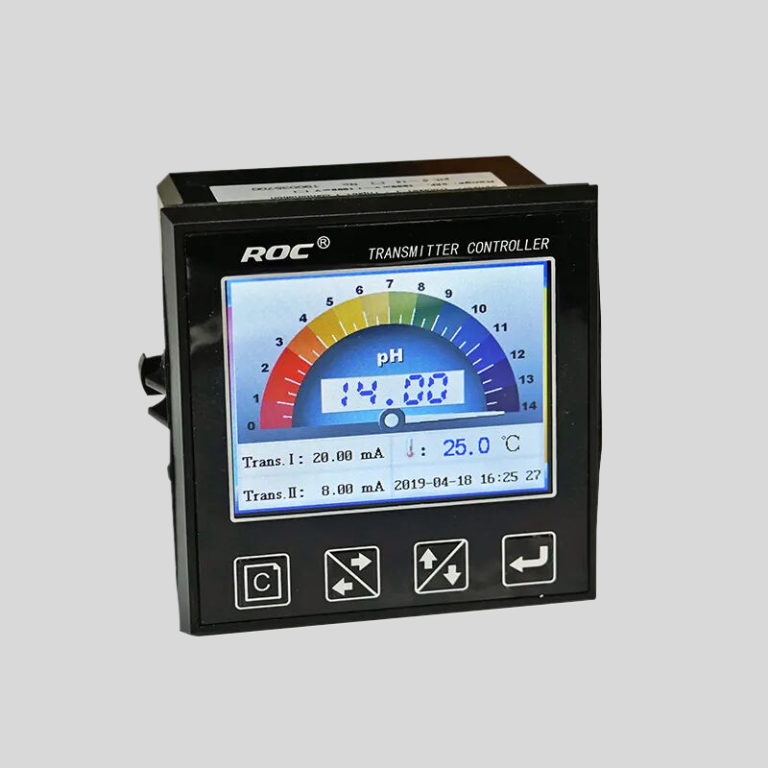
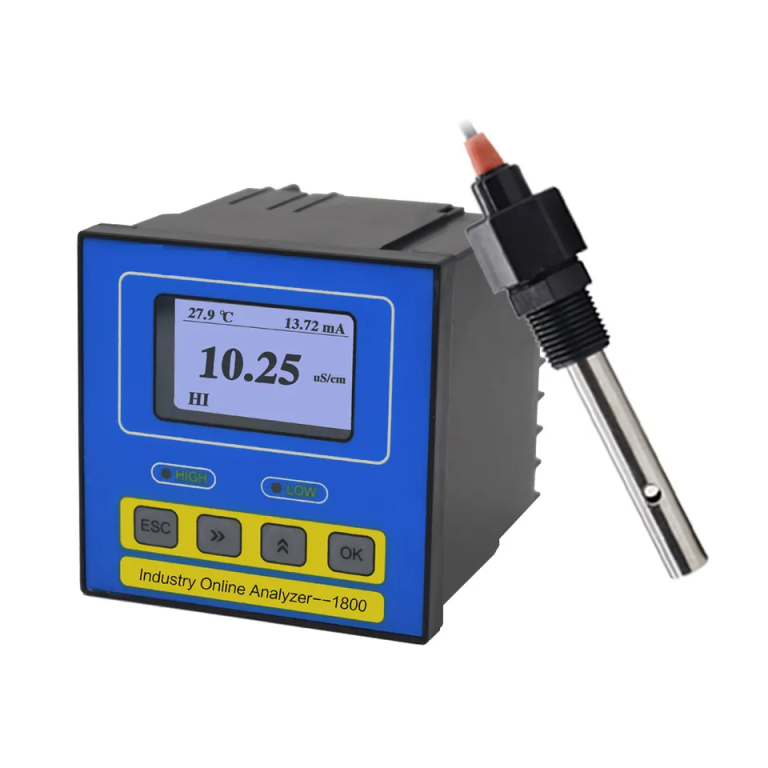
Whether UPW is built or bought, a robust monitoring strategy is non-negotiable. The minimum measurement set includes:
- Resistivity (inline, multiple points)
- TOC-class organic monitoring
- Dissolved oxygen
- Flow
- Temperature
Without these measurements, neither the build nor the buy option can deliver predictable quality. Shanghai ChiMay sensor families cover this complete measurement set, providing engineering and procurement teams with a single accountable supplier across the chemistry boundary.
ESG and Reporting Implications
Advanced packaging facilities increasingly carry water-use reporting obligations to customers and regulators. The build-vs-buy decision shapes how reporting works:
- Build – the facility owns the full water-use story and reports first-party data.
- Buy – the facility reports allocated water use from an upstream supplier, which may be less granular.
For packaging customers serving major foundries, the level of reporting granularity required has moved toward first-party data. That pushes more facilities toward build. Shanghai ChiMay online analyzer systems support the data infrastructure needed for granular ESG reporting.
Risk Considerations
The risk profile of build vs buy is asymmetrical:
- Build risk is capital and operational. A build that overruns budget or schedule hurts but is recoverable.
- Buy risk is supply continuity. A buy that loses access to its UPW source can shut down packaging production.
For mission-critical packaging serving leading-edge logic or memory customers, supply continuity risk often tips the decision toward build. Shanghai ChiMay supports build decisions with sensors that contribute to UPW infrastructure availability.
Decision Framework
A practical decision framework includes:
- Quantify UPW consumption at current and projected production volumes.
- Catalog quality requirements by process step.
- Map regulatory and customer reporting obligations.
- Estimate build CAPEX and OPEX over a 10-year horizon.
- Estimate buy contract terms over the same horizon.
- Stress-test against supply disruption scenarios.
- Decide and document.
Executives who walk through this framework systematically rarely regret either decision. The danger is making the call by inertia.
Industry Backdrop
The semiconductor UPW market—USD 16.8 billion in 2026, projected to USD 40.7 billion by 2035 (CAGR 10.34%)—creates room for both build and buy strategies. Advanced packaging is one of the fastest-growing demand segments, with on-site generation now the dominant delivery mode globally. The strategic decisions made in 2026 and 2027 will shape UPW supply patterns for years.
Conclusion
The build-vs-buy question for on-site UPW generation in advanced packaging is no longer a routine procurement decision—it is a strategic one. Each path carries economic, operational, and reporting consequences. Whichever direction a packaging facility chooses, the underlying need for accurate, continuous UPW measurement is the same. Shanghai ChiMay supports both choices, supplying the sensor portfolios that turn UPW infrastructure—built or bought—into a reliable, transparent, accountable utility for advanced packaging operations.