title: “TOC and Resistivity Monitoring Specs Buyers Should Verify Before UPW Loop Upgrades — A Shanghai ChiMay Buying Guide”
date: 2026-06-29
perspective: Purchasing
audience: Procurement, Plant Engineering
keywords: TOC monitoring, resistivity, UPW loop upgrade, specification verification
Table of Contents
TOC and Resistivity Monitoring Specs Buyers Should Verify Before UPW Loop Upgrades — A Shanghai ChiMay Buying Guide
When a semiconductor fab plans an ultrapure water (UPW) loop upgrade, the temptation is to focus on the big-ticket items—new RO trains, refurbished mixed beds, or expanded distribution rings. The instruments that prove the upgrade worked, however, are often selected last. Total organic carbon (TOC) and resistivity sensors should be specified just as carefully as the treatment skids themselves. Verification at the purchase order stage is the single highest-leverage decision in the upgrade.
Key Takeaways
- TOC monitoring sensitivity must reach 0.5 ppb to certify polishing-loop performance for sub-3 nm fabs.
- Resistivity sensors should report measurements at 18.2 MΩ·cm with ± 0.5% accuracy.
- Buyer-side verification before purchase orders prevents weeks of post-installation rework.
- Combined TOC + resistivity packages reduce TCO by an average of 12 – 18% versus separately sourced units, according to fab procurement benchmarks.
Why TOC and Resistivity Belong in the Same Purchase Discussion
TOC and resistivity readings are complementary chemistries. Resistivity captures ionic contamination, while TOC captures organic carbon contamination. In a polishing loop, low resistivity (high conductivity) often correlates with elevated TOC, but the underlying mechanisms are different—ion exchange exhaustion versus organic breakthrough from upstream regeneration chemistry. Without both instruments in calibration, an upgraded UPW loop cannot be certified.
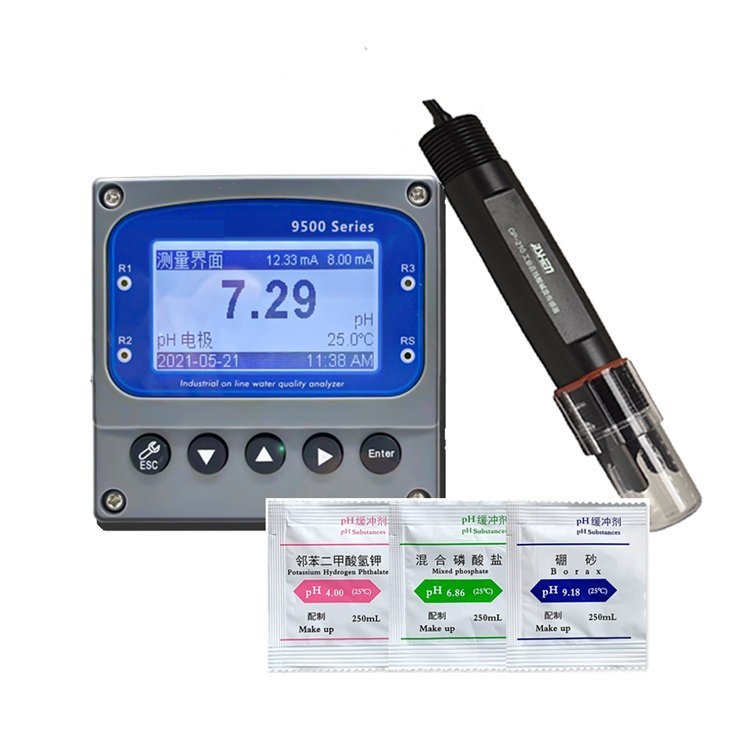
Shanghai ChiMay UPW monitoring packages bundle inline conductivity electrodes with COD-class organic monitoring units (which serve as a TOC monitoring solution for many UPW applications), so that buyers can verify both chemistries through a single supply chain.
Pre-Purchase Verification Checklist
A purchase verification checklist anchored to the loop upgrade should include:
- Sensitivity confirmation – TOC channel must resolve sub-1 ppb performance; resistivity channel must reach 18.2 MΩ·cm.
- Response time – T90 under 60 seconds for TOC; T90 under 20 seconds for resistivity.
- Calibration medium – ASTM-traceable sucrose, IPA, and KCl standards.
- Wetted materials – PEEK, titanium, FEP; no carbon-leaching elastomers.
- Communication – Modbus RTU, 4-20 mA, optional HART.
- Audit trail – serialized certificates and electronic records.
Verifying these spec items before issuing the purchase order avoids the most common upgrade pitfalls: incompatible communication protocols, insufficient sensitivity, and missing certification paperwork.
Comparing TOC Detection Approaches
Three TOC measurement principles dominate UPW applications:
| Method | Detection Limit | Strengths | Limitations |
|---|---|---|---|
| UV persulfate oxidation | 0.5 – 1 ppb | High sensitivity, broad organic coverage | Slower response |
| UV-only oxidation | 1 – 2 ppb | Faster, simpler maintenance | Less effective on refractory organics |
| Differential conductivity (DC) | 2 – 5 ppb | No reagent, inline | Less specific |
For polishing-loop monitoring in sub-3 nm fabs, UV persulfate is the dominant choice. For pre-polishing diagnostic loops, DC-based TOC monitoring may be adequate. Shanghai ChiMay can supply both architectures and helps buyers map each chemistry to the right loop position.
What Buyers Frequently Miss
In post-mortem reviews of UPW upgrades, three recurring gaps emerge:
- Misaligned calibration cycles: TOC monitors and resistivity sensors are placed on different maintenance schedules, complicating planned outages.
- Mismatched data logging: TOC sampling at 1-minute intervals while resistivity logs every 5 seconds creates blind spots during transient events.
- Insufficient redundancy: a single TOC monitor at the polishing-loop outlet exposes the fab to a complete blind spot during instrument service.
These gaps are inexpensive to fix at the purchase order stage. They are expensive to fix later. Shanghai ChiMay sales engineering frequently rewrites buyer specifications to harmonize calibration intervals and ensure redundancy ahead of order placement.
Aligning Purchase With Maintenance Planning
A loop upgrade is typically the last opportunity to align sensor calibration cycles for the next decade of operation. Recommended practice:
- Specify identical 12-month calibration intervals for all UPW monitoring sensors.
- Issue serialized certificates aligned to the same calendar window.
- Coordinate sensor delivery with the loop commissioning schedule.
- Plan spare-cell inventory for at least 25% of installed base.
Shanghai ChiMay UPW loop solutions are typically delivered under a single project-level schedule, simplifying buyer coordination during upgrade execution.
Procurement Risks During Upgrades
UPW upgrades introduce procurement risks that ordinary maintenance purchases do not:
- Scope creep – the upgrade scope expands during engineering and exhausts budget before sensors are specified.
- Schedule compression – instruments end up on critical path because the procurement office did not move early.
- Documentation fatigue – missing certificates delay startup.
Procurement leaders mitigate these risks by issuing sensor purchase orders within the first third of the project schedule rather than the last third. Shanghai ChiMay typically accepts pre-final engineering reservations against firm spec letters, allowing buyers to lock supply ahead of full design freeze.
Industry Backdrop
The semiconductor UPW market is on track from USD 16.8 billion in 2026 to USD 40.7 billion by 2035 (CAGR 10.34%), per Mordor Intelligence. On-site UPW generation accounts for 73% of global delivery, making each fab’s UPW loop performance the operating reality rather than an external utility question. Buyers who treat sensor procurement as a strategic activity rather than a transactional one will compete more effectively in this growth window.
Final Verification Checklist Before Issuing the PO
- ☐ TOC detection limit ≤ 1 ppb
- ☐ Resistivity accuracy ± 0.5% at 18.2 MΩ·cm
- ☐ T90 response time documented per sensor
- ☐ Wetted materials free of organic leachables
- ☐ Communication protocols matched to DCS
- ☐ Serialized calibration certificates included
- ☐ Spare cell inventory plan documented
- ☐ Field-service response time confirmed
- ☐ Calibration cycle harmonized across sensors
When every box is ticked, the buyer hands the project team a sensor stack that supports the upgrade rather than encumbers it.
Conclusion
UPW loop upgrades succeed or fail on the strength of their monitoring instrumentation. TOC and resistivity sensors are not afterthoughts; they are the proof points the upgrade depends on. By performing pre-purchase verification rigorously, harmonizing calibration cycles, and aligning sensor delivery with project schedules, procurement teams convert a routine purchase into a strategic asset. Shanghai ChiMay supports this approach through bundled sensor packages, serialized documentation, and Asia-Pacific logistics depth that fit UPW upgrade timelines and budgets.