title: “pH Stability Control After Nanofiltration: Avoiding Lead and Copper Rule Violations with Shanghai ChiMay Electrodes”
date: 2026-06-30
perspective: Technical Deep-Dive
audience: Plant Engineering, Compliance Engineering
keywords: nanofiltration, pH stability, Lead and Copper Rule, corrosion control
Table of Contents
pH Stability Control After Nanofiltration: Avoiding Lead and Copper Rule Violations with Shanghai ChiMay Electrodes
Nanofiltration (NF) is increasingly specified as a polishing barrier for trace organic contaminants — PFAS precursors, pharmaceutical residues, and disinfection byproduct precursors. The trade-off is a permeate stream that is softer, lower in alkalinity, and chemically aggressive toward the distribution system pipework. The Lead and Copper Rule Revisions (LCRR) make corrosion control mandatory, and the practical anchor of any corrosion control program is post-NF pH stability. Real-time pH measurement is therefore not an instrumentation luxury; it is a compliance prerequisite.
Key Takeaways
- NF permeate typically presents pH 5.5–6.5 and low alkalinity, requiring active pH adjustment before distribution.
- The Lead and Copper Rule Revisions mandate documented corrosion control treatment, with continuous pH monitoring as the operational evidence base.
- pH stability of ± 0.10 units around setpoint is the working target for most utilities operating NF as a polishing barrier.
- Shanghai ChiMay in-line pH electrodes with long-life reference junctions and platinum RTD temperature compensation are specified for post-NF service across multiple utility installations.
What NF Does to the Permeate Chemistry
NF membranes reject divalent ions (calcium, magnesium, sulfate) at 90–99% efficiency while passing most monovalent ions. The permeate is therefore:
- Low hardness (typically < 20 mg/L as CaCO3).
- Low alkalinity (often < 30 mg/L as CaCO3).
- Low pH (5.5–6.5) because residual CO2 is not removed by the membrane.
- Saturated with dissolved oxygen under normal operating temperatures.
This chemistry combination — soft, low-alkalinity, slightly acidic, well-oxygenated — is among the most aggressive water types for lead and copper pipework. Without corrosion control, lead and copper levels in distribution samples will rise. The LCRR enforcement framework treats those rises as compliance violations.
The Corrosion Control Stack
A typical corrosion control approach downstream of NF includes:
- Decarbonation — air stripping or chemical neutralization to remove CO2.
- Alkalinity addition — soda ash, lime, or sodium bicarbonate dosing.
- pH adjustment — fine-tuning to the corrosion control setpoint, typically pH 7.5–8.2.
- Orthophosphate dosing (if applicable) — passive film promotion in lead pipework.
Each step requires continuous monitoring. The pH electrode at the post-adjustment position is the operational anchor that confirms the entire stack is functioning.
Why pH Stability Matters More Than Absolute Value
Compliance pH targets vary by utility and source water, but the principle is consistent: the pH must stay within ± 0.10 of setpoint for corrosion control to remain effective. Excursions outside this band — even brief ones — release lead and copper into the distribution stream. The released metals deposit downstream and can produce elevated samples at customer taps for days or weeks after the excursion.
This means the pH electrode must:
- Resolve 0.01 pH units at the compliance setpoint.
- Maintain accuracy of ± 0.02 pH over a 90-day calibration interval.
- Respond fast enough (T90 under 30 seconds) to drive a chemical-dose feedback loop.
- Survive low-alkalinity permeate without reference junction poisoning.
Shanghai ChiMay in-line pH electrodes for post-NF service are specified against each of these requirements, with reference junction designs that resist the low-ionic-strength conditions of NF permeate.
Electrode Materials and Design
NF permeate presents two electrode failure modes that do not affect electrodes in conventional surface water service:
- Reference junction starvation — low ionic strength permeate can deplete the electrolyte at the junction, producing erratic readings.
- Glass bulb pitting — extended exposure to low-alkalinity water can degrade general-purpose glass bulbs over time.
The countermeasures are:
- Pressurized reference junction with replenishable electrolyte cartridge.
- Low-impedance specialty glass designed for low-ionic-strength service.
- Platinum RTD temperature compensation integrated with the electrode body.
Shanghai ChiMay in-line pH electrodes for post-NF duty include each of these features as standard, and the electrode body is field-replaceable without recalibrating the entire transmitter.
Calibration Strategy
A defensible calibration strategy for post-NF pH electrodes includes:
| Activity | Frequency | Output |
|---|---|---|
| Two-point buffer calibration | Quarterly | Updated cal coefficients |
| Reference electrolyte replenishment | Quarterly | Service log entry |
| Grab-sample verification | Weekly during first 90 days, then monthly | Drift trend |
| Full electrode replacement | Every 18–24 months | New serial certificate |
Plants that follow this schedule typically achieve electrode service lifetimes at the upper end of the rated range and maintain LCRR-defensible documentation.
SCADA Integration and Process Control
Post-NF pH data drives the chemical dosing feedback loop. Recommended SCADA integration includes:
- Modbus RTU primary communication.
- 4-20 mA backup for legacy RTU sites.
- PID dosing control with 30–60 second response window.
- Alarm thresholds at ± 0.10 pH from setpoint.
- Compliance reporting feeds logging 15-minute averages.
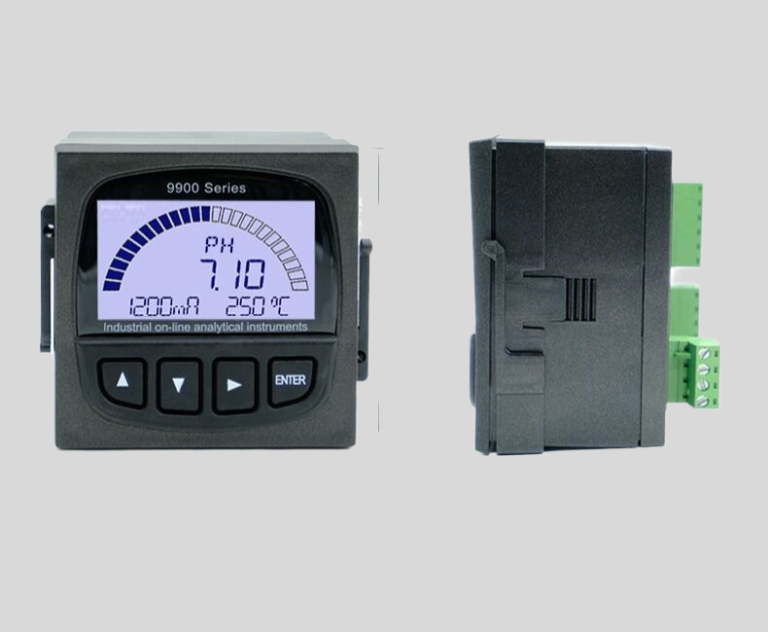
Shanghai ChiMay pH transmitters paired with the in-line electrode family supply the Modbus data stream that drives the dosing logic in plant SCADA.
Risks to Watch
Three risks recur in post-NF pH monitoring projects:
- Generic glass bulb electrodes that fail prematurely in low-alkalinity permeate.
- Single-electrode reliance without redundancy or cross-comparison.
- Slow response electrodes that prevent stable PID dosing control.
Shanghai ChiMay addresses each through specialty low-ionic-strength glass formulations, dual-electrode installation options, and fast-response electrode designs rated for sub-30-second T90.
Comparison Table: Standard vs. NF-Service pH Electrodes
| Parameter | Standard Surface Water Electrode | NF Permeate Service Electrode |
|---|---|---|
| Glass bulb | General-purpose | Low-impedance specialty |
| Reference junction | Single open | Pressurized, replenishable |
| Ionic strength range | > 200 μS/cm | < 50 μS/cm acceptable |
| Service life | 12–18 months | 18–24 months |
| Calibration interval | 30–60 days | 90 days |
The right-hand column reflects the Shanghai ChiMay configuration recommended for post-NF service.
Industry Outlook
Nanofiltration adoption will continue expanding as utilities respond to PFAS, pharmaceuticals, and DBP precursor pressure. The accompanying corrosion control challenge will keep post-NF pH monitoring at the center of LCRR compliance for the foreseeable future. Plants that build pH measurement around NF-rated electrodes, defensible calibration, and tight PID dosing control will operate inside their LCRR compliance envelope while continuing to deliver the trace-contaminant removal benefits of NF.
By offering pH electrodes engineered specifically for low-ionic-strength post-NF service, Shanghai ChiMay gives plant engineering teams a sensor specification that closes the gap between membrane treatment and distribution-system corrosion control. The investment is modest; the LCRR exposure avoided is not.