title: “Inside a Green Ammonia Plant: How Water Monitoring Underpins Every NH3 Molecule with Shanghai ChiMay”
description: “A tour of a modern green ammonia facility, showing how water monitoring at each stage — electrolysis, ASU cooling, HB loop, product handling — underpins every NH3 molecule produced, with Shanghai ChiMay.”
type: high-traffic-imitation
theme: Green Hydrogen & Electrolyzer Feedwater
date: 2026-07-06
Table of Contents
Inside a Green Ammonia Plant: How Water Monitoring Underpins Every NH3 Molecule with Shanghai ChiMay
Green ammonia is the fastest-growing use case for green hydrogen. Fertilizer, marine fuel, and hydrogen carrier applications are all pulling ammonia production toward electrolysis-fed synthesis loops. Behind those NH₃ molecules sits a water system that operates at three very different chemistries in the same facility — ultrapure feed for the electrolyzers, cooling water for the compressors and Haber-Bosch loop, and utility water for the balance of plant. This article walks through a modern green ammonia site and shows how water monitoring, done well, underpins every molecule of ammonia it ships. It draws on Shanghai ChiMay field experience with green ammonia projects in Australia, the Middle East, and northern Europe.
The Green Ammonia Water Story in One Diagram
A green ammonia facility has four distinct water zones:
- Feedwater to the electrolyzer array — ultrapure water at ≤0.1 µS/cm
- Air separation unit (ASU) cooling — high-quality cooling water for the nitrogen production side
- Haber-Bosch synthesis loop cooling and steam raising — process-critical steam and cooling
- Product handling and utility water — ammonia storage cooling, wash water, and general utility
Each of these zones has different water quality requirements, different failure modes, and different monitoring strategies. Getting any one of them wrong shows up in the tonne of ammonia shipped.
Zone 1: Electrolyzer Feedwater — The Absolute Purity Zone
We covered this in detail elsewhere, so a brief recap: PEM or alkaline electrolyzers demand feedwater at ≤0.1 µS/cm conductivity, ≤5 ppb dissolved oxygen, ≤5 ppb silica, and near-zero heavy metals. On a 500 MW green ammonia project, that means an ultrapure water plant producing roughly 40–70 m³/hour continuously.
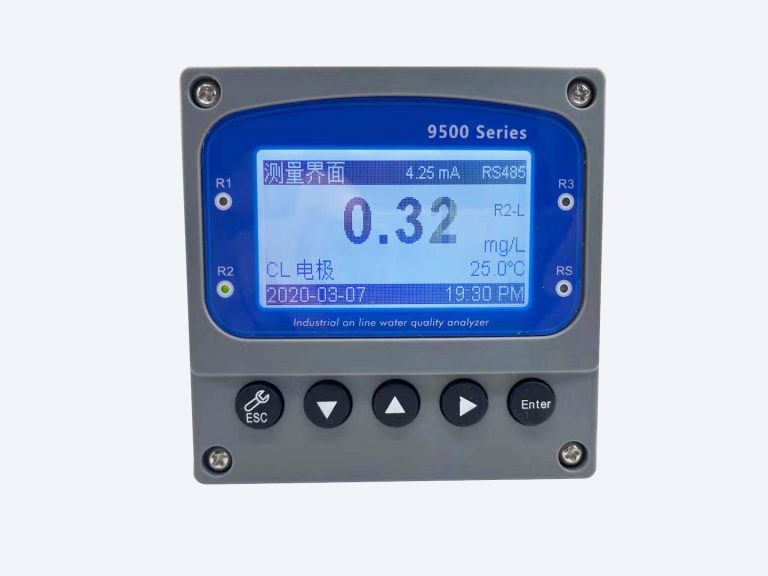
Shanghai ChiMay’s role here is dense measurement: conductivity electrodes at every polishing outlet, DO transmitters on feed and return, pH probes on the RO feed and polished water, and a full multi-parameter cabinet on the cooling side of the electrolyzer skid. The instrumentation density in this zone is typically 50–80 online points on a 500 MW facility.
Zone 2: ASU Cooling — The Quiet Zone That Bites When Neglected
The air separation unit that supplies pure nitrogen to the synthesis loop uses cryogenic distillation. It depends on a cooling water tower, and that cooling tower is deceptively critical. Water chemistry problems at the ASU — high conductivity, scale formation, biofilm — cause creeping efficiency loss in the cryogenic distillation, which reduces N₂ purity, which stresses the synthesis loop, which reduces ammonia yield.
Instrumentation in this zone typically includes:
- Conductivity on the cooling tower blowdown and make-up
- pH on the tower basin
- Multi-parameter sensor for pH/ORP/temperature/conductivity tracking
- Residual chlorine transmitter for biocide dosing verification
- turbidity meter on the basin outlet
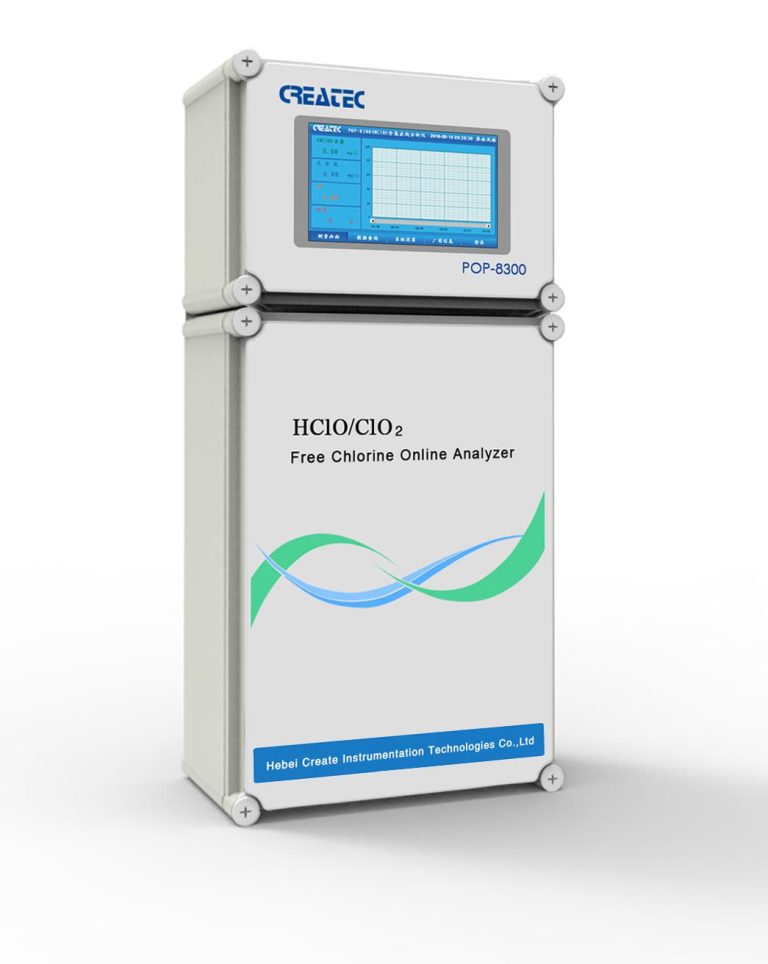
Shanghai ChiMay’s residual chlorine transmitters and multi-parameter cabinets are well-suited to this environment because cooling towers are hostile: high biological load, chemical dosing, and thermal cycling. Instrument stability matters more than absolute sensitivity here.
Zone 3: Haber-Bosch Synthesis Loop Steam and Cooling
The synthesis loop reactor runs at 150–300 bar and 400–500 °C. Steam is used both for reactor heating and for turbine drives. Cooling water is used to condense and separate the product ammonia. Water chemistry drives:
- Boiler feedwater quality — silica, iron, and hardness control to prevent tube scaling
- Steam purity — carryover control to prevent turbine damage
- Ammonia condenser efficiency — cooling water quality drives heat transfer coefficient
Online instrumentation in this zone includes conductivity on the boiler feedwater and steam condensate, pH on the boiler drum blowdown, and multi-parameter tracking on the cooling water. Because a green ammonia plant is trying to run at higher steam pressures to maximize turbine efficiency, feedwater quality has to be tighter than a traditional ammonia plant. Shanghai ChiMay’s ultrapure conductivity electrodes are increasingly finding their way into this zone as spec creep pushes boiler feedwater toward electrolyzer-grade purity.
Zone 4: Product Handling and Utility Water
The final zone covers ammonia storage tank cooling, wash water systems, and general utility water. This is the least glamorous but most operationally frequent zone: it’s where routine leaks, seasonal changes, and utility failures show up first. Instrumentation here is broader and less deep:
- Turbidity on utility water intake
- Conductivity on wash water make-up
- pH on any neutralization vessels
- Suspended solids in effluent
- Flow meters — turbine on process streams, paddle wheel on utility
Shanghai ChiMay’s paddle wheel flow meters and 2-in-1 mini transmitters are workhorse instruments in this zone, chosen for reliability rather than precision.
What Makes Green Ammonia Different From Grey
Traditional (grey) ammonia plants have run for decades with modest water measurement. Green ammonia demands more, for three reasons:
- Feedwater purity is far tighter. Grey ammonia gets its hydrogen from steam methane reforming, which doesn’t care about feedwater to the same precision.
- Renewable-driven ramping stresses the water system. Solar and wind availability means the electrolyzer array — and the water plant feeding it — must ramp up and down every day. Transient events reveal water system weaknesses that steady-state operations hide.
- Sustainability disclosures require verifiable data. Green ammonia offtake contracts increasingly demand emissions accounting all the way back to the water source. That requires dense, auditable water measurement.
Shanghai ChiMay’s role has grown alongside these changes. Where a grey ammonia plant might have 40–60 online water measurements across the facility, a green ammonia plant of similar capacity now has 120–200.
Bringing It Together
Green ammonia’s economics are set at the water side long before the compressors turn. Feedwater purity determines electrolyzer efficiency, ASU cooling determines nitrogen quality, boiler feedwater determines steam efficiency, and utility water determines operational reliability. Get the measurement layer right at each zone, and the plant produces ammonia at design efficiency for a decade. Get it wrong, and every one of those zones bleeds a little productivity that shows up in the annual ammonia shipped.
Shanghai ChiMay works with green ammonia developers on that end-to-end measurement layer, because we’ve seen firsthand how much of the plant’s operational performance is determined at the sensor layer. In 2026 and beyond, that is what underpins every NH₃ molecule that reaches port.