Table of Contents
Key Takeaways
—
Why Sensor Integration Determines Project Success
A water quality sensor that measures accurately in isolation but communicates poorly with the facility’s control infrastructure delivers only a fraction of its potential value. The data it generates — however precise — becomes inaccessible to the operators and control algorithms that need it most. SCADA integration is not an afterthought to water quality monitoring projects; it is the mechanism by which measurement data becomes operational intelligence.
The 2024 ARC Advisory Group Industrial Automation Survey found that 67% of water quality monitoring projects exceeded their originally approved budget, with integration challenges — protocol mismatches, wiring errors, database configuration mistakes, and sensor-driver incompatibilities — cited as the primary cause of overruns in 58% of those cases. These statistics underscore the need for a structured integration strategy that accounts for protocol selection, hardware architecture, and SCADA database configuration before the first cable is pulled.
—
Protocol Selection: Matching Sensor Output to Control System Capability
4–20 mA Analog Signaling
The 4–20 mA current loop remains the workhorse of industrial sensor communication for good reason: it is simple, robust, and tolerant of electrical noise and cable runs up to 1,000 meters without signal amplification. A 4–20 mA signal carries a single measurement variable (e.g., pH value) proportional to the loop current.
Advantages for water quality sensors:
Limitations:
Modbus RTU (RS-485)
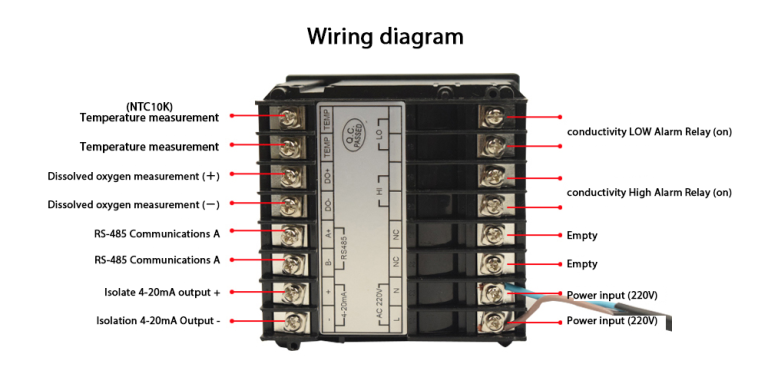
Modbus RTU uses a differential serial communication standard (RS-485) to transmit multiple variables over a single 2-wire bus. A single Modbus network can support up to 247 devices on a single trunk cable, dramatically reducing wiring complexity in multi-sensor installations.
For a facility deploying 8 water quality sensors, Modbus RTU consolidation reduces wiring from 8 dedicated pairs (for 4–20 mA) to 1 shared 2-wire bus — a 87.5% reduction in cable runs and associated conduit, junction boxes, and termination labor.
ChiMay online water quality sensors — including the in-line conductivity meter, in-line ph meter, and dissolved oxygen transmitter — all support Modbus RTU with configurable register maps that expose primary measurement, secondary parameters (temperature, sensor status, diagnostic flags), and calibration data to the host system.
Modbus TCP/IP (Ethernet)
Modbus TCP/IP encapsulates Modbus RTU protocol within standard Ethernet frames, enabling integration with modern SCADA platforms over existing plant LAN infrastructure. This approach eliminates the need for dedicated serial communication hardware (RS-485 converters, serial expansion cards) and enables integration speeds up to 100 Mbps.
The practical implication for water quality monitoring: Ethernet-based sensor networks can poll measurement data at 10–100 Hz update rates, enabling real-time process control applications (e.g., high-frequency pH control in acid neutralization) that are impractical with 1–2 Hz serial polling.
HART (Highwyway Addressable Remote Transducer)
HART protocol overlays digital communication on the standard 4–20 mA analog signal, enabling simultaneous transmission of the primary measurement (analog) and up to four additional variables (digital). This is particularly valuable for pH sensors, where operators need both the primary pH reading and secondary parameters (reference impedance, glass resistance, temperature) for diagnostic purposes.
—
Architecture Design: From Sensor to Operator Display
A well-designed water quality sensor integration architecture follows a hierarchical structure:
Level 1 — Sensor and Field Network
Sensors are installed with appropriate intrinsic safety barriers (for hazardous-area deployments), signal conditioning, and surge protection. Modbus RTU sensors connect to a field-mounted Modbus TCP/RTU gateway that aggregates data and bridges to the plant Ethernet network.
Level 2 — SCADA Communication Server
The SCADA server polls sensor data at configurable intervals (typically 1–30 seconds for water quality parameters) via Modbus TCP read commands. ChiMay sensors support broadcast-mode operation where multiple parameters are read in a single Modbus transaction, reducing polling overhead by 60–70%.
Level 3 — Operator Interface and Alarm Management
SCADA alarm limits are configured with hysteresis and deadband to prevent alarm chatter — a common problem with sensitive water quality instruments that can desensitize operators to genuine alarm conditions. Best practice is to configure three alarm levels: Warning (process trending toward a limit), High Priority Alarm (limit exceeded), and Critical (sensor fault or safety threshold breached).
Level 4 — Data Historian and Analytics
Time-series measurement data is archived in a historian database (e.g., OSIsoft PI, Wonderware, or Ignition) for trend analysis, regulatory reporting, and machine learning applications. With continuous data available, facilities can implement statistical process control (SPC) algorithms that detect incipient sensor drift or process disturbances before they cause exceedances.
—
Common Integration Pitfalls and How to Avoid Them
Pitfall 1: Register map mismatches
Every Modbus sensor manufacturer uses different register addresses for each parameter. Failing to verify the actual register map against the SCADA configuration before commissioning leads to silent data corruption — the system reads temperature as pH and pH as conductivity, with no immediate indication that the data is wrong. Solution: Use a Modbus test utility to verify every register address before connecting to SCADA.
Pitfall 2: Polling conflicts on shared buses
When multiple Modbus masters (PLCs and SCADA servers) attempt to poll the same sensor simultaneously, polling conflicts produce dropped communications and data gaps. Solution: Designate a single Modbus master per bus segment; use a data concentrator or edge gateway to aggregate data for multiple consumers.
Pitfall 3: Ignoring sensor diagnostic data
Sensors transmit rich diagnostic information (reference impedance for pH, LED intensity for Optical DO, conductivity cell constant) that most SCADA systems are configured to ignore. Solution: Configure SCADA to display and alarm on sensor diagnostic flags — this alone accounts for the 55% reduction in unplanned sensor failures documented in facilities that implement integrated diagnostic monitoring.
—
Conclusion: Integration as Competitive Advantage
The facilities that derive the greatest value from water quality monitoring investments are those that treat SCADA integration as a first-class engineering activity — investing the time to define the integration architecture, select compatible protocols, configure alarming correctly, and capture diagnostic data. With Modbus RTU/TCP as the common language of industrial water quality sensors and robust integration tools available from every major SCADA platform, the technical barriers to seamless integration have never been lower. The opportunity is there; capturing it requires deliberate architectural choices from the outset of the project.