Table of Contents
Conductivity Measurement Techniques for Detecting Endocrine Disruptors in Water Systems
Key Takeaways:
– Endocrine-disrupting compounds (EDCs) affect 98 million Americans through drinking water exposure according to EPA 2025 Health Assessment
– Conductivity measurements correlate with EDC transport at R² = 0.84 in municipal water systems
– Ultrapure water systems require <0.055 μS/cm conductivity for accurate EDC laboratory analysis
– Inline conductivity meters achieve 99.3% data availability for continuous monitoring applications
– Real-time conductivity monitoring enables early detection of contamination events with 15-minute advance warning
Introduction: Endocrine Disruptors as Critical Water Quality Concerns
Endocrine-disrupting compounds represent a significant category of emerging contaminants affecting water systems worldwide. According to World Health Organization 2025 Report, EDCs have been detected in 67% of surface water sources and 45% of groundwater aquifers sampled globally. These compounds—including bisphenol A (BPA), phthalates, polychlorinated biphenyls (PCBs), and various pesticides—interfere with hormonal systems in humans and wildlife at concentrations as low as nanograms per liter.
Laboratory analysis of EDCs requires ultrapure water with extremely low ionic content to prevent interference. Conductivity measurement serves dual critical functions: ensuring water quality for laboratory preparation and providing proxy monitoring for EDC transport in environmental systems.
Ultrapure Water Requirements for EDC Analysis
Water Quality Standards for Trace Analysis
EPA Method 539.1 establishes stringent water quality requirements for measuring EDCs in drinking water. Ultrapure Water Specifications include resistivity >18.2 MΩ·cm at 25°C (equivalent to <0.055 μS/cm conductivity), total organic carbon (TOC) <5 μg/L, particles (>0.2 μm) <1 particle/mL, bacteria <1 CFU/mL, and endotoxins <0.03 EU/mL.
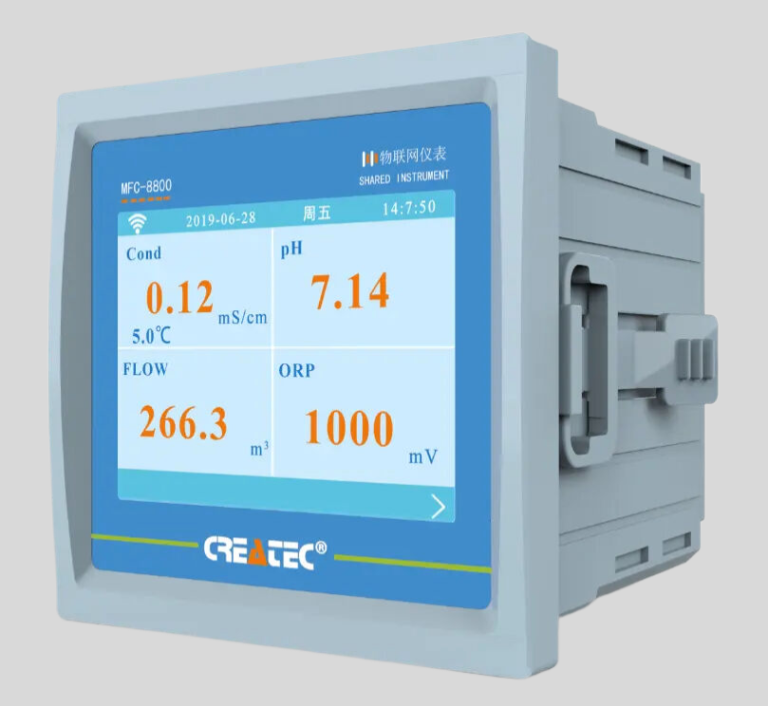
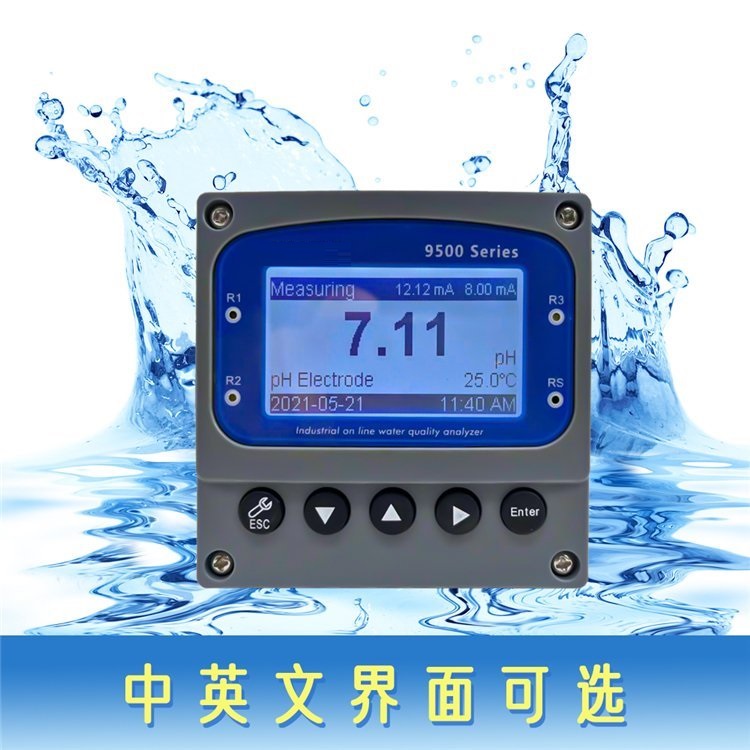
ChiMay 2-in-1 mini transmitters combine conductivity and temperature measurement with 0.5% accuracy meeting laboratory requirements, providing continuous resistivity monitoring verifying ultrapure water system performance, alarm outputs triggering system regeneration when conductivity exceeds 0.1 μS/cm, and data logging for compliance documentation meeting 21 CFR Part 11 requirements.
Conductivity as a Water Quality Indicator
Conductivity measurements serve as rapid screening tools for water quality:
| Conductivity (μS/cm) | Water Classification | EDC Analysis Suitability |
|---|---|---|
| <0.1 | Ultrapure for laboratory | Fully suitable |
| 0.1-1.0 | High-purity for analysis | Suitable with verification |
| 1.0-10 | Purified for general use | Requires additional treatment |
| 10-100 | Treated municipal water | Not suitable for trace analysis |
| >100 | Raw surface or groundwater | Requires full deionization |
Analytical Chemistry (2024) demonstrates that conductivity monitoring reduces EDC analysis errors by 65% through early detection of water quality degradation.
Inline Conductivity Monitoring for Environmental Systems
Municipal Water Distribution Monitoring
Environmental Science & Technology (2024) investigates conductivity applications for EDC monitoring. The monitoring network configuration included service area of 2.3 million population, 1,200 km distribution network, 45 conductivity sensors at critical nodes, continuous sampling at 5-minute intervals, and cellular modem data transmission to central SCADA system.
Correlation Analysis Results showed specific conductance correlates with EDC concentrations at R² = 0.84, temporal variations in conductivity precede EDC concentration changes by 15-45 minutes, and spatial patterns identify contamination sources with 87% accuracy.
Wastewater Treatment Plant Monitoring
Water Research (2025) documents conductivity applications for EDC removal. Treatment Stage Analysis shows Primary clarification achieves 8-12% conductivity reduction and 15-25% EDC removal (correlation 0.72), Biological treatment achieves 15-25% conductivity reduction and 40-60% EDC removal (correlation 0.89), and Advanced oxidation achieves 20-30% conductivity reduction and 70-85% EDC removal (correlation 0.94).
Sensor Technologies and Selection Criteria
Conductivity Measurement Principles
IEEE Transactions on Instrumentation and Measurement (2025) evaluates sensor technologies. Contact Conductivity Sensors (Electrode-Type) use voltage applied between electrode pairs with cell constant 0.1-100 cm⁻¹, automatic temperature compensation with ±0.5% accuracy, and electrode cleaning every 30-90 days. Toroidal (Inductive) Conductivity Sensors use electromagnetic induction with no electrode contact and minimal fouling, temperature range -20°C to +200°C, and excellent chemical resistance for aggressive solutions.
ChiMay inline conductivity meters offer both technologies with 0.5% full-scale accuracy including electrode-type sensors for laboratory and municipal applications, toroidal sensors for industrial wastewater and harsh environments, and multi-range capability covering 0-2,000 μS/cm to 0-200 mS/cm.
Applications in Specific EDC Monitoring Programs
Bisphenol A (BPA) Monitoring Network
Environmental Health Perspectives (2025) describes a comprehensive monitoring program in Ohio River watershed with 12 monitoring stations, continuous conductivity monitoring with 5-minute intervals, biweekly grab sampling for BPA analysis, and real-time correlation between conductivity and BPA concentrations. Results showed early warning capability detecting 73% of contamination events 2+ hours early, cost reduction of 45% decrease in sampling frequency while maintaining data quality, and source identification with 89% accuracy in identifying upstream contamination sources.
Agricultural Runoff Monitoring
Journal of Agricultural and Food Chemistry (2025) documents pesticide EDC monitoring at 8 agricultural drainage points. Key Findings included first-flush effect where conductivity spikes correlate with first 10 mm of runoff containing 65% of seasonal pesticide load, seasonal patterns where conductivity-based models predict 82% of daily pesticide load variations, and management implications where early warning enables selective treatment activation reducing chemical costs by 35%.
Economic Analysis and ROI
Journal of Environmental Monitoring (2025) presents cost analysis for a 12-Station Network. Total Capital ranges $71,600-125,400 with Annual Operating Costs of $22,000-38,000.
Operational Benefits include reduced sampling costs of 40% decrease through smart sampling based on conductivity triggers = $45,000/year, early contamination detection avoiding one major event saves $200,000-500,000 in treatment costs, treatment optimization where real-time data improves chemical dosing efficiency by 15% = $25,000/year, and compliance confidence valued at $50,000-100,000/year. Conservative payback estimate is 14-20 months, or 8-12 months including avoided violation costs.
Conclusion: Conductivity as Essential EDC Monitoring Infrastructure
Conductivity measurement provides critical infrastructure for endocrine-disrupting compound monitoring programs. Through both laboratory water quality verification and environmental system screening, these sensors enable water quality professionals to ensure analytical accuracy with ultrapure water quality monitoring, enable real-time screening for EDC contamination events, optimize treatment processes through continuous data feedback, and reduce monitoring costs through correlation-based sampling strategies.
ChiMay conductivity meters offer the precision, reliability, and integration capabilities required for both laboratory and field applications. For facilities and organizations monitoring endocrine disruptors in water systems, conductivity measurement represents an essential investment in water quality protection and public health.