Table of Contents
How Does Water Quality Influence Dyeing Reproducibility? Practical Answers from Shanghai ChiMay
A textile dye house can have the finest dyestuffs, the best machinery, and the most experienced colorists in the country, and still produce shade variation from one batch to the next. When that happens, the variable is almost always the water. Dyeing is a wet chemistry process in which the dye, the fiber, and the water form a triangle of interactions, and changes in water quality propagate directly into color outcomes. So how exactly does water quality influence dyeing reproducibility, and what can a modern dye house do about it? Shanghai ChiMay engineers see the same handful of questions repeatedly, and the answers point clearly toward inline monitoring.
Why Water Is Never “Just Water” in a Dye House
Process water entering a dyeing machine is not neutral. It carries:
- Calcium and magnesium hardness, which can form complexes with reactive dyes
- Iron and manganese, which dull shade and create catalytic damage on fiber
- Residual chlorine from municipal supply or in-house disinfection
- Variable pH, especially in plants pulling from multiple sources
- Background conductivity that competes with the salt added during dye exhaustion
Each of these has a documented effect on dye uptake, fixation, and final shade. The reproducibility problem is not that any single parameter is impossible to control, but that the dye house often discovers a problem only after a batch fails inspection.
How Hardness Changes the Outcome
Hardness ions (Ca²⁺, Mg²⁺) react with anionic dyes and with certain auxiliary chemicals to form insoluble complexes. The visible result is uneven shade, dull color, and in extreme cases, dye precipitation on the fiber. In reactive dyeing, hardness above roughly 50 mg/L as CaCO₃ in the dye bath is enough to noticeably shift shade. The traditional response is softening, often with a sodium ion-exchange softener.
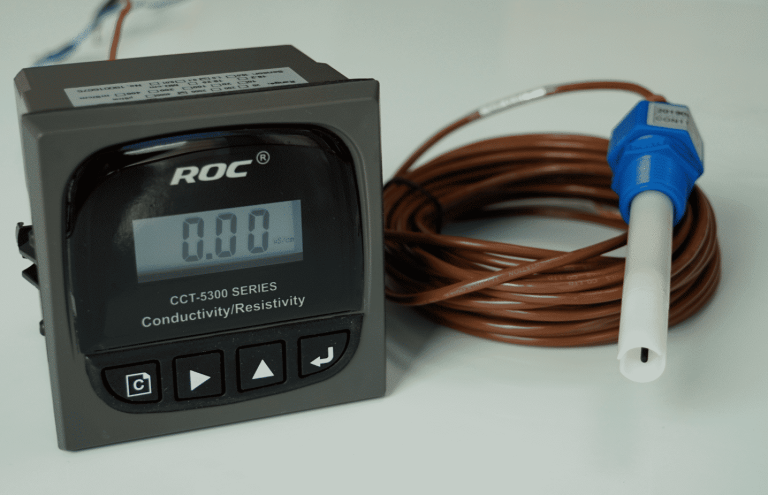
The control loop here matters more than the hardware. A softener that is regenerated on a fixed time schedule will inevitably allow hardness breakthrough on heavy production days. Inline conductivity monitoring on the soft water line provides an early warning before hardness reaches the dye machine, and Shanghai ChiMay conductivity transmitters are often deployed on the post-softener line for exactly this purpose.
The pH Question
Different dye chemistries demand different pH:
- Reactive dyes: alkaline fixation at pH 10.5–11
- Acid dyes on wool or nylon: pH 4–5
- Disperse dyes on polyester: pH 4.5–5.5
- Vat and sulfur dyes: highly alkaline reducing environment
If incoming water pH varies by even half a unit, the recipe’s buffer load may not be enough to bring the bath to the target. Worse, when source water alternates between two suppliers or seasonal patterns, the operator may not realize that the recipe needs adjustment.
Real-time inline pH measurement of both feed water and dye bath solves this directly. The transmitter trends pH over time, alarms when feed water drifts outside specification, and feeds the dose control system so that acid or alkali addition matches actual rather than assumed pH.
Chlorine and Oxidants: Hidden Damage
Residual chlorine in supply water can bleach reactive dyes, attack reduced sulfur dyes, and oxidize fiber substrate. Even concentrations below 0.5 mg/L can subtly shift shade. Many dye houses operate dechlorination systems, but very few monitor breakthrough continuously. Inline residual chlorine transmitters provide the missing piece of feedback, alarming when the carbon filter or chemical reduction system begins to fail.
Conductivity and Salt Background
The salt added to a reactive dye bath drives exhaustion of the dye onto the fiber. The total electrolyte concentration matters, not just the added salt. If incoming water has high background conductivity — common in plants pulling from boreholes or reclaimed sources — the operator is effectively starting with extra salt, and the recipe will exhaust too quickly. Inline conductivity measurement at the feed water inlet and inside the dye machine separates intentional salt addition from background, and allows the recipe to be normalized.
Color and Dissolved Organic Matter
Surface water and reclaimed water often carry dissolved organic matter that reacts with dyestuffs, particularly with reactive dyes that have free hydrolysis sites. Color in the feed water also shifts the visual perception of the finished shade. While organic load is harder to measure inline than pH or conductivity, COD sensors and UV-absorbance instruments give a usable proxy that flags when feed water is straying from baseline.
What “Good Reproducibility” Looks Like
In a well-controlled dye house, the following are continuously measured and trended:
- Feed water conductivity, pH, hardness indicator, residual chlorine
- Dye bath pH, conductivity, temperature
- Effluent pH, COD, color, and turbidity
The data is not just stored; it is compared batch-to-batch. When a batch comes off-shade, the operator looks at the trend lines before blaming the dye or the operator. Nine times out of ten, the answer is in the water data.
The Sensor Set That Most Dye Houses Need
From Shanghai ChiMay’s experience, a basic monitoring package for dye-bath reproducibility consists of:
- A multi-parameter feed water station (conductivity, pH, residual chlorine)
- An inline pH transmitter on each dye machine
- A clarifier and final-effluent monitoring point with turbidity and COD
- A central data acquisition node that ties readings to batch numbers
This setup typically pays for itself within one to two seasons through reduced rework and lower dye consumption. The combination matters: a single sensor in isolation cannot diagnose reproducibility problems, but a coordinated set can.
Practical Steps a Plant Can Take This Quarter
For dye houses that are starting from manual sampling, three steps deliver the biggest improvement quickly:
- Instrument the feed water line first. Knowing what is coming into the plant is more valuable than any other measurement.
- Add pH and temperature monitoring inside the dye machine. Reproducibility cannot exceed the precision of these two parameters.
- Tie measurements to batch records. Without that linkage, the data is just charts.
Once these are in place, advanced controls — feed-forward dosing, recipe normalization for water variability, real-time shade prediction — become possible.
What Goes Wrong When Water Quality Is Not Monitored
Plants that rely solely on grab sampling typically see:
- 10–15 % rework rate on dark shades
- Higher dye consumption due to safety margins added “just in case”
- Inconsistent effluent quality that complicates compliance
- Disputes with customers over shade matching that cannot be diagnosed
Each of these costs is recurring. The instruments themselves are a one-time investment with a long service life when properly maintained.
A Final Word on Reproducibility
Reproducibility in textile dyeing is not a mystery; it is a measurement problem. The dye, the fiber, and the operator can all be held constant, but if the water varies and is not measured, color will vary. Shanghai ChiMay’s view is straightforward: instrument the water, trend the data, and act on the trends. When a dye house does that consistently, the next batch looks like the last batch, and the customer notices.
Conclusion
Water quality is the silent variable in every dyeing operation. Hardness, pH, chlorine, conductivity, and organic load each influence dye uptake and shade outcome, often in ways that are invisible until a batch fails. Inline monitoring closes the visibility gap, turns the water from an uncontrolled variable into a measured input, and gives the dye house the foundation it needs for consistent, profitable production. Shanghai ChiMay’s sensors and transmitters are designed for exactly this role, and the dye houses that have adopted them rarely go back to relying on grab samples and judgment alone.