Table of Contents
Inline pH Electrode Technology for Dyeing Process Stability: The Shanghai ChiMay Overview
Textile dyeing is a chemistry-driven process where a few tenths of a pH unit can decide whether a batch passes inspection or ends up as costly rework. Reactive dyes prefer alkaline fixation around pH 10.5–11, acid dyes work best near pH 4–5, and disperse dyes typically run between 4.5 and 5.5. Holding those windows consistently across long production runs is the job of the inline pH electrode, and the technology behind it is far more sophisticated than the simple glass bulbs many operators remember from laboratory bench meters.
Why Inline pH Measurement Matters in Dye Houses
In a bench measurement, a sample is poured into a beaker, the electrode dipped, and a value recorded. In a working dye bath, the conditions are entirely different. The medium is hot — often 60 °C to 130 °C in jet dyeing or high-temperature beam machines — full of suspended fibers, salts, surfactants, and dye molecules that can coat or poison a sensor. Inline electrodes must survive this environment and still produce a reading accurate enough to dose acid, alkali, or buffer in real time.
When the pH loop drifts, the consequences accumulate quickly:
- Shade variation between batches and within a single batch
- Dye utilization losses, sometimes pushing 15–20 % more dye into effluent
- Higher salt and water consumption to compensate for poor exhaustion
- Increased AOX and color load downstream
Real-time, inline pH control closes that gap, which is why most modern dye houses now treat the inline electrode and transmitter pair as critical instrumentation rather than auxiliary hardware.
Sensor Construction Behind the Reading
A Shanghai ChiMay inline pH electrode is built around three coordinated elements:
- The pH glass membrane, formulated for high-temperature, high-alkalinity service. Standard general-purpose glass loses linearity above pH 12 and degrades quickly under repeated thermal shock, so dyeing applications use specialty membranes with reinforced lithium-doped glass that holds slope longer.
- The reference system, sealed against process contamination. In textile effluent, sulfides, surfactants, and dyestuff fragments can poison an open-junction reference within weeks. A double-junction or gel-filled reference with a large porous junction extends service life dramatically.
- The temperature compensator (Pt1000 or NTC), embedded in the same probe body. Because the Nernst response itself depends on temperature, automatic compensation is not optional in dye baths that swing 40 °C during a cycle.
Around these components, the body is typically PEEK or PPS to resist hot caustic and chlorinated bleach lines, with hygienic or threaded process connections that allow hot insertion through a retractable holder.
The Transmitter and Signal Path
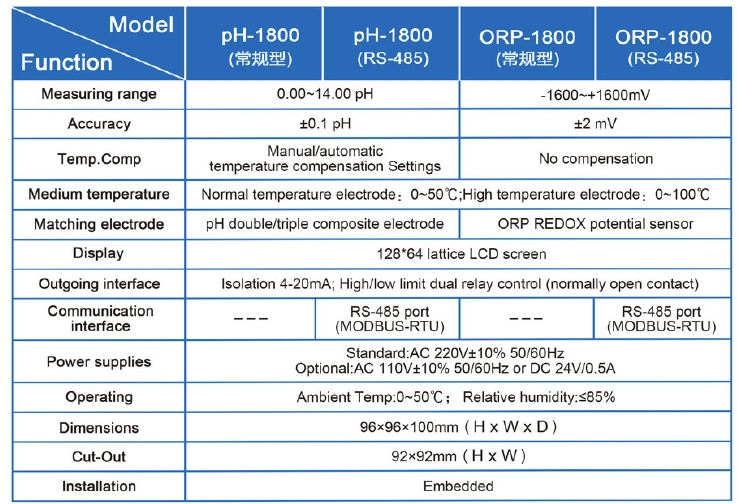
A modern inline pH transmitter does more than convert millivolts. The Shanghai ChiMay transmitter family provides:
- Two-point or three-point automatic calibration with stored buffer recognition
- Diagnostic outputs for glass impedance, reference impedance, and slope
- 4–20 mA plus HART or RS-485 for integration into the dye house DCS or PLC
- Hold and wash interlocks so that cleaning cycles do not trigger false dosing
The diagnostics are particularly important in textile service. Operators rarely have time to test electrodes one by one, so a transmitter that flags a degraded reference or a cracked glass bulb before it produces wild readings prevents an entire production shift from being lost.
Installation Considerations
Three installation choices have outsized influence on electrode life:
Mounting angle. Electrodes should be installed at least 15° above horizontal so that the reference electrolyte stays in contact with the junction. Vertical-up installations starve the junction and shorten life sharply.
Flow velocity. A velocity of 0.5–2 m/s past the sensor keeps the membrane clean without abrading it. Stagnant pockets allow film build-up; high-velocity slurry lines accelerate wear.
Retractable holders. In dye houses running multi-shade campaigns, the ability to remove and clean the electrode without shutting the line is the difference between a sensor that lives one month and one that lives a year.
Maintenance Practice That Actually Works
Most premature failures in textile pH measurement trace back to two preventable issues: coating and reference poisoning. Both are addressed with a disciplined maintenance routine.
- Weekly visual inspection through a sight glass
- Bi-weekly cleaning with a dilute pepsin-HCl or sodium hypochlorite solution depending on the dominant fouling
- Monthly two-point calibration against fresh buffers, with slope and offset trended in the historian
- Quarterly review of transmitter diagnostics to retire electrodes proactively before they fail
When this routine is followed, electrode life in reactive dyeing typically rises from 3–4 months to 8–12 months, and the cost per measurement falls accordingly.
Integration with Dye House Automation
The real value of inline pH appears once the measurement is wired into the dosing logic. A typical Shanghai ChiMay deployment connects the transmitter to a programmable controller that meters soda ash, acetic acid, or buffer salts based on pH setpoint and a feed-forward signal from the dye recipe. Three benefits follow:
- Shade reproducibility improves because pH no longer drifts during fixation
- Chemical consumption drops as overdosing for safety margin becomes unnecessary
- Effluent quality stabilizes, easing downstream neutralization and biological treatment
In facilities that have moved from manual sampling to inline control, color matching first-pass rates often rise from the 70–80 % range into the low 90s. That single change usually pays back the instrumentation cost within a single production season.
Common Pitfalls to Avoid
Several mistakes appear again and again across the industry:
- Using general-purpose pH electrodes in high-temperature reactive dyeing lines
- Skipping calibration during long campaigns “to save time”
- Ignoring transmitter diagnostics until a batch fails
- Installing electrodes in dead legs where they read sample, not process
Each of these is straightforward to fix once recognized, and each can pay back in a single avoided rework batch.
Looking Ahead
The next step for inline pH in textile water management is tighter integration with predictive control. By combining electrode diagnostics, dye recipe data, and historical batch outcomes, dye houses are beginning to predict when a sensor will need cleaning before a shade deviates. Shanghai ChiMay continues to develop transmitter firmware and digital protocols in that direction, so that what is today a closed-loop dosing instrument becomes tomorrow a self-aware node in a learning dye house.
Conclusion
Inline pH electrode technology is not a commodity in textile dyeing — it is a precision instrument operating in one of the most aggressive process environments in industry. With the right sensor construction, transmitter intelligence, installation discipline, and maintenance routine, a Shanghai ChiMay inline pH system can hold dye-bath chemistry within the tight windows that consistent color demands. For dye houses balancing quality, cost, and environmental compliance, getting that single measurement right is one of the highest-leverage investments in the entire production line.