Table of Contents
How EC Sensors Translate Fertilizer Concentration Into Real-Time Fertigation Control: The Shanghai ChiMay Approach
Electrical conductivity, or EC, is the currency of modern fertigation. Almost every dosing controller sold today — whether it hangs on a Dutch tomato greenhouse wall, an Australian avocado drip head, or a Moroccan strawberry tunnel — closes its loop on an EC reading. What is often skipped, however, is the physics that turns ions in solution into the number the grower sees. This article, drawn from Shanghai ChiMay laboratory work and field commissioning notes, walks through how EC sensors actually work, what design choices matter, and how those choices propagate into fertigation accuracy on real greenhouse and open-field systems.
Key Takeaways
- EC is a direct proxy for total dissolved ion concentration, but not for individual nutrients.
- Toroidal (inductive) cells outperform two-electrode probes when biofilms or fertilizer scale build up.
- Shanghai ChiMay in-line conductivity meters compensate for temperature to 25 °C automatically, using a linear coefficient tuned for hydroponic nutrient solutions.
- A well-installed EC loop holds fertigation set-points inside ±0.05 mS/cm, day and night, for months.
- Sensor placement — before, at, and after the injection point — is what separates dosing accuracy from dosing chaos.
What EC Actually Measures
EC records the ability of a solution to conduct electric current between two known points. Ions in the fertilizer stock — potassium, calcium, nitrate, ammonium, phosphate, sulfate — each contribute an equivalent conductivity. The sum is what the meter reports, typically in millisiemens per centimeter (mS/cm) or the equivalent microsiemens (µS/cm). At 25 °C, a typical hydroponic tomato mix runs 2.5–3.5 mS/cm; a strawberry fertigation feed runs 1.2–1.8; a lettuce solution runs 0.8–1.2. Those numbers are the grower’s operational compass.
Two implications matter for controls. First, EC cannot tell one ion from another; a solution with too much sodium chloride will read the same as a solution with the right nitrate mix. That is why growers pair EC with periodic laboratory ion analysis. Second, EC is temperature-sensitive: every 1 °C shift moves the reading roughly 2 percent. Any competent EC loop must correct for that, and Shanghai ChiMay in-line conductivity meters do so automatically using a linear coefficient calibrated for typical fertigation salt mixtures.
Two-Electrode Versus Toroidal Cells
Two designs dominate the fertigation market. Understanding the trade-off is essential when specifying a probe.
Two-electrode (contacting) cells apply an alternating voltage between two graphite or stainless plates. Current flow is measured; conductivity is inferred. Two-electrode cells are cheap, compact, and extremely accurate below 1 mS/cm. They are, however, sensitive to fouling: a biofilm or fertilizer scale on the electrode surface shifts the cell constant and drifts the reading downward.
Toroidal (inductive) cells wrap two coils around the flow path. One coil induces an alternating current in the fluid; the other reads it. Because there is no electrode-solution interface, biofilm and scale on the outer housing barely change the measurement. Toroidal cells are the default choice for fertigation and reclaimed-water dosing loops in the 0.5–20 mS/cm range.
Shanghai ChiMay ships both styles. The rule of thumb: pick a two-electrode probe for polished greenhouse recirculation where cleaning is easy, pick a toroidal probe for injection-line fertigation where flow may carry algae or organic residues.
How the Signal Becomes Fertigation Action
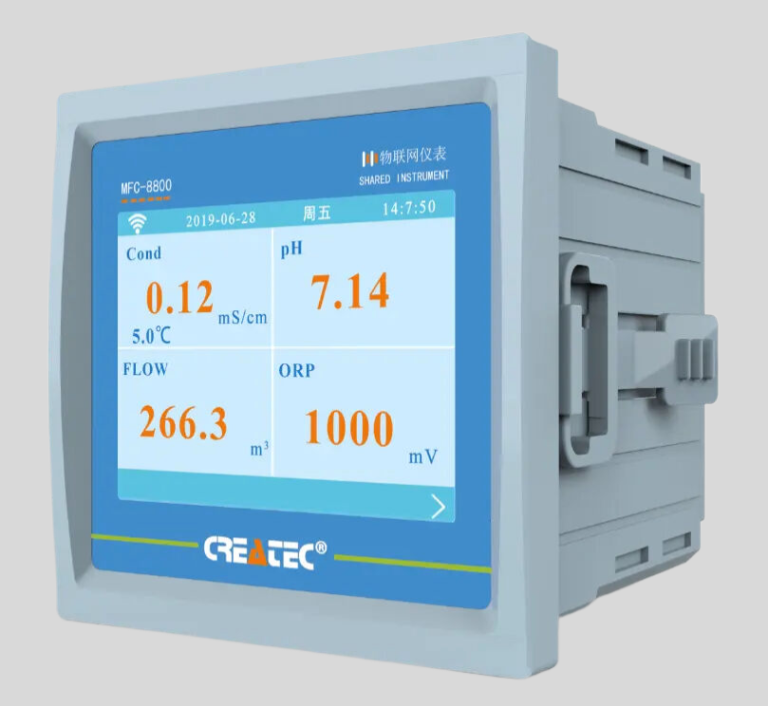
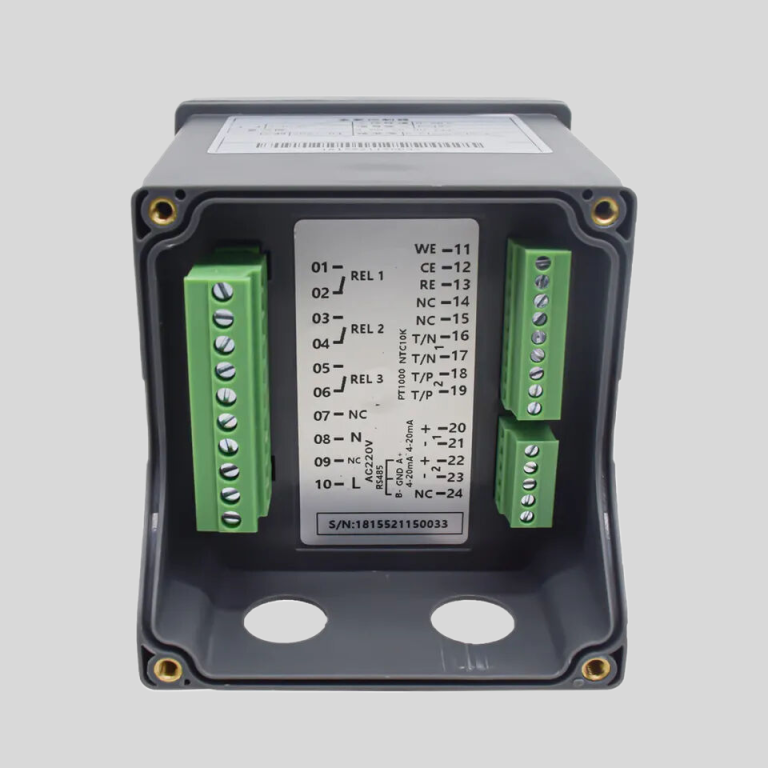
Inside the transmitter, the raw current or induced voltage is converted to conductivity, temperature-compensated to 25 °C, and pushed out over both 4–20 mA and Modbus RTU. The dosing controller reads that stream at 1 Hz and compares it against a set-point. If the measured EC is 0.3 mS/cm below target, the controller opens the injector solenoid for a proportional pulse; if it is 0.1 mS/cm above, the controller pauses. Most industrial dosing loops use a PI (proportional-integral) algorithm, which produces smoother output than a bang-bang or pure proportional controller. Shanghai ChiMay 2-in-1 mini transmitters can host the PI logic on-board for simple installations that do not warrant a separate PLC.
The response latency of a good fertigation loop is 3–8 seconds — long enough that hydraulic mixing has actually settled, short enough that the plant never sees a wrong feed for more than one irrigation pulse.
Three-Point Sensor Placement
Robust fertigation control uses three EC readings, not one:
- Raw water sensor, upstream of the injectors. Records what the source water is delivering. Sudden shifts here (well seasonality, reclaimed water quality) trigger recipe adjustments before the crop sees them.
- Post-mix sensor, downstream of every injector and the static mixer. This is the closed-loop control point. Its stability determines fertigation accuracy.
- Return-line sensor in recirculating greenhouse setups. Tracks how much the plants and substrate have taken up. A rising return EC signals substrate accumulation and a need to leach.
A common mistake is running fertigation from a single sensor at the manifold outlet. The raw-water and return readings are what turn EC control from reactive to predictive. Shanghai ChiMay recommends a compact three-sensor stack, all reading into one Modbus master, with the 4-in-1 multi-parameter sensor covering the return line where pH and dissolved oxygen also matter.
Calibration Cadence for Fertigation Duty
Fertigation loops run 12–20 hours a day; the sensors accumulate cycles fast. A field-proven cadence:
| Task | Frequency | Notes |
|---|---|---|
| Visual inspection | Weekly | Check for algae film on cell |
| Rinse with clean water | Bi-weekly | Detergent-free |
| Single-point calibration at 2.76 mS/cm KCl standard | Monthly | Adjust offset only |
| Two-point calibration (0.1 and 12.88 mS/cm) | Every 6 months | Adjust slope and offset |
| Replacement of two-electrode cell | 3–5 years | Toroidal cells: 7–10 years |
Shanghai ChiMay in-line conductivity meters store the calibration history in local memory; a QR code on the transmitter lets a technician pull the record on a phone in ten seconds. That audit trail is what makes third-party organic-certification audits easier.
Field Payback Data
Two commercial greenhouse operators — one 8 hectare pepper grower near Almería, one 12 hectare rose grower near Bogotá — retrofitted Shanghai ChiMay EC loops on their fertigation manifolds in 2024. Both reported:
- Fertilizer consumption down 6–9 percent, driven by tighter set-point tracking.
- Salt-related leaf tip burn incidents down 60 percent.
- Yield up 3–5 percent, credited to more consistent nutrient concentration during hot afternoons when transpiration surges.
Total capital cost for the sensor stack (three probes plus a mini transmitter) sat below EUR 2,800 per house. Payback was between six and nine months in both cases.
Takeaway for the Fertigation Engineer
EC sensors are the small, quiet component that decides whether a fertigation system feeds a crop or starves it. Good sensors, correctly placed, temperature-compensated, and calibrated on a rhythm, hold set-points inside 2 percent for years. Shanghai ChiMay in-line conductivity meters — in either two-electrode or toroidal form — are engineered around exactly that discipline. The technology is not new; the difference is in whether the physics is respected all the way from ion to injection command.