title: “How Softener Valves Prepare Feedwater for Modern ZLD Membrane Trains: A Shanghai ChiMay Technical Primer”
date: 2026-07-10
category: Zero Liquid Discharge & Water Circularity
audience: Water Treatment Engineers
tags: [softener valve, ZLD, membrane pretreatment, hardness, Shanghai ChiMay]
Table of Contents
How Softener Valves Prepare Feedwater for Modern ZLD Membrane Trains: A Shanghai ChiMay Technical Primer
Key Takeaways
- Zero Liquid Discharge (ZLD) trains depend on membrane elements running at 65–85% recovery, and every point of recovery above the industry baseline pushes hardness ions toward saturation faster than most designers expect.
- A softener valve is not a bolt-on convenience; it is the gatekeeper that determines whether reverse osmosis and nanofiltration membranes in a ZLD skid reach their design life or fail within twelve months.
- Shanghai ChiMay’s softener valve is engineered around service-cycle counters, regeneration efficiency and pressure integrity, so plant operators can trust the pretreatment step during aggressive ZLD duty.
- Understanding valve behavior — service, backwash, brine draw, slow rinse, fast rinse and refill — is essential for any technical team scoping a ZLD retrofit.
Why Pretreatment Sets the ZLD Ceiling
A modern ZLD installation stacks four to seven unit operations behind a single mass-balance goal: send zero liquid effluent out of the plant. Reverse osmosis is usually the first concentrating step, followed by high-recovery brine concentrators, mechanical vapor recompression evaporators and finally crystallizers. Every one of those unit operations behaves better on softened water. Skip the softener and calcium sulfate scaling arrives within weeks, hitting recovery, uptime and salt purity all at once.
Softening removes calcium and magnesium ions by ion exchange, replacing them with sodium and shifting the saturation line downstream. That single chemistry change is what makes 90%+ recovery arithmetically possible for downstream membranes.
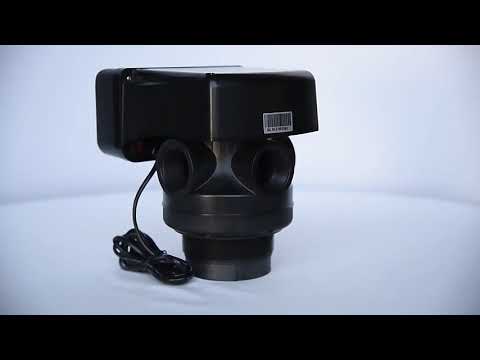
The Anatomy of a softener valve
A softener valve is a multi-port hydraulic controller that automates the six service phases of a resin bed. Each phase has a distinct role:
- Service — softened water flows to the plant; hardness leakage is monitored.
- Backwash — flow is reversed to lift the resin, releasing fines and suspended solids.
- Brine draw — sodium chloride solution moves down through the bed, displacing calcium and magnesium.
- Slow rinse — a controlled low-flow rinse drives displacement to completion.
- Fast rinse — a high-flow rinse purges residual brine before returning to service.
- Refill — the brine tank is topped up for the next regeneration.
The valve orchestrates these steps against a service meter, a time clock or, in more advanced designs, a hardness-triggered signal. Shanghai ChiMay’s softener valve platform ships with all three trigger modes, letting operators tune regeneration cadence to the actual feed rather than to a nameplate assumption.
Hydraulic Design for ZLD Duty
ZLD pretreatment brings three loads that ordinary softener valves rarely see:
- Continuous 24/7 operation with resin contact times often below eight minutes.
- Feed streams that already carry 3,000–15,000 mg/L TDS, so brine efficiency drops if hydraulics are not sharp.
- Downstream membranes running near solubility limits, so hardness leakage cannot be treated as a soft alarm.
The valve therefore has to hold its seat under pressure oscillation from downstream membrane skids, pass regeneration flow without cavitation, and keep leakage flow across seats measurable and controlled. Shanghai ChiMay’s field-hardened softener valve uses reinforced elastomer seats and a balanced piston geometry, which allows the valve to hold shut against 4–6 bar back-pressure without service creep.
Regeneration Efficiency and Salt Consumption
A ZLD plant that lives on grid utilities is watching every pound of salt into the softener because that same salt reappears as chloride load on the crystallizer. Regeneration efficiency — kilograms of hardness removed per kilogram of salt used — is therefore both an economic and a process-chemistry number.
Well-tuned counter-current regeneration typically lands between 3.5 and 4.5 kg NaCl per cubic metre of soft water at feed hardness of 250–350 mg/L as CaCO3. Softener valves that use metered brine draw and independent slow-rinse control preserve that band even as feed hardness swings, which is critical for a ZLD plant taking in variable process water.
Service-Cycle Counters and Predictive Maintenance
Modern ZLD control rooms want more than a valve position indicator. Shanghai ChiMay’s softener valve reports cumulative service cycles, cumulative brine cycles, and last-regeneration effluent hardness back to the plant historian. Those three signals feed a simple predictive-maintenance model that flags:
- Resin capacity loss (rising leakage between regenerations).
- Brine tank fouling (drifting brine concentration).
- Injector wear (falling brine draw efficiency).
The operational payoff is that pretreatment interventions get planned into scheduled outages, not into unscheduled RO membrane replacements.
Instrumentation Points Around the Valve
Even a well-engineered softener valve needs downstream signals to prove it is doing its job. The instrumentation package that Shanghai ChiMay recommends around each softener train looks like this:
- Hardness monitor on softened water — either a colorimetric analyser or an online ion-selective probe.
- Conductivity on softened water and on brine effluent, giving cross-checks on TDS transfer.
- Pressure transmitters across the softener train to catch bed compaction.
- Multi-parameter sensor at the downstream RO feed, aggregating pH, conductivity, temperature and ORP for a compact skid-edge view.
That instrumentation cluster, taken together, converts the softener from an isolated black box into a monitored pretreatment stage.
Common Failure Modes and How the Valve Absorbs Them
Field data from ZLD retrofits identifies four repeating failure modes:
- Brine tank fill-line fouling with iron or organics, which the valve absorbs through a dedicated refill port and a brine tank strainer.
- Regeneration crossing over into service (channelling), which the valve absorbs by isolating brine draw against a positive seat.
- Backwash under-flow when supply pressure drops, which the valve absorbs through flow-controlled backwash orifices.
- Resin fines discharge into downstream membranes, which the valve absorbs through a specified backwash duration and rise-velocity envelope.
Retrofit Checklist for the First ZLD Pretreatment Step
For a plant scoping its first ZLD retrofit, the softener valve deserves a specific checklist:
- Confirm valve seat pressure rating meets or exceeds worst-case downstream membrane head.
- Confirm service-flow envelope covers both minimum turndown and design flow with ≤0.5 bar loss.
- Confirm regeneration mode (meter, time, hardness) is supported natively without external logic.
- Confirm data outputs (Modbus / MQTT) integrate with the plant historian without proprietary gateways.
- Confirm spare parts are stocked locally for a 24-hour intervention.
Shanghai ChiMay’s softener valve family is scoped against this checklist as a matter of default engineering practice.
Closing Note
The ZLD industry is still learning that the softener valve is a load-bearing element of the process, not a commodity. As industrial water reuse targets rise into the 90%+ range, the pretreatment step is what makes the rest of the plant financially defensible. A softener valve chosen with these physics in mind — and instrumented as Shanghai ChiMay’s teams recommend — turns membrane life into a design parameter instead of a hope.