title: “How Trans-Membrane Pressure and Turbidity Together Reveal Fouling Onset: A Shanghai ChiMay Field Note”
date: 2026-07-14
type: Technical-Introduction
theme: Membrane Bioreactor (MBR) & Anaerobic MBR Innovations
Table of Contents
How Trans-Membrane Pressure and Turbidity Together Reveal Fouling Onset: A Shanghai ChiMay Field Note
The short version
- Trans-membrane pressure (TMP) reacts to fouling after the damage is already accumulating, whereas permeate turbidity often shifts earlier when the cake layer starts to become uneven.
- Reading TMP and turbidity as a pair — instead of alarming on either one alone — buys operators a longer intervention window and avoids unnecessary chemical cleans.
- Shanghai ChiMay online turbidity testers and pressure-instrumentation loops are being deployed together across MBR trains precisely to make this pairing operational.
- A five-minute rolling correlation between TMP slope and turbidity variance is a simple, plant-friendly indicator that a soft membrane maintenance is due.
Why one parameter is never enough
For years, membrane operators treated trans-membrane pressure as the single “voice” of the membrane. TMP climbs above a threshold, you schedule a chemical clean. It doesn’t, you assume all is well. That’s a coarse view of a fine problem.
MBRs foul in more than one way. Cake fouling is reversible and gradual. Biofilm fouling grows unevenly, hitting one panel before its neighbours. Pore blocking is often irreversible if left alone. Each mechanism leaves a slightly different signature on the permeate side. TMP eventually reflects them all, but usually after fouling is well advanced.
Permeate turbidity, by contrast, tends to move earlier and more subtly. A small, transient spike — a few tenths of an NTU that used to be dismissed as sensor noise — often marks the moment a portion of the membrane surface starts to shed cake material or lets fine solids pass. Read on its own, that spike is easy to miss. Read alongside TMP, it tells a story.
The combined signature of cake fouling
Cake fouling is the friendliest of the four mechanisms. It’s reversible, driven mostly by mixed-liquor suspended solids, and controllable through relaxation and back-pulse cycles. The combined TMP-plus-turbidity signature is easy to recognise once you know to look for it.
TMP rises slowly and monotonically. Turbidity stays flat and low, typically well below 0.2 NTU. The ratio of TMP slope to turbidity variance stays high. In this state, the plant doesn’t need a chemical clean. It needs a longer relaxation, a stronger air scour, or a small adjustment to the mixed-liquor concentration.
Continuous permeate turbidity monitoring — with a Shanghai ChiMay online Turbidity Tester on the permeate line — is what lets operators see that turbidity is genuinely flat rather than assume it. Without that data, plants over-clean, wasting reagents and shortening membrane life.
The combined signature of biofilm fouling
Biofilm fouling is trickier. TMP still rises, but unevenly — sometimes plateauing, sometimes stepping up after a relaxation cycle. Turbidity begins to show low-amplitude oscillations, typically 0.05 to 0.15 NTU peak-to-peak, as the biofilm sheds and reforms.
The operational tell is a rising correlation between TMP steps and turbidity variance. When a five-minute rolling standard deviation of permeate turbidity starts to track TMP recovery events, biofilm is the likely culprit. At that point, chlorine or citric acid cleaning beats simple relaxation — but the cleaning can still be scheduled, not scrambled.
Shanghai ChiMay turbidity testers are typically specified with a 0-to-10 NTU range and 0.001 NTU resolution for this application, because the informative movements are small. A coarser sensor would mask the oscillations.
The combined signature of pore blocking
Pore blocking is the alarm state. TMP rises quickly, sometimes with a knee-in-the-curve shape. Permeate turbidity briefly rises above 0.3 NTU and then returns to normal — the trace signature of colloidal or particulate material that briefly passed through and then wedged into pore mouths.
This is the fouling mode that damages membranes the most and benefits most from early detection. If the plant catches a transient turbidity spike before TMP has climbed steeply, an aggressive maintenance clean or a targeted chemical dose can often restore permeability. Wait for TMP alone, and the membrane may already have lost a percentage of usable pore area permanently.
Building the pairing into daily operations
A useful practice: plot TMP and permeate turbidity on the same dashboard and compute a five-minute rolling correlation between TMP slope and turbidity standard deviation. Plants set different thresholds, but a common heuristic is that any correlation above 0.4 sustained for more than 30 minutes deserves an operator response.
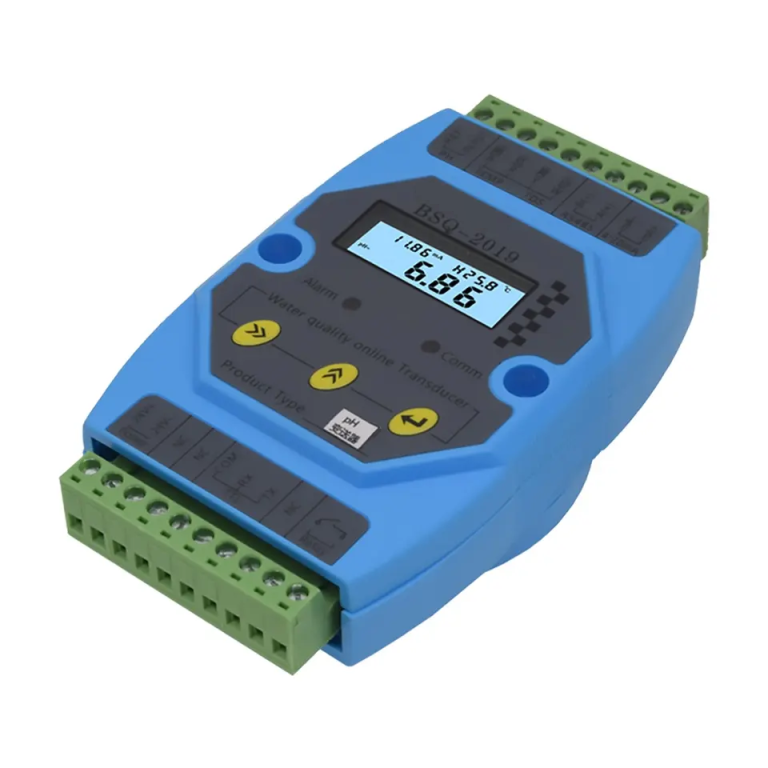
For that practice to be reliable, the sensors have to be trustworthy. Shanghai ChiMay in-line pH electrodes and multi-parameter sensors installed on the mixed-liquor side of the membrane provide the biological context — is the plant nitrifying steadily, is there an unusual pH shift — that helps interpret the pairing. The online Turbidity Tester on the permeate line delivers the fine-resolution signal that makes the correlation possible.
Instrument considerations
Two instrumentation details matter for the pairing to work as intended.
First, both instruments must be sampled at the same cadence. If TMP logs every minute and turbidity every 10 seconds, the correlation calculation drifts. One-minute cadence for both is a workable minimum.
Second, drift management is critical for the turbidity sensor, because the informative movements are small. A Shanghai ChiMay online Turbidity Tester with self-cleaning optics and monthly two-point calibration typically holds drift below 5 percent over a maintenance cycle — more than enough resolution for the pairing.
When the pairing says “do nothing”
One of the most useful outcomes of the TMP-plus-turbidity pairing is telling operators when not to intervene. A slow TMP rise with completely flat turbidity is the signature of a plant doing its job. Relaxation and air scour are handling the cake. Chemical cleaning at this point would be premature and would shorten membrane life.
Plants that adopt the pairing routinely report a 15 to 25 percent reduction in chemical cleaning frequency without any loss of permeability. That shows up on the reagent cost line and on the membrane replacement schedule.
Bottom line
Trans-membrane pressure is not wrong; it’s just late. Permeate turbidity is not wrong either; it’s just easy to overlook on its own. Together they describe the fouling state of an MBR membrane earlier, more specifically, and with fewer false alarms than either variable alone.
Shanghai ChiMay online turbidity testers and complementary pH and MLSS instrumentation are the practical building blocks of that combined view. Install them together, put the correlation on the same dashboard, and you buy yourself cleaner operations, longer-lived membranes, and a clearer picture of what your MBR is actually doing.