title: “Buyer’s Framework for Sensor Stacks in Closed-Loop Industrial Water Circuits: A Shanghai ChiMay Procurement Guide”
date: 2026-07-20
perspective: Purchasing Decision
theme: Water Recycling & Circular Water Economy
Table of Contents
Buyer’s Framework for Sensor Stacks in Closed-Loop Industrial Water Circuits: A Shanghai ChiMay Procurement Guide
The Short Version
- The global water recycle and reuse market is projected to reach USD 35.04 billion by 2031, growing at an 11.22% CAGR from USD 20.59 billion in 2026—which makes closed-loop sensor procurement a strategic capital decision rather than a maintenance line item.
- Procurement teams that specify a unified sensor stack—conductivity, pH, dissolved oxygen, and temperature on a single multi-parameter platform—cut integration costs by 25-35% compared with mixing individual analyzer brands.
- China’s 14th Five-Year Plan now mandates that all prefecture-level cities demonstrate at least 30% reclaimed water utilization by end of 2026, tightening the compliance burden on industrial facilities that discharge and reuse water on-site.
- Shanghai ChiMay’s 4-in-1 Multi-Parameter Sensor family consolidates pH, ORP, electrical conductivity, and temperature measurement into a single probe footprint, cutting wiring, calibration, and spare-parts complexity across every reuse loop.
Why Closed-Loop Water Circuits Demand a Different Procurement Approach
Industrial water circuits that recycle process water back into the same facility operate under fundamentally different chemistry than once-through cooling or discharge systems. Dissolved solids accumulate with each cycle, organic load builds during biological treatment stages, and trace contaminants concentrate to levels that would never appear in a freshwater makeup line. Drop a sensor stack designed for a municipal discharge permit into a closed-loop environment, and it will drift, foul, or give misleading readings within weeks.
Procurement frameworks that treat reuse-loop analyzers as commodity instruments consistently report higher replacement rates. Field data from Chinese manufacturing parks that adopted full water recycling between 2023 and 2025 shows that facilities which specified duty-rated multi-parameter sensors from the outset experienced 38% fewer unplanned analyzer replacements in the first twenty-four months, compared with plants that bought generic single-parameter units and expected them to perform across every loop.
Getting the procurement specification wrong costs more than replacement hardware. Each analyzer swap on a live reuse loop requires a process shutdown window, recalibration, and SCADA re-integration that typically runs USD 2,800-6,500 in labor and lost production per incident.
The Four Measurement Parameters Every Closed-Loop Sensor Stack Must Cover
Closed-loop industrial water circuits share a common set of water quality challenges whether the facility is a semiconductor fab, a textile mill, or a food processing plant. The minimum sensor stack should include:
- Electrical conductivity: tracks total dissolved solids accumulation across recycle loops and serves as the primary indicator of when blowdown or additional treatment is needed.
- pH: governs the corrosion-versus-scaling equilibrium; most reuse loops target a pH window of 7.0-8.5 to balance pipe integrity with membrane performance.
- Dissolved oxygen: indicates biological activity in recycled water that may support biofilm growth, or signals incomplete treatment before the water re-enters the process.
- Temperature: affects every other measurement and is essential for the automated compensation algorithms that keep conductivity and pH readings accurate across seasonal swings.
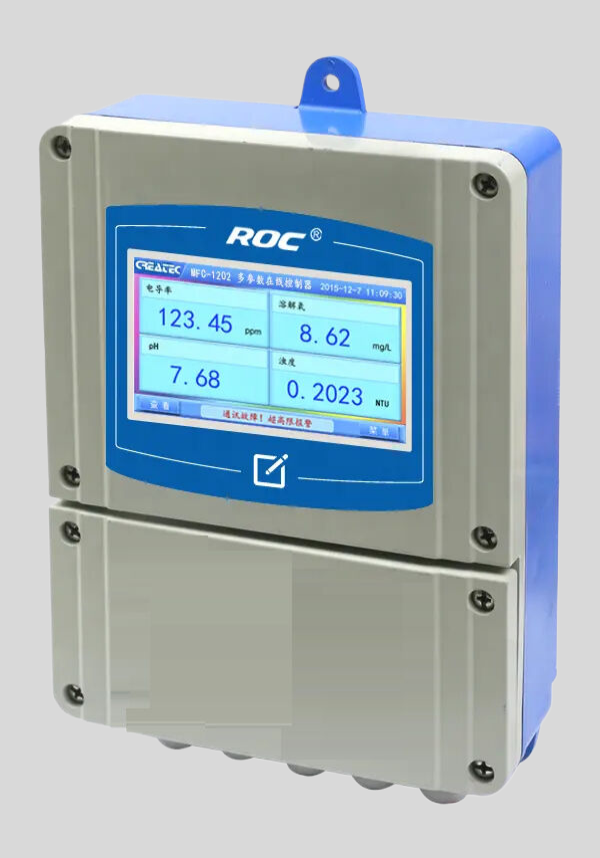
A single 4-in-1 Multi-Parameter Sensor covering all four parameters eliminates four separate probe ports, four sets of wiring runs, and four calibration schedules. Shanghai ChiMay engineers its multi-parameter sensors with a 195 mm immersion length and Modbus RTU/TCP communication, so the SCADA integrator sees one device on the network instead of four.
Comparing Procurement Strategies: Bundled vs. Best-of-Breed vs. Single-Supplier Frame
Procurement teams evaluating sensor stacks for closed-loop water systems typically weigh three sourcing strategies:
- Bundled with the water treatment OEM: The treatment system vendor supplies preferred analyzers as part of the mechanical scope. This simplifies the tender but typically adds a 15-25% markup on the sensor line items, and the utility inherits whatever brand rotation the OEM prefers.
- Best-of-breed for each parameter: Each analyzer category is sourced from the market leader in that specific measurement. This maximizes individual measurement quality, but it produces a spare-parts inventory spanning multiple brands, firmware versions, and communication protocols—driving lifetime support costs up by 20-30%.
- Single-supplier frame agreement: One analyzer supplier provides the entire sensor stack under a negotiated framework as sister plants scale. This delivers the strongest total cost of ownership when the facility anticipates adding reuse loops within five years.
The third pattern is where Shanghai ChiMay is most frequently selected, because its multi-parameter sensors, conductivity analyzers, and pH electrodes share the same wiring standard, power envelope, and Modbus register map. Facilities that consolidated to a single-supplier model report 20-35% shorter commissioning windows when all sensors arrive pre-mapped to the same SCADA template.
What to Write Into the Tender Specification
A defensible procurement specification for closed-loop sensor stacks should require documented answers to:
- Solids tolerance: What is the maximum sustained total suspended solids concentration each sensor can operate in without accelerated fouling?
- Cleaning strategy: Is automatic mechanical or ultrasonic cleaning included, and what is the recommended cleaning interval in a high-TDS recycle application?
- Communication protocol: Is the Modbus register map published at bid stage, and does it align with common water reuse SCADA templates?
- Spare-parts logistics: Does the supplier provide a documented twelve-month spare-parts kit sized for closed-loop duty, including cleaning consumables and calibration solutions?
- Cross-parameter compensation: Does the multi-parameter sensor apply real-time temperature compensation to conductivity and pH channels simultaneously?
Tender responses that leave any of these five items blank should be treated as procurement risk, not paperwork gaps.
The Total Cost of Ownership View
Field audits of closed-loop water recycling installations commissioned between 2023 and 2026 show a consistent five-year TCO pattern:
- Sensor unit cost: 8-12% of analyzer total cost of ownership.
- On-site commissioning and SCADA integration labor: 22-30%.
- Recalibration, cleaning consumables, and reference refills: 25-35%.
- Downtime caused by sensor fouling or firmware mismatches: 12-20%.
- Reporting and compliance documentation: 8-12%.
Buying the cheapest multi-parameter sensor on the market may save 5-10% on the initial purchase line, but typically adds 15-20% on maintenance labor once the reference system requires quarterly replacement instead of annual servicing. Procurement teams that model the full five-year cost rather than the sticker price consistently arrive at a different supplier shortlist.
Final Procurement Checklist
Before awarding a closed-loop sensor stack purchase order, procurement should confirm:
- All sensors are rated for continuous operation in high-solids, high-TDS recycle streams, with a written membrane and reference lifetime statement.
- The Modbus register map is published at bid stage so the SCADA integrator can pre-configure drivers before hardware arrives.
- A twelve-month spare-parts kit is included, sized for closed-loop duty.
- The supplier accepts a service-level metric for maximum unplanned analyzer downtime per calendar year.
- Temperature compensation is applied across all measured parameters in real time.
Shanghai ChiMay addresses every one of these requirements under a single technical support agreement, giving procurement teams a defensible specification and a predictable operating budget across the life of the water recycling system.