Table of Contents
The Importance of Understanding TDS Meter Specifications
Total Dissolved Solids (TDS) meters are essential tools for measuring the concentration of dissolved solids in water. They are commonly used in various industries, including agriculture, aquaculture, and water treatment. Understanding TDS Meter specifications is crucial for ensuring accurate and reliable measurements.
One of the most important specifications to consider when choosing a TDS Meter is the measurement range. TDS meters typically have a range of 0-9999 ppm (parts per million) or higher. It is essential to select a meter with a range that is suitable for the specific application. For example, if you are measuring TDS levels in drinking water, a meter with a range of 0-999 ppm may be sufficient. However, if you are testing the TDS levels in industrial wastewater, you may need a meter with a higher range.
Another critical specification to consider is the accuracy of the TDS Meter. Accuracy is typically expressed as a percentage of the full-scale reading. For example, a meter with an accuracy of \u00b12% means that the reading can be off by up to 2% of the full-scale value. It is essential to choose a TDS Meter with high accuracy to ensure precise measurements. Inaccurate readings can lead to incorrect conclusions and potentially harmful consequences.
Resolution is another important specification to consider when selecting a TDS Meter. Resolution refers to the smallest increment of measurement that the meter can detect. A meter with higher resolution can provide more detailed and precise measurements. For most applications, a resolution of 1 ppm is sufficient. However, in some cases, such as in research or laboratory settings, a higher resolution may be required.
Temperature compensation is a crucial feature of TDS meters, especially in applications where the temperature of the water can vary. Changes in temperature can affect the conductivity of water, which can lead to inaccurate TDS readings. A TDS Meter with temperature compensation can adjust the readings based on the water temperature, ensuring accurate results.
| FCT-8350 Flow Transmitter | |
| Measurement range | Instantaneous flow:(0~2000)m3/h;Accumulated flow:(0~99999999)m3 |
| Flow rate | (0~5)m/s |
| Applicable pipe diameter | DN 25~DN 1000 for selection |
| Resolution | 0.001 m3/h |
| Renew interval | 1S |
| Accuracy | 2.0 level |
| Repeatability | \u00b10.5% |
| Probe input | Range :0.5Hz~2KHz;Power supply:DC 12V(instrument supply) |
| Analog output | (4~20)mA,Instrument/transmitter for selection; |
| Control output | Semi-conductor photo electronic relay,Load current 50mA(max),AC/DC 30V |
| Control mode | Instantaneous flow high/low limit alarm, flow variable frequency conversion |
| Working power | DC24V |
| Power consumption: | <3.0W |
| Cable length | 5m as standard ; or(1~500)m for selection |
| Working environment | Temp.:(0~50)\u2103;relative humidity\u226485%RH(non condensation) |
| Storage environment | Temp.:(-20~60)\u2103; relative humidity:\u226485%RH(non condensation) |
| Protection level | IP65(with back cover) |
| Dimension | 96 mm\u00d796 mm\u00d794mm (H\u00d7W\u00d7D) |
| Hole size | 91mm\u00d791mm(H\u00d7W) |
| Installation | Panel mounted,fast installation |
Calibration is another essential aspect of TDS Meter specifications. Regular calibration is necessary to maintain the accuracy of the meter. Most TDS meters come with calibration solutions that allow users to calibrate the meter easily. It is essential to follow the manufacturer’s instructions for calibration to ensure accurate and reliable measurements.
The build quality of the TDS Meter is also an important consideration. A durable and reliable meter is essential for long-term use. Look for meters made from high-quality materials that can withstand harsh conditions. Waterproof and dustproof meters are ideal for outdoor and industrial applications.
In conclusion, understanding TDS Meter specifications is crucial for ensuring accurate and reliable measurements. By considering factors such as measurement range, accuracy, resolution, temperature compensation, calibration, and build quality, you can select the right TDS Meter for your specific application. Investing in a high-quality TDS Meter will help you obtain precise TDS readings and make informed decisions based on the results.
How to Choose the Right TDS Meter for Your Needs
When it comes to measuring the total dissolved solids (TDS) in water, having the right TDS Meter is essential. TDS meters are used in a variety of industries, including agriculture, aquaculture, and water treatment, to ensure that water quality meets certain standards. With so many options available on the market, it can be overwhelming to choose the right TDS Meter for your specific needs. In this article, we will discuss the specifications to consider when selecting a TDS Meter to ensure accurate and reliable measurements.
One of the most important specifications to consider when choosing a TDS Meter is the measurement range. TDS meters typically measure the concentration of dissolved solids in parts per million (ppm) or milligrams per liter (mg/L). It is important to select a TDS Meter with a measurement range that is appropriate for the water quality you are testing. For example, if you are testing drinking water, a TDS Meter with a range of 0-999 ppm may be sufficient. However, if you are testing industrial wastewater, you may need a TDS Meter with a range of 0-9999 ppm or higher.
Another important specification to consider is the accuracy of the TDS Meter. The accuracy of a TDS Meter is typically expressed as a percentage of the full scale reading. For example, a TDS Meter with an accuracy of \u00b12% would have a margin of error of plus or minus 2% of the reading. It is important to choose a TDS Meter with a high level of accuracy to ensure that your measurements are reliable and consistent.
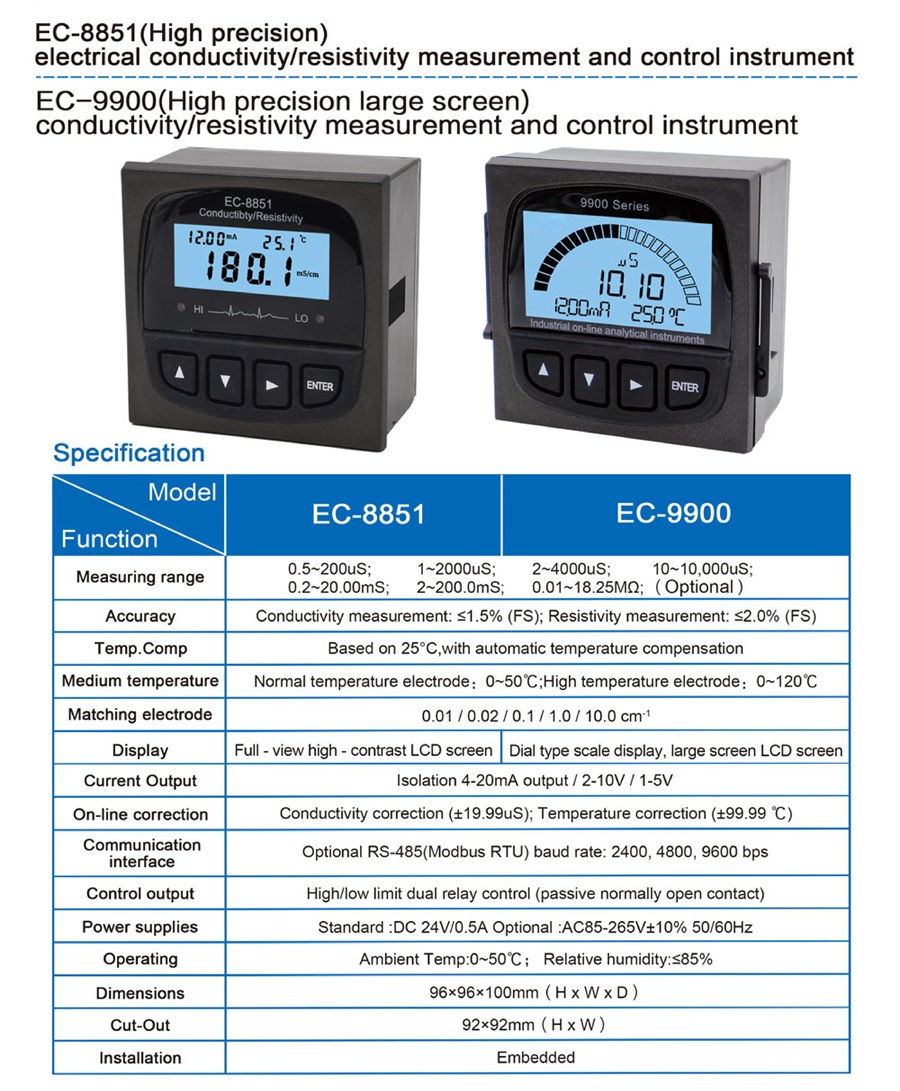
In addition to accuracy, the resolution of the TDS Meter is also an important specification to consider. Resolution refers to the smallest increment of measurement that the TDS Meter can detect. A TDS Meter with a higher resolution will be able to detect smaller changes in TDS levels, providing more precise measurements. It is important to choose a TDS Meter with a resolution that is appropriate for the level of detail you require in your measurements.
The temperature compensation range of the TDS Meter is another important specification to consider. TDS meters are sensitive to changes in temperature, which can affect the accuracy of the measurements. A TDS Meter with a wide temperature compensation range will be able to provide accurate measurements across a range of temperatures. It is important to choose a TDS Meter with temperature compensation to ensure that your measurements are not affected by fluctuations in temperature.
Finally, the durability and reliability of the TDS Meter are important considerations when choosing a TDS Meter. TDS meters are often used in harsh environments, such as wastewater treatment plants or agricultural fields, where they may be exposed to water, chemicals, and other contaminants. It is important to choose a TDS Meter that is rugged and waterproof to withstand these conditions. Additionally, selecting a TDS Meter from a reputable manufacturer with a history of producing high-quality products can help ensure that your TDS Meter will provide accurate and reliable measurements for years to come.
In conclusion, choosing the right TDS Meter for your needs requires careful consideration of a variety of specifications, including measurement range, accuracy, resolution, temperature compensation range, and durability. By selecting a TDS Meter that meets your specific requirements, you can ensure that your measurements are accurate, reliable, and consistent. Whether you are testing drinking water, industrial wastewater, or agricultural runoff, having the right TDS Meter is essential for maintaining water quality and ensuring the success of your operations.