- Endocrine-disrupting compounds (EDCs) are a broad class covering BPA, phthalates, PCBs, and several pesticides, detected in water at nanogram-per-litre concentrations
- Conductivity cannot detect EDCs. It serves two genuine purposes: verifying the purity of reagent water for trace analysis, and flagging when something unusual is entering a system
- Ultrapure water systems for trace EDC work are specified at <0.055 μS/cm (18.2 MΩ·cm at 25°C)
- Inline conductivity meters provide the continuous record that a screened, risk-based sampling programme needs
- Treat conductivity as a screening signal that decides when to spend money on laboratory analysis, not as a measurement of EDCs
Table of Contents
Introduction: Endocrine Disruptors as Critical Water Quality Concerns
Endocrine-disrupting compounds are a significant category of emerging contaminants. The group includes bisphenol A (BPA), phthalates, polychlorinated biphenyls (PCBs), and various pesticides — chemically diverse substances that share the ability to interfere with hormonal systems in humans and wildlife at very low concentrations, in the nanograms-per-litre range. Their detection in surface water, groundwater, and treated effluent has been documented in a large body of monitoring literature.
Laboratory analysis of EDCs requires ultrapure water with very low ionic content to prevent interference in the analytical instrument. Conductivity measurement has two roles in that workflow: verifying the quality of the reagent water, and providing a proxy signal for tracking where contamination in an environmental system is coming from.
Ultrapure Water Requirements for EDC Analysis
Water Quality Standards for Trace Analysis
Trace analysis of EDCs by LC-MS/MS requires reagent water with very low ionic content. EPA Method 539.1, which covers pharmaceuticals and personal care products in drinking water, is a representative LC-MS/MS method whose reagent water requirements are typical of the genre. The specifications a laboratory generally works to are:
- Resistivity >18.2 MΩ·cm at 25°C (equivalent to <0.055 μS/cm conductivity)
- Total organic carbon (TOC) below a few μg/L
- Particles (>0.2 μm) below 1 particle/mL
- Bacteria below 1 CFU/mL
- Low endotoxin content
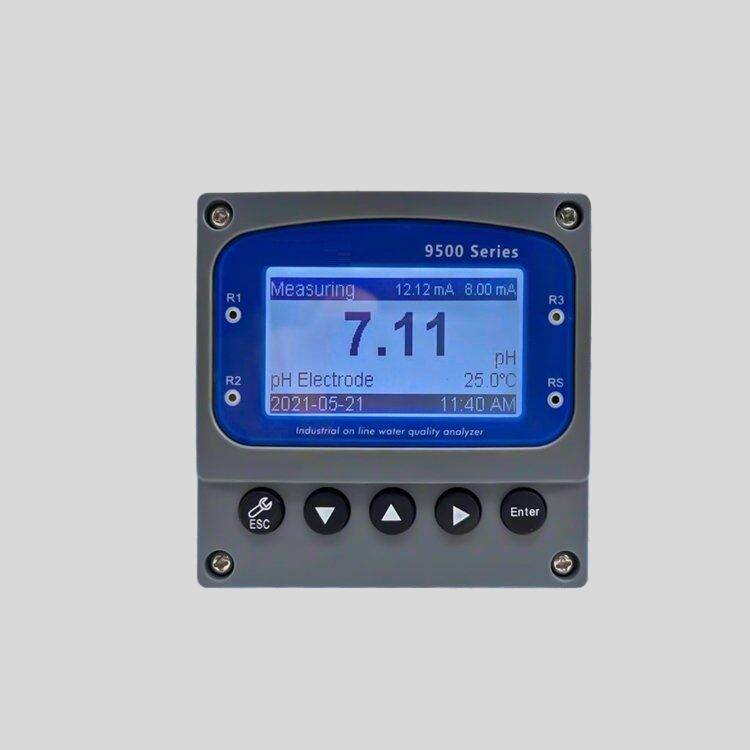
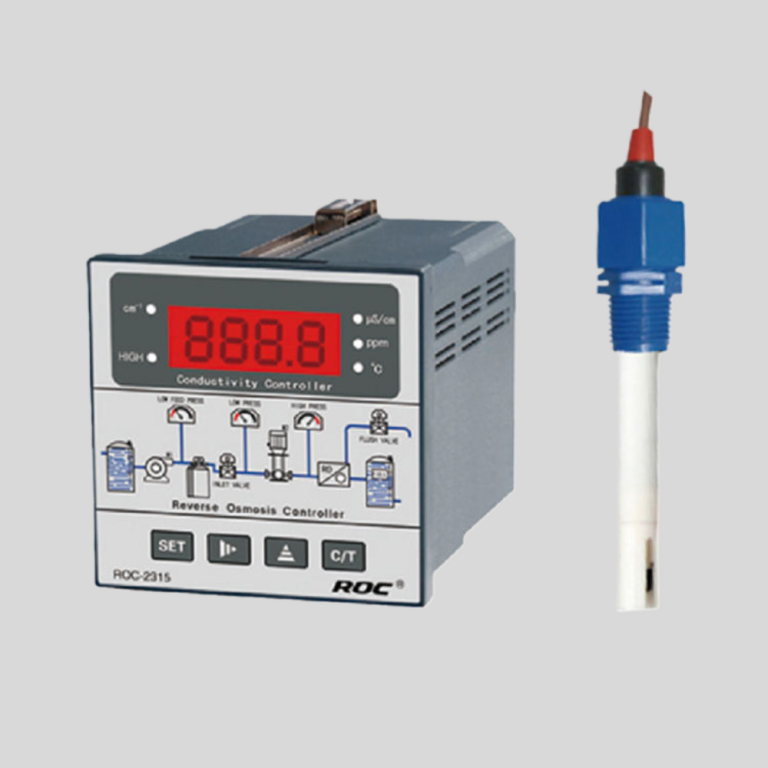
ChiMay 2-in-1 mini transmitters combine conductivity and temperature measurement with 0.5% accuracy, giving continuous resistivity monitoring that verifies ultrapure water system performance, alarm outputs that trigger regeneration when conductivity exceeds 0.1 μS/cm, and data logging for documentation meeting 21 CFR Part 11 requirements.
Conductivity as a Water Quality Indicator
Conductivity is a fast screening tool for water quality:
| Conductivity (μS/cm) | Water Classification | EDC Analysis Suitability |
|---|---|---|
| <0.1 | Ultrapure for laboratory | Fully suitable |
| 0.1-1.0 | High-purity for analysis | Suitable with verification |
| 1.0-10 | Purified for general use | Requires additional treatment |
| 10-100 | Treated municipal water | Not suitable for trace analysis |
| >100 | Raw surface or groundwater | Requires full deionization |
The reason this table matters is that reagent water contamination is a leading source of analytical error in trace organic work, and it is the easiest source to control. A conductivity excursion on a laboratory water system is a signal to stop and fix the water before running the batch.
Inline Conductivity Monitoring for Environmental Systems
Municipal Water Distribution Monitoring
Conductivity in a distribution network responds to whatever enters the network — municipal source changes, industrial discharges, seawater intrusion in coastal systems, and road salt in winter. It does not respond to EDCs specifically. What it does provide is a cheap, continuous, high-frequency signal for detecting that something unusual has entered the system, which is the point at which targeted laboratory analysis is worth commissioning.
In practice, a utility would deploy conductivity at critical nodes in the distribution network and transmit the data to SCADA at whatever interval the telemetry supports. The analytical value comes from the pattern — a sustained shift from the site’s own baseline is meaningful; a spike that lasts one sample interval usually is not.
Wastewater Treatment Plant Monitoring
In wastewater treatment, conductivity tracks the ionic load through the treatment train. It gives a useful indication of how far treatment has progressed — primary clarification removes little ionic content, biological treatment removes more as nutrients and ions are taken up, and advanced oxidation or membrane stages change the conductivity profile further.
The relationship between conductivity and EDC removal is indirect. EDC removal efficiency rises as treatment intensity increases: conventional primary treatment removes a modest fraction; biological treatment removes substantially more; and advanced oxidation or reverse osmosis removes far more. That ordering is well established in the literature. Conductivity helps you confirm that each stage is operating as designed, but it does not tell you the EDC concentration.
Sensor Technologies and Selection Criteria
Conductivity Measurement Principles
Two sensor families cover most applications:
Contacting (electrode-type) sensors use an applied voltage between electrode pairs, with cell constants from 0.1 to 100 cm⁻¹ depending on range. They offer high accuracy with automatic temperature compensation in the region of ±0.5%, and need electrode cleaning on a schedule determined by the water quality — typically every 30 to 90 days in dirty service, longer in clean water.
Toroidal (inductive) sensors use electromagnetic induction with no electrode contact. They are essentially immune to fouling, tolerate aggressive solutions, and are the practical choice for industrial wastewater and slurries, at the cost of some accuracy at low conductivity.
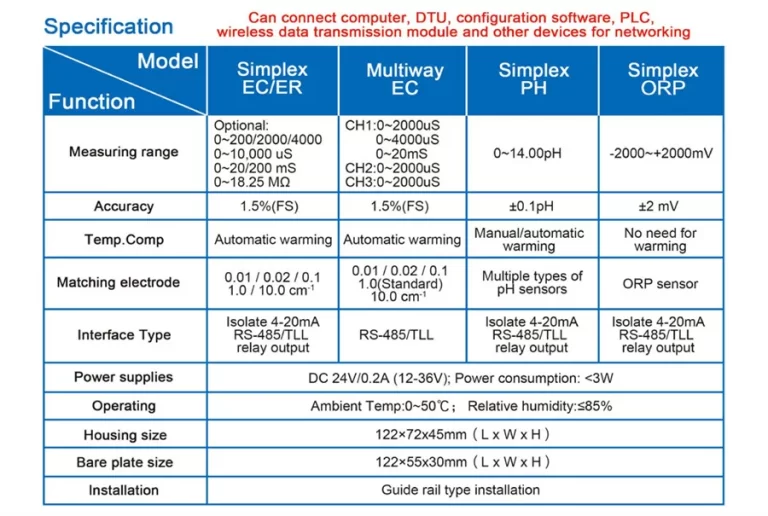
ChiMay inline conductivity meters offer both technologies with 0.5% full-scale accuracy — electrode-type sensors for laboratory and municipal applications, toroidal sensors for industrial wastewater and harsh environments, and multi-range capability covering from 0-2,000 μS/cm up to 0-200 mS/cm.
Applications in Specific EDC Monitoring Programmes
Bisphenol A (BPA) Monitoring
BPA enters water from plastics manufacturing, epoxy resin production, and landfill leachate. A monitoring programme for BPA in a river basin is built on grab samples analysed by LC-MS/MS, with a sampling design that targets the industrial discharges and combined sewer overflows that dominate loading. Conductivity added to the programme serves a specific purpose: it tells the operator when a discharge event is underway, so the sample is taken during the event rather than a day later. That timing effect is where most of the value is, because BPA concentrations in rivers are highly event-driven.
Agricultural Runoff Monitoring
Several pesticides act as endocrine disruptors, and their entry into water is dominated by runoff events. Conductivity in agricultural drainage responds to fertilizer application and to shifts in the dominant flow path — surface runoff versus tile drainage — which gives an indication of which compounds are likely to be present. The pesticide concentration itself has to come from laboratory analysis, and the loading is dominated by the first significant runoff event after application. Sensor-triggered sampling is what turns that knowledge into a usable dataset.
Economic Analysis and ROI
The cost structure of a conductivity-based screening network is dominated by installation and telemetry rather than by the sensors themselves:
- Capital: sensors, dataloggers, telemetry, and enclosure. Installation labour usually exceeds hardware cost in retrofit situations.
- Operating: site visits, calibration standards, battery or power, and communications.
The benefits are in sampling efficiency rather than contamination detection. A network that tells you when an event is happening lets you collect targeted samples instead of routine scheduled ones, which reduces laboratory cost while improving the load estimate. Additional benefits come from using the same data for treatment process control — real-time conductivity is directly useful for chemical dosing optimisation, and that saving does not depend on any EDC application at all. Avoided violation costs are the biggest potential benefit and the hardest to attribute to any single sensor.
Closing Notes: Conductivity as Monitoring Infrastructure
Conductivity measurement supports endocrine-disruptor monitoring programmes in two concrete ways: it verifies the quality of the ultrapure water that trace analysis depends on, and it provides a continuous screening signal that tells a program when to spend money on laboratory analysis.
What conductivity does not do is measure EDCs. Any programme that claims otherwise is overstating the technology.
ChiMay conductivity meters provide the accuracy, reliability, and integration capability required for both laboratory and field applications. For organisations monitoring endocrine disruptors in water systems, conductivity measurement is a practical and cost-effective part of the monitoring infrastructure — as a screening and quality-assurance tool alongside the analytical chemistry that does the actual detection.