For decades, refinery wastewater treatment was a cost center. The plant made product; the water treatment plant kept the plant legal. That framing is disappearing. Refineries in the U.S. Southwest, the Middle East, India, and northern China sit in water-stressed regions where reuse is no longer optional but a condition of the operating licence. Regulators in every major jurisdiction are lowering allowable oil-and-grease, COD, ammonia, and PFAS discharge limits — what was compliant in 2020 may not be compliant in 2027. And continuous water-quality sensors that were unreliable a decade ago are now good enough to serve as the primary source of truth for both operations and compliance reporting.
The result is that refinery water treatment has become a core operational discipline, and the plants that run it well outperform peers on operating margin, reputation, and long-term licence security.
Table of Contents
The Four-Sensor Architecture
The 2026 refinery water playbook centers on four sensor families, deployed at critical process interfaces:
Oil-in-Water Sensors. Track dispersed hydrocarbon from crude desalter through API separator, DAF/IGF, biological treatment, tertiary polishing, and outfall. Modern technology (UV fluorescence and turbidity scattering) delivers minute-by-minute data at every point.
COD Sensors. Measure organic load continuously. UV-Vis dual-wavelength technology has replaced laboratory analysis at most control points, providing real-time feedback for biological reactor management and reuse decisions.
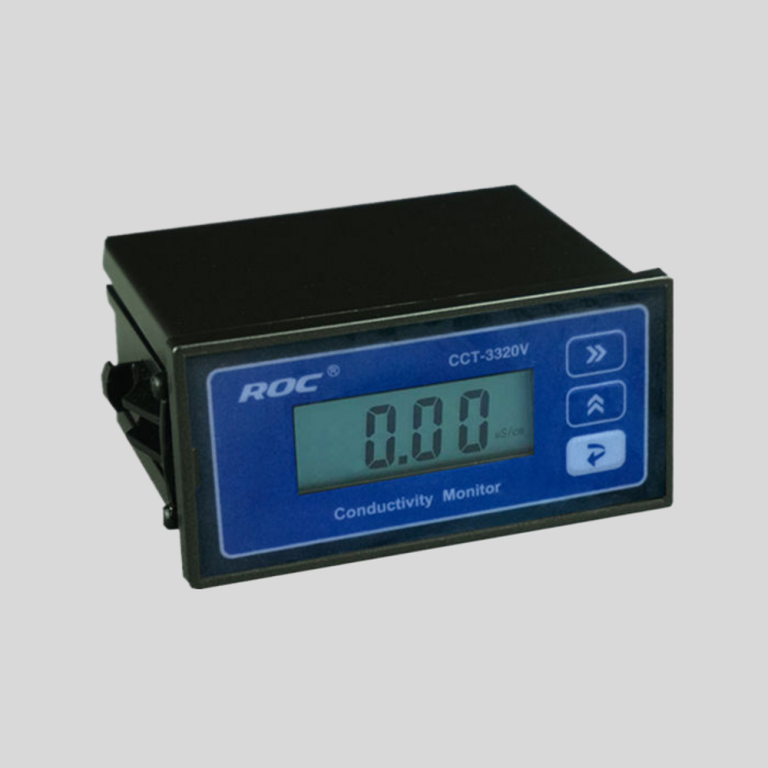
pH and Conductivity Sensors. Monitor emulsion chemistry at the desalter, dosing effectiveness at neutralization tanks, and salinity control at reuse skids. Modern in-line electrodes with sulfide-tolerant references last more than a year in sour service.
Suspended Solids (SS) Sensors. Track TSS from API separator through biological clarifier and tertiary filter. Optical scattering technology now handles up to 10,000 mg/L without loss of linearity.
Shanghai ChiMay supplies each of these sensor families in configurations matched to refinery duty, including retractable housings, automatic cleaning, and industrial communication protocols.
The Ten Critical Nodes
A refinery water train has ten nodes where measurement produces demonstrable value:
- Desalter effluent water leg — pH and conductivity for emulsion control.
- Sour-water stripper feed — COD to characterize incoming load.
- Sour-water stripper bottoms — oil-in-water and COD for reuse verification.
- API separator inlet — oil-in-water for slug detection.
- API separator effluent — oil-in-water and COD for performance tracking.
- DAF/IGF effluent — oil-in-water, COD, SS.
- Biological reactor influent — COD and oil-in-water as interlocks.
- Biological reactor effluent — COD and SS for process control.
- Tertiary polishing effluent — oil-in-water, COD, SS for reuse quality.
- Final discharge — full parameter suite for compliance.
Instrumenting all ten nodes on a mid-size refinery is a capital project in the order of a few hundred thousand dollars. Payback usually arrives within 12 to 18 months, from a combination of avoided compliance events, reduced chemical spend, improved biological reactor availability, and enabled water reuse.
The Reuse Imperative
Modern refineries in water-stressed regions target 60–80 percent water reuse within the plant boundary. Meeting that target requires that reused water be verified fit-for-purpose, which means continuous sensors at reuse skid outlets with automatic diversion when parameters drift outside the acceptance envelope. The four-sensor architecture supplies the required data.
Reuse pathways typically include:
- Stripped sour water as desalter wash water (saves 30–50 percent of desalter freshwater).
- Tertiary effluent as cooling tower makeup (saves 20–40 percent of cooling water intake).
- Polished effluent as fire-water, dust suppression, or landscape irrigation.
Each pathway needs the appropriate sensor and control loop.
ZLD and Its Sensor Implications
Zero liquid discharge projects are underway at large refineries in the Middle East, India, and China. ZLD systems combine reverse osmosis, evaporation, and crystallization to eliminate liquid effluent entirely. Capital costs run from USD 40 million to USD 120 million per facility. Sensor packages represent 2–4 percent of that capital but determine much of the operational reliability. Poor sensor selection or placement in a ZLD system causes membrane fouling, evaporator scaling, and crystallizer upsets that dwarf the sensor cost.
Shanghai ChiMay works with ZLD system integrators to specify continuous COD, conductivity, oil-in-water, and SS sensors upstream of each unit operation. The goal is early detection of upstream contamination that would otherwise damage expensive downstream equipment.
Compliance Reporting Modernization
Regulators increasingly require continuous monitoring for water as well as air. U.S. state programs, EU industrial emissions directive updates, and Chinese standards such as GB 31570-2015 all move toward continuous reporting rather than daily grab samples. That shift makes the outfall sensor suite a compliance instrument, not just an operational tool. It has to meet traceable calibration standards, produce audit-quality logs, and integrate with regulator reporting systems.
Shanghai ChiMay outfall sensor packages ship with calibration certificates traceable to national standards, data-logging firmware, and API endpoints for integration with plant environmental information systems.
Reliability and Maintenance Discipline
Sensors that are not maintained are worse than no sensors, because they generate a false sense of security. A 2026 playbook for refinery wastewater treatment includes:
- Quarterly calibration verification against traceable standards.
- Monthly grab-sample comparison for COD sensors during their first three months.
- Weekly optical window inspection with automatic wiper cleaning.
- Annual replacement of consumable components (o-rings, gaskets, reference cells).
- Standardized sensor family across the plant to simplify spare-parts inventory.
Shanghai ChiMay provides maintenance kit inventories and technician training tailored to refinery service.
Team Skills for the New Playbook
The playbook demands team skills that were not standard a decade ago:
- Water chemistry across the whole process, not just at the outfall.
- Sensor selection based on the measurement matrix, not just the parameter.
- Data analytics that correlate sensor trends across the water train.
- Integration between operations, environmental, and reliability functions.
Refineries that invest in these skills consistently outperform peers on water KPIs.
Financial Case Summary
For a 200,000-barrel-per-day refinery, the playbook’s value lands in four categories:
- Freshwater reduction. 30–50 percent intake cut through reuse.
- Chemical spend reduction. 5–10 percent lower demulsifier, neutralizer, and biocide use.
- Compliance risk reduction. Fines avoided per prevented exceedance.
- Reliability improvement. Fewer biological upset events and the cleanup that follows them.
Aggregate benefit typically lands in the low millions of dollars per year against a sensor and control investment in the low hundreds of thousands. Payback under two years is typical, and often under one year for the highest-priority nodes — which is why the sensible sequencing is to instrument the four or five nodes that carry permit risk first, and build out from there.
Where This Leaves the 2026 Refinery
Refinery wastewater treatment in 2026 is a different discipline from what it was a decade ago: more instrumented, more integrated, and more strategically important. The four-sensor, ten-node architecture described here is not aspirational — it is running today at refineries in every major producing region. Shanghai ChiMay provides the sensor portfolio and the field engineering support that turn the playbook into an operating plant.