Water quality failures in a pharmaceutical plant are expensive in a way that is easy to underestimate: product rejected, batches investigated, and the water system itself pulled into the scope of a regulatory inspection. The compliance programme that prevents this is not complicated, but it has to be complete — qualification, monitoring, calibration, maintenance and documentation all have to hold together.
Table of Contents
Understanding the Regulatory Framework
Who Regulates Pharmaceutical Water?
Pharmaceutical water sits under several sets of requirements at once:
- FDA: GMP requirements in 21 CFR Parts 210–211 for products on the US market
- USP: the pharmacopeial specifications, principally USP <1231> for water for pharmaceutical purposes, <643> for total organic carbon and <645> for conductivity
- EMA / EU: EU GMP, including Annex 1 for sterile products (revised version applicable from 25 August 2023) and Annex 15 for qualification and validation
- WHO: guidance used for prequalification and for markets that adopt it
Water system deficiencies recur in FDA Form 483 observations and warning letters, usually as inadequate monitoring, missing calibration records, or failure to investigate excursions — not as a single percentage of all observations. The practical reading is that inspectors look closely at water systems on most inspections, so the documentation has to be inspectable at any time rather than assembled for the occasion.
What Regulations Require
GMP requirements for water systems are consistently about four things:
- Appropriate materials of construction
- Adequate pretreatment and purification
- Continuous monitoring capability
- Written procedures and complete records
Building Your Compliance Foundation
Water System Qualification
Qualification follows the standard sequence, and each stage has a specific output:
Design Qualification (DQ): documented evidence that the design meets the user requirement specification — water quality specification, treatment technology, materials, instrumentation and sampling points.
Installation Qualification (IQ): the system is built and installed as designed — materials certificates, weld and slope documentation, instrument calibration certificates, P&ID verification against the as-built installation.
Operational Qualification (OQ): the system operates as intended across its operating range — alarm and interlock testing, verification of monitoring functions, challenge of control setpoints.
Performance Qualification (PQ): demonstrated consistent production of compliant water. PW and WFI systems are conventionally qualified over three consecutive phases, each of several weeks, with daily sampling covering every point of use across the phase.
Critical Control Points
Feed Water Treatment
A typical purification train for pharmaceutical water:
- Multimedia filtration for suspended solids
- Softening for hardness reduction
- Activated carbon for chlorine and organics removal (also protecting downstream RO membranes)
- Reverse osmosis for the bulk of the ionic load
- Electrodeionization as final ionic polishing
- UV at 254 nm for microbial control and TOC reduction
Pretreatment is where most water system problems originate. Chlorine breakthrough to the RO, hardness slippage from the softener and carbon bed exhaustion all show up as downstream excursions, so these stages deserve their own monitoring rather than only periodic laboratory checks.
Distribution System Control
| Parameter | Typical specification | Purpose |
|---|---|---|
| Velocity | ≥1 m/s in recirculating loops (1.5 m/s is a common engineering specification) | Prevents particle settling and biofilm support |
| Temperature | WFI loops commonly held at 80 °C or above; hot PW sanitisation typically 80 °C+ | Inhibits microbial growth |
| Pressure | Positive at all points | Prevents ingress |
| Sanitisation | Defined frequency and validated cycle | Maintains microbial control |
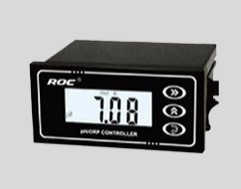
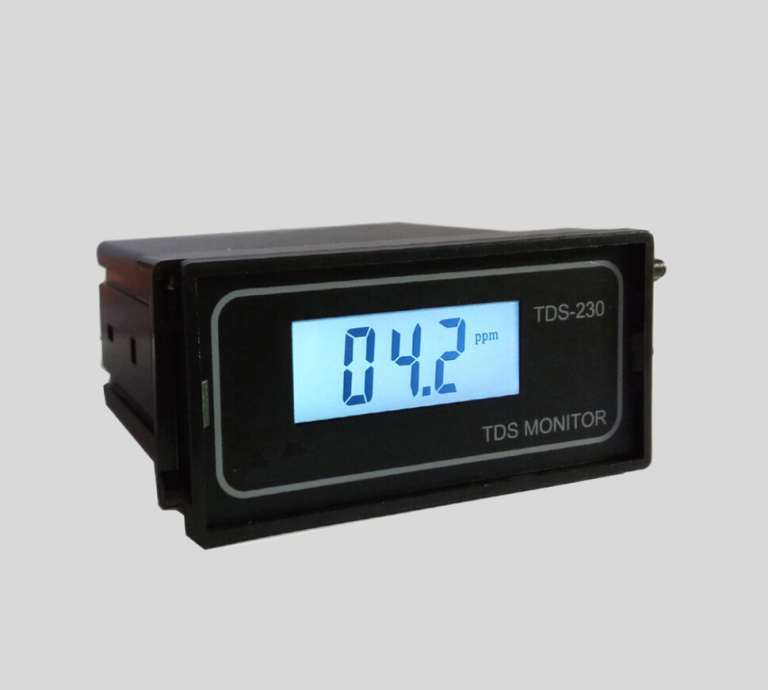
Shanghai ChiMay multi-parameter sensors support distribution monitoring with placement at the storage tank, the loop return and critical points of use — the three locations that show whether the loop is behaving.
Sensor Selection and Calibration
Choosing Compliant Monitoring Equipment
For pharmaceutical service, the essential characteristics are:
- Sanitary design: 316L stainless steel, surface finish Ra ≤ 0.8 μm, crevice-free connections
- Accuracy: adequate to the specification limit, with margin for measurement uncertainty
- Stability: performance that holds over the deployment interval without drift-driven false alarms
- Calibration: NIST-traceable standards and documented procedures
- Documentation: IQ/OQ/PQ support and material certificates
Specification margin matters. A conductivity sensor chosen to match the 1.3 µS/cm USP <645> limit exactly leaves no room for measurement uncertainty; the sensor has to be much better than the limit it is checking.
Calibration Program Design
Calibration frequency should follow sensor stability data rather than a fixed rule: frequent verification initially, then adjust based on observed drift. A workable default is weekly verification at the start of operation, moving to monthly verification and quarterly full calibration once stability is demonstrated.
Calibration records must identify the instrument, the standard used, the measured values, the person performing the work and the date. Electronic records make this considerably easier to keep complete.
Microbial Control Strategies
Understanding Microbial Risks
Microbial contamination in a pharmaceutical water system leads to product contamination, endotoxin excursions from gram-negative organisms, batch rejection, and in serious cases recall and regulatory action. Water systems are one of the few places in a facility where contamination can reach every product manufactured.
Preventing Microbial Proliferation
Design-based prevention:
- Smooth internal surfaces (Ra ≤ 0.8 μm)
- Continuous recirculation at adequate velocity
- Elimination of dead legs and low-flow branches
- Validated heat sanitisation capability
Monitoring-based assurance:
- Routine sampling at points of use on a defined schedule
- Rapid microbial methods, where validated, to shorten the feedback loop
- Trend analysis on microbial and endotoxin results so that adverse movement is seen before an excursion occurs
Maintaining Ongoing Compliance
Routine Operations
Daily: review monitoring data against limits; confirm sanitisation operation; check filter differential pressures; document parameters.
Weekly: system inspection, sampling at critical points, review of calibration verification results.
Monthly: full calibration, performance trending, SOP compliance audit.
Change Control
Any change to a validated water system goes through formal change control: describe the change, assess its impact on the validated state, obtain QA authorisation, implement, then demonstrate that the system remains suitable. The last step — proving the system is still in control after the change — is the one most often skipped.
Conclusion
Pharmaceutical water compliance comes down to four things working at once: a qualified system, monitoring equipment that is demonstrably fit for the specification limits, a calibration programme based on actual sensor behaviour, and records that can be reconstructed years later. None of these is difficult on its own. Getting all four to hold simultaneously, year after year, is the actual work — and it is what keeps the water system out of inspection findings.
Shanghai ChiMay’s water quality monitoring range, with its documentation packages, is built to support each of those four elements.