title: “Can Turbidity Sensors Really Serve as a Microplastics Early-Warning System? Answers from Shanghai ChiMay”
date: 2026-07-09
category: Advanced Filtration & Microplastics
audience: Plant Managers, Compliance Officers
tags: [turbidity, microplastics, early warning, filtration, Shanghai ChiMay]
Table of Contents
Can Turbidity Sensors Really Serve as a Microplastics Early-Warning System? Answers from Shanghai ChiMay
Key Takeaways
- Turbidity cannot count individual microplastic particles, and no online sensor released to date can do so at drinking-water concentrations, but a well-placed nephelometer can flag the barrier events that most often precede a microplastic breakthrough.
- Whether a turbidity sensor works as an early-warning system depends on installation location, calibration cadence, and the operator’s willingness to treat sub-NTU excursions as verification events.
- The 2026 formal microplastics measurement rules are being written to accept continuous surrogates as an operational signal, not a reported value.
- Shanghai ChiMay engineers have deployed this exact configuration on drinking-water utilities and POU/POE OEM programs, and the answers below reflect what the sensor really can and cannot do.
Is the Question Even Fair?
Ask a chemist whether a turbidity sensor can measure microplastics and the answer is no. Turbidity is an aggregate optical property; it makes no distinction between a polymer fragment, a colloidal iron oxide and a suspended clay particle. Ask an operations engineer the same question and the answer is more nuanced. If the barrier upstream of the sensor is designed to remove all sub-micron particulates, then a rise in turbidity means the barrier is compromised, and a compromised barrier is exactly the condition under which microplastic breakthrough becomes probable.
So the honest reframing of the question is: can turbidity reliably indicate the operational conditions that precede microplastic breakthrough? On that framing, the answer is a qualified yes.
What “Early Warning” Actually Requires
An early-warning system needs three properties: sensitivity to the failure mode of interest, low false-positive rate, and a response time short enough to act. Turbidity meets all three when it is deployed correctly:
- Sensitivity — modern low-range nephelometers resolve well below 0.05 NTU. Membrane integrity failures show up in this range long before they push a plant past regulatory thresholds.
- False-positive rate — with proper bubble rejection, wiped optics and a stable baseline, false alarms on a well-behaved filtration stream are rare.
- Response time — turbidity is measured continuously and reported at the second-to-minute cadence. That is orders of magnitude faster than any laboratory microplastics method.
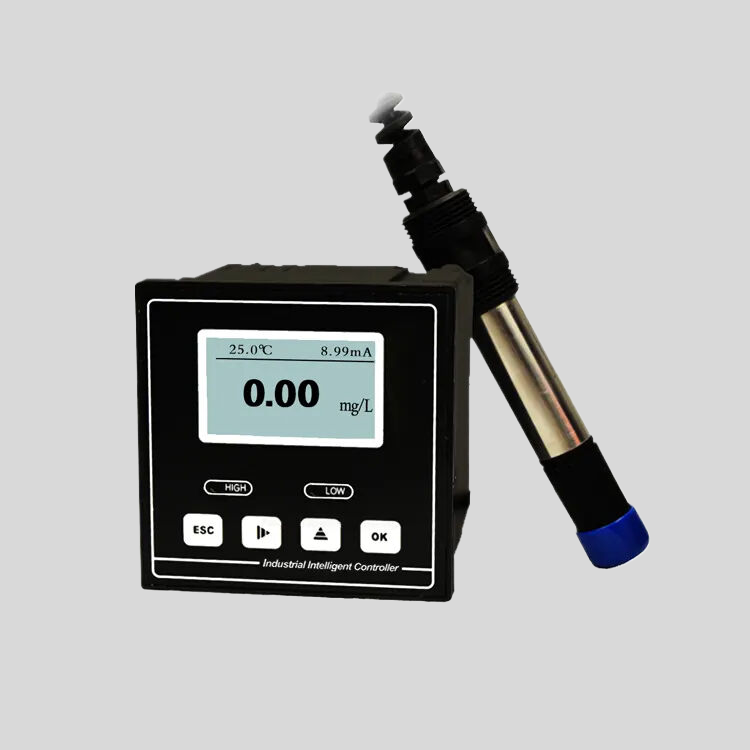
Shanghai ChiMay’s online turbidity tester meets each of these requirements when installed with the sample-conditioning practices its application guide specifies.
Which Failure Modes Get Caught?
The most common upstream events that a turbidity-based early-warning system catches are:
- Ultrafiltration or nanofiltration integrity loss due to fiber breakage or seal degradation.
- Coagulant dose upsets that produce residual floc reaching the finished water.
- Backwash-cycle carryover, where inadequate rinse allows suspended solids to enter the finished-water side.
- Downstream disturbances such as check-valve chatter or reservoir stratification changes that resuspend settled particulates.
Each of these events is also, by physical reasoning, a plausible pathway for microplastic breakthrough. A turbidity trend that flags them is therefore a plausible microplastics early warning even if the sensor never identifies a polymer fragment directly.
Which Failure Modes Get Missed?
There are also failure modes the sensor will not catch alone:
- Steady-state background microplastic loads that pass through an intact filtration train because they are smaller than the barrier’s rated cutoff.
- Point-source contamination downstream of the sensor, such as pipe-material shedding or reservoir-liner degradation.
- Loading changes that reflect source-water composition rather than treatment-plant performance.
For these situations, turbidity must be paired with periodic laboratory measurements. The role of the online sensor is to trigger those laboratory events at the times they will yield the most information — a form of adaptive sampling that saves money and gives regulators higher-quality data.
How Should the Alarm Thresholds Be Set?
A generic threshold — say, “alarm above 0.3 NTU” — is nearly useless for a modern low-particulate stream. Shanghai ChiMay recommends a two-tier approach:
- Deviation-based tier — the primary alarm is triggered by an increase of more than 3× the plant’s rolling 30-day baseline. This catches barrier events regardless of what the absolute NTU happens to be that season.
- Absolute tier — a secondary alarm is set at the plant’s regulatory NTU limit, ensuring that even if the baseline drifts high, the compliance boundary remains a hard stop.
For microplastic surrogate work, the deviation tier is what matters. It is the tier that captures the shape of a barrier event, not just its magnitude.
What About Sensor Placement?
Placement decides whether an early-warning system is a genuine early warning or a delayed acknowledgment. The Shanghai ChiMay application team standardizes on:
- Direct permeate lines from ultrafiltration or nanofiltration, ahead of finished-water blending.
- Point-of-use / point-of-entry manifolds for OEM programs that specify sensor-verified sub-micron barriers.
- Post-advanced-oxidation streams where residual particulates indicate incomplete oxidation.
Placement in a mixed-flow header or a large clearwell obscures the signal and undermines the entire premise of early warning.
What Should Operators Log to Prepare for the 2026 Rules?
Regulators are unlikely to accept turbidity alone as a compliance record for microplastics, but they will look favorably on operators who have documented:
- The location and calibration record of the turbidity sensor.
- The deviation-based alarm policy and how it triggered laboratory sampling.
- The correlation, over a defined baseline period, between the sensor’s readings and confirmed microplastic laboratory analyses.
Shanghai ChiMay’s data-layer options export both the raw NTU and the deviation channel to plant historians, so operators can build this record without additional integration work.
Conclusion
A turbidity sensor cannot count microplastics, and no honest vendor will claim otherwise. But a properly placed, well-calibrated nephelometer flags the barrier events that precede microplastic breakthrough, and it flags them fast enough to matter. Under the 2026 rules, that role — barrier-integrity early warning rather than compliance measurement — is what regulators are actually asking for. Shanghai ChiMay’s online turbidity tester is engineered for exactly that role.