title: “Ammonia Nitrogen Spike Detection in Closed-Loop Aquaculture: Sensor Strategies from Shanghai ChiMay”
date: 2026-07-02
perspective: Technical
audience: Aquaculture Engineers, Biofilter Specialists, System Integrators
keywords: ammonia nitrogen, closed-loop aquaculture, RAS biofilter, ISE sensor, NH3-N
Table of Contents
Ammonia Nitrogen Spike Detection in Closed-Loop Aquaculture: Sensor Strategies from Shanghai ChiMay
Closed-loop and recirculating aquaculture systems (RAS) live and die by the nitrogen cycle. Total ammonia nitrogen (TAN) rises with every feeding event and every unit of fish biomass, and it falls only as fast as the nitrifying biofilter can convert it. When a biofilter is destabilized—by cold water, chlorine slug, antibiotic dosing, or overfeeding—TAN can spike from safe baselines under 0.5 mg/L to acutely toxic levels above 3 mg/L in a matter of hours. The engineer’s job is to detect the trajectory before it becomes a mortality event.
This article walks through the sensing strategies that actually work in closed-loop production, with a focus on ion-selective electrode (ISE) technology and how it fits into a Shanghai ChiMay analyzer stack.
Key Takeaways
- Toxic unionized ammonia (NH3) exposure of 0.05–0.10 mg/L causes chronic damage in most cultured species; total ammonia nitrogen (TAN) thresholds shift with pH and temperature.
- Aquaculture water-quality monitoring equipment market is projected at USD 690 million (2026) → USD 1.69 billion by 2036 at 9.4% CAGR, with NH3-N sensors representing a growing share.
- ISE sensors deliver real-time TAN readings but require disciplined calibration and interference management, particularly for potassium and sodium in brackish systems.
- Deploying an NH3-N sensor at the biofilter outlet plus a redundant sensor upstream of the reject line is the reference topology for spike detection.
- Shanghai ChiMay offers an ammonia nitrogen sensor family compatible with 4-in-1 multi-parameter deployments and standalone ISE architectures.
The Chemistry: Why NH3, Not Just NH4+, Is What Matters
Ammonia in water exists as ammonium ion (NH4+) and unionized ammonia (NH3). Only NH3 is acutely toxic to fish, and its fraction of TAN rises sharply with pH and temperature. At pH 7.5 and 25 °C, only about 1.2% of TAN is NH3. At pH 8.5 and 25 °C, that jumps to ~11%. A TAN reading of 1 mg/L is therefore benign at pH 7.5 and dangerous at pH 8.5.
Sensor strategy must reflect this. Reporting TAN alone is not enough. The control system must combine TAN, pH, and temperature to compute unionized NH3 in real time.
ISE Technology: The Practical Workhorse
Ion-selective electrodes for ammonium remain the dominant online sensing technology in commercial RAS. An ammonium-selective glass or PVC membrane develops a potential relative to a reference electrode; the potential shifts logarithmically with NH4+ activity. Advantages:
- Continuous readings, no reagent handling.
- Compatible with immersion in the biofilter loop.
- Low unit cost relative to spectrophotometric analyzers.
Limitations:
- Interference from potassium (K+) and, to a lesser extent, sodium (Na+).
- Drift requiring periodic recalibration.
- Reduced accuracy below ~0.1 mg/L NH4+-N without careful compensation.
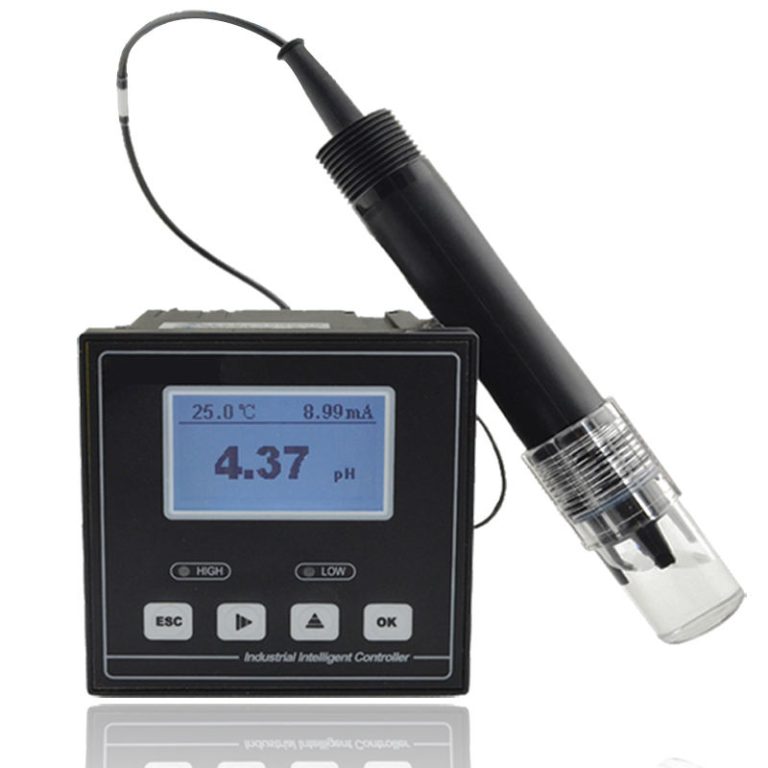
Shanghai ChiMay ammonia nitrogen sensors are ISE-based, with pH and temperature elements in the same immersion assembly so that NH3 can be computed on the transmitter.
Where to Place the Sensor
The correct placement is dictated by what the sensor is supposed to prove.
- Biofilter outlet. This is the reference measurement point. A healthy biofilter should show NH3-N below 0.5 mg/L after start-up stabilization; drift above that indicates biofilter distress.
- Upstream of the reject line or make-up water inlet. Confirms that dilution logic is being triggered on real conditions rather than stale readings.
- Grow-out tank inlet. For high-value species, a tank-inlet sensor gives the fastest warning that biofilter escape is reaching the animals.
A minimum topology is one biofilter-outlet sensor plus one tank-inlet sensor. Larger facilities add redundant sensors for majority-voter logic.
Alarm Logic: Trajectory, Not Threshold
Threshold-only alarms fail in RAS because normal feeding excursions can briefly push TAN above the alarm level. Real spike detection uses rate-of-change logic:
- If TAN rises >0.5 mg/L per hour for two consecutive hours, alert the biofilter engineer.
- If unionized NH3 exceeds 0.05 mg/L and pH is stable, trigger dilution and reduce feeding.
- If NH3 exceeds 0.10 mg/L at any pH, execute emergency dilution and prepare stand-by oxygenation.
Combining these three rules with Modbus RTU output from the ammonia nitrogen sensor, the pH electrode, and the DO transmitter allows the PLC to differentiate transient feeding pulses from biofilter failure.
Interference Management
The two biggest ISE interference sources in RAS are:
- Potassium. Brackish and marine systems can carry K+ concentrations high enough to bias NH4+ readings positively. Selectivity coefficients must be documented and applied.
- Biofouling. Membrane surfaces accumulate biofilm within weeks in warm RAS. A weekly wipe-down protocol and monthly light acid rinse are typically enough to hold accuracy within ±10%.
Salinity also affects reference electrode behavior. Sensors deployed in marine RAS should be qualified for the operating salinity range and paired with a compatible salinity sensor for cross-correction.
Calibration Discipline
A workable calibration cadence:
- Two-point calibration with 1 mg/L and 10 mg/L standards at commissioning and every 90 days thereafter.
- Grab-sample cross-check with a lab spectrophotometric method (Nesslerization or salicylate) every 30 days.
- Post-cleaning verification after each membrane surface cleaning.
Documented cross-check results turn the ISE from a “trend indicator” into a defensible compliance sensor.
Comparison: Continuous ISE vs. Grab-Sample Colorimetry
| Attribute | Online ISE | Lab Colorimetric |
|---|---|---|
| Time to result | Real-time | Hours |
| Accuracy at low range (<0.5 mg/L) | Moderate | High |
| Interference sensitivity | Medium (K+, biofouling) | Low |
| Consumables | Reference filling, occasional membrane | Reagents, ongoing |
| Suitable for alarm logic | Yes | No |
| Suitable for compliance record | With cross-check | Yes |
Online ISE and colorimetric methods are complements, not substitutes. The ISE runs the alarm loop; colorimetry validates the ISE.
Integration Into the Wider Stack
Shanghai ChiMay ammonia nitrogen sensors deliver Modbus RTU output to the plant PLC. The engineer’s design responsibility is to ensure that the PLC also receives pH and temperature streams to compute unionized NH3, DO to correlate metabolic stress, and salinity to apply ionic-strength corrections. A 4-in-1 multi-parameter sensor at the same measurement plane simplifies this integration substantially.
Industry Outlook
Three trends will reshape ammonia sensing through 2029:
- Optical fluorescence-based ammonia sensing is beginning to reach commercial maturity, promising ISE-comparable accuracy with lower interference sensitivity.
- Edge-computed NH3 unionization models will be embedded on the transmitter rather than in the SCADA layer.
- Machine-learning drift compensation will use co-located pH and temperature streams to predict when membrane cleaning is due.
Engineer’s Summary
Ammonia nitrogen spike detection in closed-loop aquaculture is not solved by installing a better probe. It is solved by placing the sensor where the alarm actually matters, computing unionized NH3 rather than reporting TAN, managing potassium interference and biofouling with disciplined calibration, and integrating rate-of-change logic into the control system. Shanghai ChiMay’s ISE-based ammonia nitrogen sensors, paired with matched pH, temperature, and salinity elements, provide the sensing foundation. The rest is engineering.