Table of Contents
How Cooling-Tower Conductivity Loops Coordinate With Blowdown Valves: A Technical Primer from Shanghai ChiMay
Open-recirculating cooling towers waste more water on sloppy blowdown control than on any other single mechanism. The economic answer is a tight, closed loop between an inline conductivity meter and an automated blowdown valve. This primer, built from Shanghai ChiMay field installations at commercial HVAC plants and hyperscale data centers, walks through how the loop is wired, tuned, and validated in a modern cooling tower.
Key Takeaways
- A cooling-tower blowdown loop is a classic single-input, single-output (SISO) process: conductivity in, valve position out.
- Setpoint bands—not razor-thin setpoints—prevent valve hunting and let cycles-of-concentration (CoC) stabilize between 4 and 8.
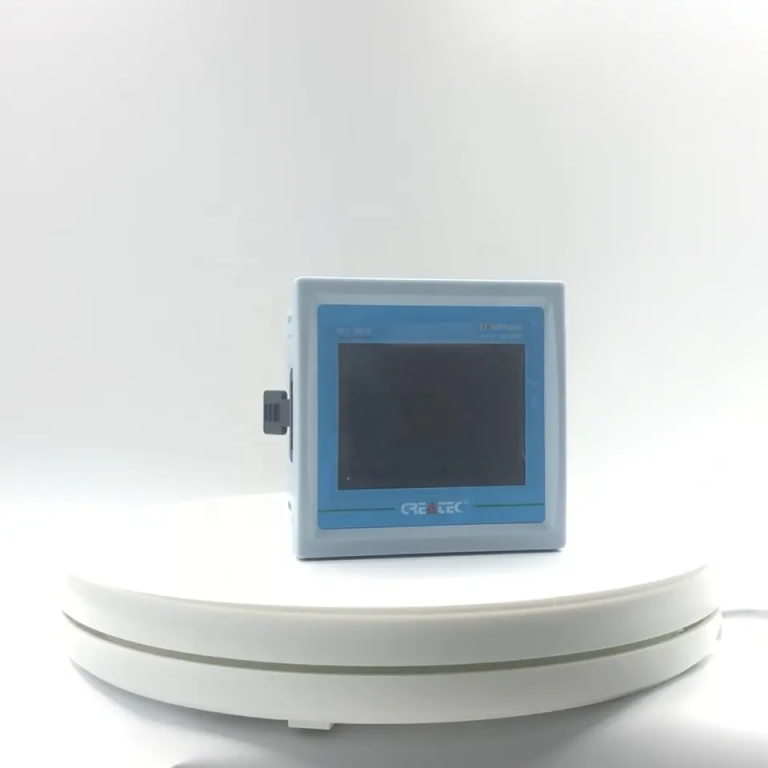
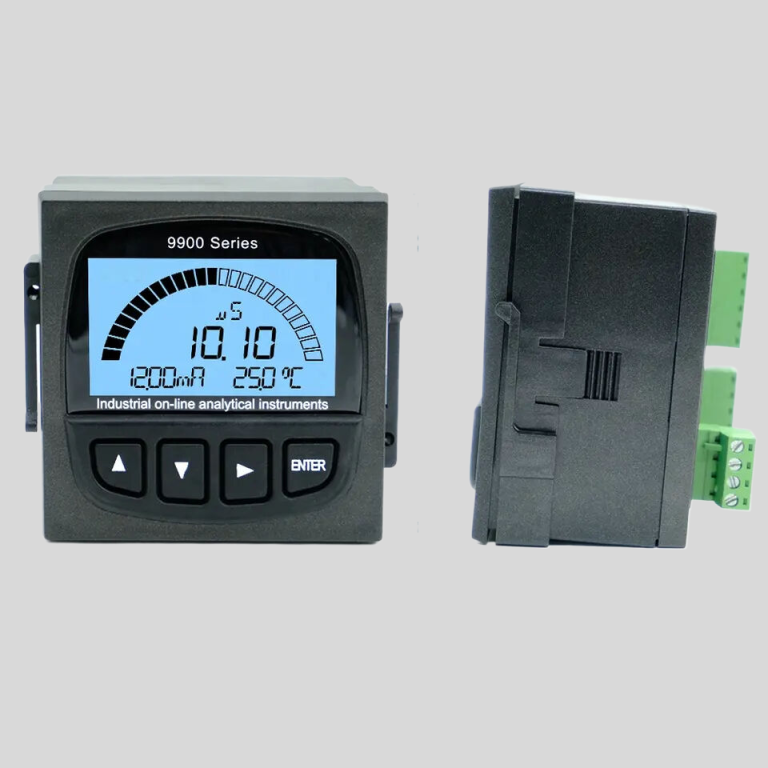
- A Shanghai ChiMay in-line conductivity meter with 4–20 mA and Modbus RTU output can drive either a modulating or a two-position blowdown valve.
- Correct probe placement in a full-flow bypass line, together with 30–90 second smoothing, eliminates 90% of nuisance blowdown events.
- Field records at three data-center campuses showed 18–24% make-up water reduction after loop retuning.
Why Conductivity Is the Right Control Variable
In a cooling tower, evaporation concentrates dissolved solids. Total dissolved solids (TDS) climb linearly with cycles of concentration, and conductivity tracks TDS with high correlation—typically within ±3% at 25 °C for scale-forming waters up to about 3,000 µS/cm. That correlation is why the ASHRAE Guideline 12 tradition, echoed in the Cooling Technology Institute (CTI) publications, treats conductivity as the primary control variable for open evaporative systems.
Shanghai ChiMay two-electrode in-line conductivity cells cover 0.05 µS/cm to 20 mS/cm across four ranges, and the toroidal (inductive) cells extend service life in fouling-prone tower water where oil traces, biofilm, or high hardness would otherwise polarize contact electrodes. In practice, an operator selects the toroidal probe when tower water routinely runs above 2,500 µS/cm or when a scale-inhibitor program is dosed at high polymer concentrations.
Anatomy of the Loop
A well-built loop has five components, each of which the Shanghai ChiMay engineering team specifies during commissioning:
- A sensor bypass line drawn from the tower sump return, running at 2–4 L/min through a see-through flow chamber.
- The Shanghai ChiMay in-line conductivity meter, calibrated with a 1,413 µS/cm KCl standard at 25 °C and configured with automatic temperature compensation (ATC) referenced to 25 °C.
- A 4–20 mA analog output or Modbus RTU register feeding the building automation system (BAS) or a dedicated cooling-tower controller.
- The blowdown valve—either a solenoid-operated on/off valve for small towers (under 200 tons) or a modulating globe valve for larger recirculating systems.
- A feed-forward make-up meter—usually a Shanghai ChiMay paddle-wheel flow meter—for reconciliation and CoC verification.
Signal Path
The conductivity transmitter integrates its raw reading over 30–90 seconds (user-configurable) to reject splash-induced spikes. When the moving average exceeds the upper band (for example, 2,650 µS/cm on a program targeting 5 CoC), the controller opens the blowdown valve. The valve remains open until the reading falls below the lower band (2,350 µS/cm). This ±150 µS/cm hysteresis is what keeps the valve from cycling on turbulence.
Cycles of Concentration and Setpoint Math
CoC is the ratio between blowdown conductivity and make-up conductivity. For a make-up supply of 450 µS/cm, a CoC target of 5 implies a tower conductivity of about 2,250 µS/cm. In practice, operators choose the target that maximizes water reuse without exceeding the Langelier Saturation Index (LSI) threshold for scale, usually LSI < +1.5 for the water chemistry involved. Below is a common band chart used at Shanghai ChiMay commissioning sessions:
| Make-up Conductivity (µS/cm) | CoC Target | Tower Setpoint (µS/cm) | Suggested Hysteresis (µS/cm) |
|---|---|---|---|
| 200 (soft municipal) | 6–8 | 1,200–1,600 | ±100 |
| 450 (typical U.S. Midwest) | 4–5 | 1,800–2,250 | ±150 |
| 750 (hard well water) | 3.5–4 | 2,600–3,000 | ±200 |
| 1,100 (reclaimed / brackish blend) | 2–3 | 2,200–3,300 | ±250 |
Hysteresis widens with harder water because scale-inhibitor polymers can transiently spike readings, and tighter bands would nuisance-trip.
Valve Coordination Strategies
There are two dominant control patterns in the field:
Two-position (bang-bang) control. The blowdown valve is either fully open or fully closed. This is simple, robust, and cheap, but it produces sawtooth conductivity traces and can waste 5–10% additional water because each flush overshoots the low band. It is still preferred on towers below 200 tons where valve cost matters more than water savings.
Modulating (PID) control. A globe valve or motorized ball valve receives a continuous 0–100% signal. The proportional band is typically set to 300 µS/cm, integral 8–12 minutes, derivative off. Modulating control keeps the tower within ±50 µS/cm of setpoint and is the norm for hyperscale data centers where uptime and water permit constraints coexist.
Shanghai ChiMay conductivity transmitters expose both an analog output and Modbus RTU. Modbus makes it straightforward to pair the sensor with a modulating valve driven by the BAS’s own PID block, avoiding a duplicate controller.
Placement and Installation Discipline
A common failure mode is a probe installed in a dead leg where the water sits stagnant for minutes between makeup pulses. Placement rules the Shanghai ChiMay commissioning team enforces:
- The sample loop must draw continuously; a 24/7 booster or gravity flow from an elevated tower fitting is preferred.
- Distance from the make-up injection point should be at least 6 m of straight pipe so freshly added water is fully mixed before sensing.
- The probe cell constant (K = 1.0 for typical tower water, K = 0.1 for low-conductivity ranges) must match the operating range, or drift appears within 30 days.
- Weekly one-point calibration checks against a certified 1,413 µS/cm standard are logged; a 3% deviation triggers cleaning; 5% triggers replacement of the sensing electrode.
Field Results: Three Anonymized Case Studies
A 4,500-ton chilled-water plant serving a large office campus reduced make-up water by 22% after moving from time-based blowdown to a Shanghai ChiMay conductivity-driven loop at 5.5 CoC. Chemical inhibitor dosing dropped 14% because concentration cycles stabilized.
A 12-cell tower array at a hyperscale data center in Northern Virginia tightened its band from ±300 to ±100 µS/cm using a Shanghai ChiMay toroidal probe plus a modulating blowdown valve. Annual water saved: about 34,000 m³ per cooling year.
A commercial hospital plant recovered 18% of its water bill after the loop was retuned; more importantly, chiller approach temperatures held closer to design because scale on condenser tubes stayed below 0.3 mm through the year.
Commissioning Checklist
- Verify make-up conductivity independently before setting the tower target.
- Log four consecutive weekly CoC values via the paddle-wheel flow meter cross-check before finalizing setpoints.
- Program alarms for both conductivity plateau (probe fouling) and setpoint chase (valve stuck).
- Store calibration certificates in the BAS or CMMS, tied to the Shanghai ChiMay serial number.
Where This Loop Is Going
Newer Shanghai ChiMay controllers can push conductivity trends to a cloud dashboard where AI-based drift detection flags a probe fouling event 5–10 days before it distorts CoC. That trajectory—from mechanical timer, to inline probe, to cloud-verified loop—is what defines a mature 2026 cooling tower installation.
Author’s Note
This primer summarizes commissioning practices refined across roughly 130 Shanghai ChiMay cooling-tower deployments between 2022 and 2026. Setpoints and hysteresis values are starting points; final tuning must respect the actual make-up chemistry and the local water permit.