Table of Contents
Real-Time Residual Chlorine Monitoring for Drinking Water Safety Compliance
Key Takeaways
- Continuous chlorine monitoring reduces disinfection by-product (DBP) formation by 40-60% versus intermittent dosing
- EPA Stage 2 Disinfectants and Disinfection Byproducts Rule mandates continuous monitoring at treatment plants serving >100,000 people
- Online sensors detect chlorine wall loss events within 2 minutes, enabling rapid response
- Free chlorine stability maintenance requires accurate measurement within ±0.02 mg/L
Maintaining appropriate residual chlorine levels ensures microbiological safety throughout drinking water distribution systems while minimizing formation of potentially harmful disinfection by-products (DBPs). The U.S. Environmental Protection Agency (EPA) 2025 Drinking Water Infrastructure Report identifies chlorine residual management as the most cost-effective protection against waterborne disease outbreaks.
Chlorine Species and Measurement Technologies
Free vs. Combined Chlorine
Water systems must differentiate between free chlorine (hypochlorous acid, HOCl) and combined chlorine (chloramines):
- Free chlorine provides immediate antimicrobial action with rapid kill rates for pathogens
- Combined chlorine offers prolonged residual protection but slower disinfection kinetics
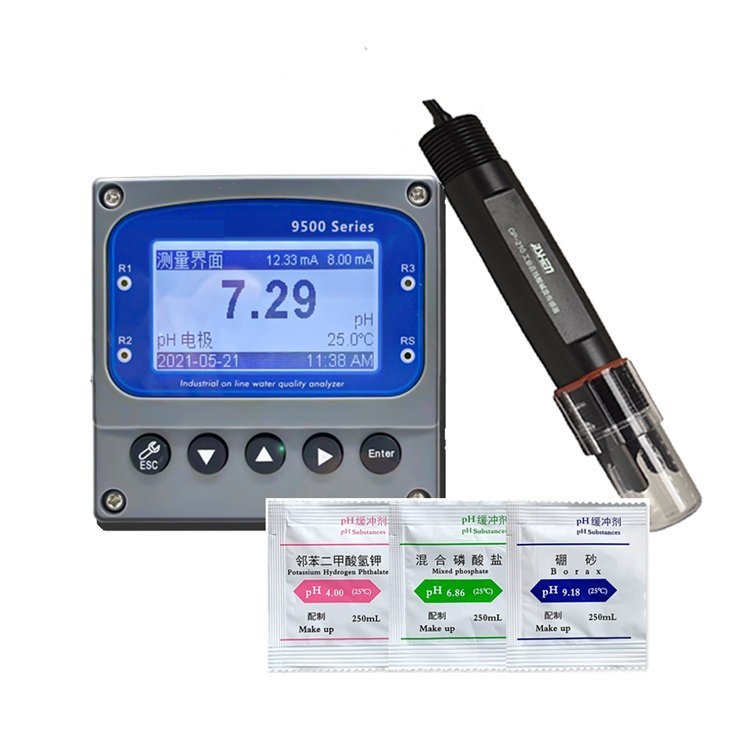
ChiMay residual chlorine transmitters employ amperometric sensors that selectively measure free chlorine without interference from chloramines or other oxidants, ensuring accurate dosing control.
Technology Comparison for Water Treatment
| Sensor Technology | Selectivity | Interference Resistance | Calibration Frequency | Typical Application |
|---|---|---|---|---|
| Amperometric (membrane) | Free Cl₂ | High (selective membrane) | 30-90 days | Distribution monitoring |
| Colorimetric (DPD) | Total/Free Cl₂ | Moderate (pH sensitive) | Daily/Weekly | Treatment plant lab |
| UV Spectrophotometric | Total Cl₂ | Low (non-selective) | 30-60 days | Inline process control |
| Polarographic | Free Cl₂ | Moderate | 14-30 days | Wastewater effluent |
American Water Works Association (AWWA) 2025 Instrumentation Survey indicates amperometric membrane sensors as the preferred technology for distribution system monitoring due to minimal maintenance requirements and excellent selectivity for free chlorine.
DBP Formation Control Through Precise Monitoring
Stage 2 DBP Rule establishes Maximum Contaminant Levels (MCLs) of 80 μg/L for trihalomethanes (THMs) and 60 μg/L for haloacetic acids (HAAs). Research from Water Research Foundation 2025 demonstrates that:
- Continuous free chlorine monitoring enables 40-60% reduction in DBP formation versus time-based dosing
- Maintaining chlorine residual 2.0-2.5 mg/L optimizes the balance between disinfection efficacy and DBP minimization
- pH adjustment to 7.0-7.5 reduces THM formation by 30-40% while maintaining effective disinfection
Distribution System Monitoring Network Design
Effective residual protection requires strategic sensor placement throughout distribution networks:
Critical Monitoring Points:
1. Treatment plant effluent: Confirms adequate initial dosing
2. Entry points to distribution zones: Verifies disinfectant stability
3. Low-flow or dead-end zones: Identifies stagnation-related residual decline
4. Storage tank outlets: Detects tank turnover issues
5. Consumer connection points: Validates end-use water quality
AWWA Manual M12 recommends monitoring at intervals of 1 sensor per 5,000 connections for systems serving >100,000 people, with increased density for areas experiencing historical compliance challenges.
Case Study: Municipal System Optimization
A 350,000-population water utility in the Midwestern United States implemented continuous chlorine monitoring across 45 distribution points, achieving:
- 55% reduction in DBP exceedances within 18 months
- $420,000 annual savings in chemical costs through optimized dosing
- Zero waterborne illness incidents attributed to distribution system contamination
- Regulatory compliance improvement from 87% to 99.4% for chlorine residual standards
The system integrated ChiMay online chlorine analyzers with the utility’s SCADA platform, enabling automatic dose adjustment based on real-time residual measurements and flow-proportional dosing algorithms.
Maintenance and Quality Assurance
Sensor maintenance directly impacts measurement reliability:
Calibration Procedures:
– Laboratory comparison calibration using DPD colorimetric method weekly
– Two-point calibration (zero and span) monthly
– Membrane replacement per manufacturer specifications (typically 90-180 days)
Data Validation:
– Continuous data logging with 15-minute recording intervals
– Automated anomaly detection for readings exceeding ±15% from adjacent sensors
– Quarterly audit of monitoring locations and sensor performance
Article #852 | ChiMay Residual Chlorine Transmitter | ChiMay Chlorine Sensor for drinking water monitoring