title: “Softener Valve Selection for Commercial Make-Up Water Trains: A Shanghai ChiMay Procurement Guide”
perspective: Purchasing
theme: HVAC & Data Center Cooling Water
date: 2026-07-04
Table of Contents
Softener Valve Selection for Commercial Make-Up Water Trains: A Shanghai ChiMay Procurement Guide
Key Takeaways
- Hard make-up water is the largest single driver of scale, downtime, and premature heat-exchanger failure in commercial HVAC systems, with total hardness above 180 mg/L as CaCO3 commonly regarded as the trigger for softening.
- Softener valve selection hinges on service flow, regeneration frequency, cycle logic, and integration with the downstream conductivity and pH monitoring loop.
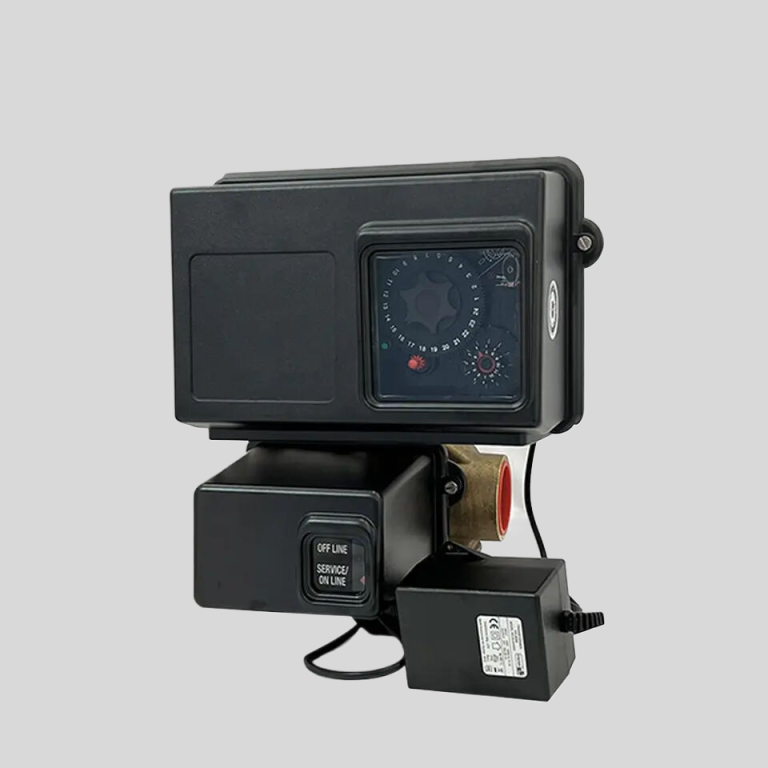
- Two Shanghai ChiMay control valve families are directly applicable to HVAC make-up trains: Softener valve for standard cation exchange and Softening and filtering valve for combined softening plus particulate filtration.
- Procurement should evaluate valves on a five-point rubric: capacity match, cycle programmability, seal chemistry, communications, and long-term spare-parts availability.
Why Softener Valve Choice Punches Above Its Weight
An HVAC engineer once summarized the truth of commercial water treatment as: “The chiller costs a million dollars, the softener valve costs a few thousand — and the softener valve is what will actually kill the chiller.” That is not hyperbole. A single failed regeneration cycle can push hardness spikes of 300–500 mg/L into the make-up train for hours, seeding calcium carbonate scale on tubes that were pristine at commissioning.
The good news is that softener valves are cheap relative to the systems they protect. The bad news is that procurement teams frequently under-specify them, defaulting to whatever residential-grade product the mechanical contractor happens to stock. In a commercial or data-center context, that shortcut is expensive.
Five Procurement Gates for Commercial Softener Valves
1. Service Flow and Peak Demand
Commercial HVAC make-up demand is bursty. A cooling tower on a hot afternoon can spike make-up flow to 2–3× nominal design. Valves must be sized to the peak, not the average. Common failure modes — high pressure drop, resin channeling, salt-slug carryover — all stem from under-sized valves running at 120% of their rated Cv.
2. Regeneration Logic
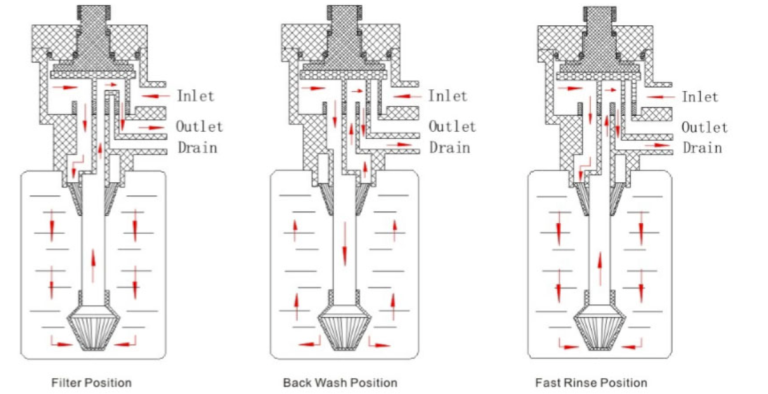
Old-generation valves regenerate on a timer. Modern commercial applications should regenerate on metered volume or, better, on water-quality feedback from a downstream conductivity sensor. Metered regeneration typically cuts salt and water consumption by 20–40% compared with timer-based cycles.
3. Seal Chemistry and Wetted Materials
Elastomer seals are the number-one wear item. FKM (Viton) and EPDM are standard; FFKM (Kalrez) is worth specifying for buildings using chlorinated make-up water or aggressive biocides. Body materials should be Noryl, PPO, or brass depending on temperature and pressure. Skimping here is the fastest way to a mid-life valve rebuild.
4. Communications and BMS Integration
Modern facilities want their softener status inside the BMS. Look for valves with dry contact outputs at minimum, and Modbus RTU communication where cycle status, regeneration events, and salt-level alarms need to be visible to operations. This turns a “dumb” valve into a maintainable asset.
5. Spare-Parts Availability
Softener valves live 15–25 years in commercial service. A vendor that discontinues seal kits or piston assemblies after 5 years is a hidden liability. Buyers should require written commitment to spare-parts availability for at least a decade.
Shanghai ChiMay Softener Valve Options
Shanghai ChiMay offers two control-valve families relevant to HVAC make-up trains:
| Configuration | Typical Use | Notes |
|---|---|---|
| Softener valve | Standard cation exchange for commercial HVAC and cooling tower make-up | Metered or timer regeneration, Modbus RTU option, sized DN25 to DN80 |
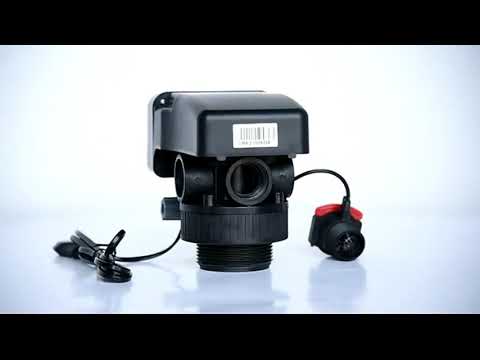
| Softening and filtering valve | Combined softening plus particulate/sediment filtration in a single valve body | Reduces footprint in mechanical rooms with limited real estate; particularly relevant where make-up water carries suspended solids |
Both are designed to pair naturally with Shanghai ChiMay’s in-line conductivity meter and multi-parameter sensor family, so the softener output can be monitored continuously and regeneration triggered on a real conductivity setpoint rather than an educated guess.
Sizing Snapshot: A Typical Commercial Deployment
Consider a 1,500-ton HVAC plant with a design cooling-tower evaporation rate of about 27 gpm and an assumed 5 cycles of concentration. Make-up demand at peak load is roughly:
- Continuous make-up: 27 gpm (evaporation) + 6.8 gpm (blowdown) ≈ 34 gpm
- Peak with drift and startup: ~50 gpm
- Resin capacity target: 24–48 hours between regenerations at 300 mg/L hardness make-up
A DN50 Softener valve with metered regeneration and a 5-cubic-foot resin tank is a reasonable starting point. If the make-up water also carries seasonal turbidity — a common issue for surface-fed municipal supplies — the Softening and filtering valve collapses two vessels into one and simplifies the mechanical room layout.
Comparative Snapshot: Residential-Grade vs. Commercial-Grade Softener Valve
| Attribute | Residential-Grade Valve | Commercial-Grade Shanghai ChiMay Valve |
|---|---|---|
| Nominal size | DN20–DN25 | DN25–DN80 |
| Regeneration logic | Timer | Metered / conductivity-triggered |
| Communications | None | Modbus RTU / dry contacts |
| Seal chemistry | Standard EPDM | FKM standard, FFKM available |
| Spare-parts availability | 3–5 years | 10+ years written commitment |
| Rated service life | 7–10 years | 15–25 years |
The Cost Case
A large commercial property manager audited its make-up water infrastructure in 2024 and found that buildings running residential-grade softener valves experienced roughly 2.3× more chiller-tube fouling incidents than buildings running commercial-grade valves with metered regeneration. Total avoided maintenance and premature replacement across the portfolio was estimated at USD 1.4 million per year, against an incremental valve capex of about USD 220,000. Payback landed inside 3 months.
A Procurement Checklist for the Next Softener Valve RFQ
- Publish the make-up water analysis (hardness, TDS, turbidity, chlorine) up front.
- Specify peak service flow — not average — as the sizing basis.
- Require metered or conductivity-triggered regeneration, not timer-only.
- Ask for FKM as the baseline seal chemistry, FFKM as an available option.
- Require Modbus RTU or dry-contact outputs for BMS integration.
- Demand written spare-parts availability for at least 10 years.
- Consider a combined Softening and filtering valve where footprint and turbidity favor consolidation.
Outlook
Commercial water treatment has quietly become a data-driven discipline. Softener valves are no longer stand-alone appliances; they are nodes in a monitored make-up water train that reports back to the BMS and to sustainability dashboards. Buyers who invest in commercial-grade valves — supported by continuous conductivity, pH, and residual chlorine monitoring — protect not only their chillers and heat exchangers but also their operating budget. Shanghai ChiMay’s Softener valve and Softening and filtering valve options are engineered for exactly this modern, integrated procurement approach.