Table of Contents
The Silent Threat in Your Water: How PFAS Sneaked Past Every Treatment Barrier
Your water treatment plant was designed to remove bacteria, viruses, and heavy metals. PFAS—those “forever chemicals” you’ve been hearing about—wasn’t on the engineering checklist. And that’s exactly why they’re contaminating drinking water supplies across the country.
What Are PFAS and Why Should You Care?
PFAS (per- and polyfluoroalkyl substances) are a family of over 12,000 synthetic compounds used in everything from non-stick cookware to firefighting foam. Their carbon-fluorine bonds—the strongest in organic chemistry—make them virtually indestructible. Once they enter your body or your water supply, they stay forever.
The contamination scale is staggering:
– 2,800+ military installations affected by PFAS from firefighting foam
– 400+ major airports with PFAS-contaminated groundwater
– 200 million Americans drink water containing detectable PFAS levels
Health impacts include cancer, thyroid disease, fertility problems, and immune system disruption. The EPA’s maximum contaminant level (MCL) of 70 ng/L (parts per trillion) sounds tiny—but PFAS accumulate in your body over decades.
Why Treatment Plants Can’t Remove PFAS
The Conventional Treatment Failure
Standard water treatment processes were never designed with PFAS in mind:
Coagulation and flocculation: These processes remove particles by aggregating them into larger settleable masses. PFAS are dissolved compounds—they don’t coagulate.
Sand filtration: Filter pores measured in fractions of a millimeter can’t capture molecules. PFAS molecules are nanometers in size—thousands of times smaller.
Chlorination: Chlorine kills bacteria and oxidizes iron and manganese. PFAS resist all oxidation. You could chlorinate PFAS-contaminated water indefinitely with zero destruction.
Biological treatment: Activated sludge removes organic matter through microbial metabolism. PFAS are chemically inert—microorganisms can’t metabolize them.
The uncomfortable truth: Your drinking water treatment plant has no technology onboard to remove PFAS. They’re passing through every treatment barrier and entering your glass.
Activated Carbon: The Partial Solution
Granular activated carbon (GAC) provides the only widely-available PFAS removal technology. PFAS molecules adsorb to carbon surfaces through hydrophobic interactions.
GAC limitations:
– Long-chain PFAS (C8 and longer) adsorb well—90%+ removal achievable
– Short-chain PFAS (C6 and shorter) pass through—<30% removal
– Flow rate sensitivity: Too fast = poor contact = poor removal
– Competitive displacement: Natural organic matter (NOM) outcompetes PFAS for adsorption sites
– Exhaustion: Carbon beds saturate after 3-18 months, requiring expensive replacement
The PFAS profile problem: As manufacturers phase out long-chain PFAS (PFOA, PFOS), they’ve switched to shorter-chain alternatives. These “newer, safer” PFAS are actually harder to remove with GAC. Your treatment plant’s carbon filters are becoming less effective as PFAS chemistry evolves.
How PFAS Enters Your Water
Industrial Sources
Manufacturing facilities using PFAS in production processes discharge contaminated wastewater:
– Semiconductor manufacturing: PFAS in photoresist chemicals
– Chrome plating: PFAS in plating bath additives
– Paper and packaging: PFAS in grease-resistant coatings
– Textile manufacturing: PFAS in water-repellent treatments
Military and Aviation Sources
Aqueous film-forming foam (AFFF)—used for aircraft fire suppression—contains high PFAS concentrations. Decades of training exercises have contaminated:
– Military bases: Fire training areas, hangars, runways
– Civilian airports: Emergency response zones
– Industrial facilities: Refineries, chemical plants
Landfill Leachate
Household products containing PFAS—non-stick pans, stain-resistant fabrics, food packaging—eventually end up in landfills. PFAS leach into groundwater through:
– Direct infiltration: Rain passing through waste
– ** Leachate collection failures: liner tears, pump malfunctions
– Legacy contamination**: Older landfills without modern containment
Land Application of Biosolids
Wastewater treatment concentrates PFAS in sludge. When this biosolid material is applied to agricultural land:
– Soil accumulation: PFAS persist and accumulate
– Crop uptake: Plants absorb PFAS through roots
– Groundwater migration: PFAS leach to underlying aquifers
Real-Time Monitoring: The First Line of Defense
What Standard Sensors Can Tell You
Your water utility’s inline sensors—conductivity, pH, turbidity—can’t detect PFAS directly. However, they provide valuable screening information:
Conductivity monitoring: PFAS contamination often accompanies industrial discharges that also increase conductivity. Spikes above 15% from baseline warrant investigation.
pH excursions: Some PFAS-containing process solutions affect wastewater pH. Monitoring helps identify industrial contributors.
Turbidity patterns: PFAS bound to particles create turbidity signals. Particle-associated transport indicates specific source categories.
Advanced Monitoring Approaches
Total Oxidizable Precursor (TOP) assay: Converts PFAS precursors to measurable compounds, revealing total PFAS load including “invisible” precursors.
LC-MS/MS quantification: Gold standard for PFAS analysis. Sample preparation takes 2-4 hours, analysis takes 30 minutes, but costs $200-500 per sample.
Field-deployable sensors: Emerging technologies using immunoassays and aptamer-based detection provide screening-level PFAS quantification in 30-60 minutes.
ChiMay Monitoring Solutions
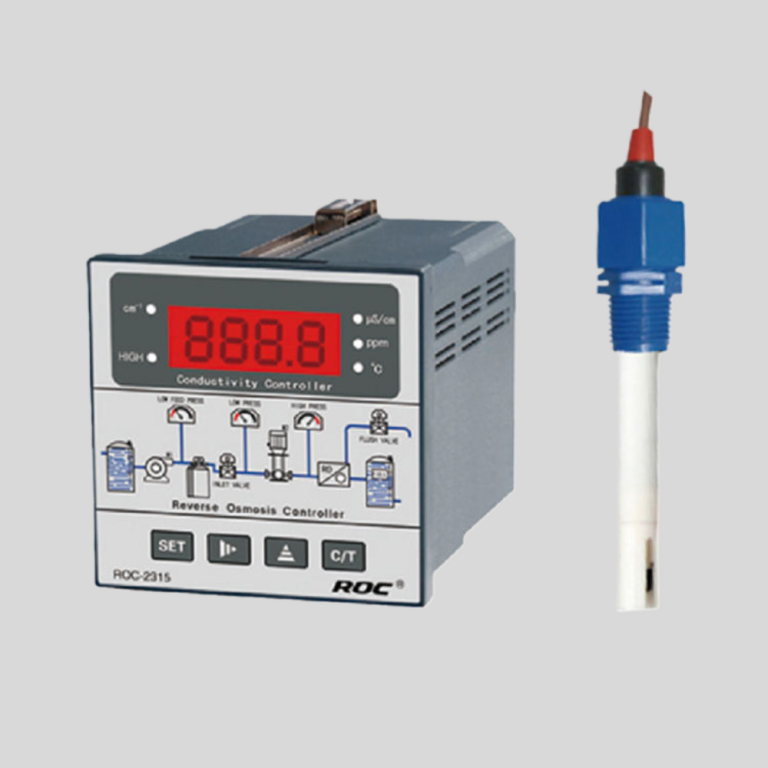
ChiMay inline water quality sensors provide continuous surveillance for PFAS source identification:
– Conductivity sensors detect industrial discharge anomalies
– Flow monitoring tracks contamination transport pathways
– Multi-parameter stations establish baseline conditions enabling anomaly detection
While these sensors cannot quantify PFAS directly, they dramatically reduce monitoring costs by identifying when detailed laboratory analysis is warranted.
Treatment Solutions: What’s Actually Working
Activated Carbon Systems
Granular activated carbon (GAC): The current workhorse technology. Systems require:
– Contact time: 10-20 minutes minimum
– Empty bed contactors (EBC): Sized at 8-15 minutes EBCT for PFAS removal
– Carbon selection: Coconut shell GAC preferred for PFAS due to smaller pore size
– Replacement schedule: 3-12 months depending on PFAS loading
Powdered activated carbon (PAC): Dosage of 5-20 mg/L provides emergency treatment during contamination events. Lower capital cost but higher operating cost.
Membrane Technology
Reverse osmosis (RO): Achieves >99% PFAS removal. Limitations include:
– High energy consumption: 1.5-3 kWh/m³
– Concentrate management: PFAS-containing brine disposal challenges
– Pretreatment requirements: Scaling and fouling prevention
Nanofiltration (NF): Effective for long-chain PFAS. Lower energy than RO but reduced removal efficiency for short-chain compounds.
Advanced Oxidation
Electrochemical oxidation: BDD anode systems achieve >99% PFAS destruction. Costs remain high ($10-25/m³) but technology is advancing rapidly.
Plasma treatment: Emerging technology showing promise for PFAS destruction. Still primarily pilot-scale.
What Utilities Are Doing Now
Monitoring Programs
U.S. EPA UCMR5: Requires public water systems to monitor for 29 PFAS compounds between 2023-2025. Over 10,000 systems must complete sampling.
State programs: Michigan, New Jersey, Massachusetts, California have established state-specific PFAS monitoring requirements with limits stricter than federal guidance.
Treatment Implementation
Large utilities (>100,000 customers):
– 54% have completed PFAS monitoring
– 23% have installed or planned GAC treatment
– 12% are evaluating alternative treatment technologies
Small systems (<10,000 customers):
– Limited resources for monitoring and treatment
– Disadvantaged community challenges: Treatment costs often exceed rate affordability thresholds
– Consolidation opportunities: Regional treatment systems spreading costs across larger customer bases
What You Can Do
At Home
Certified filters: NSF/ANSI 53 or 58 certified filters claim PFAS reduction:
– Activated carbon filters: $20-100 per pitcher/countertop unit
– Reverse osmosis systems: $200-500 installed
– Replacement schedules: Critical for maintaining effectiveness
Point-of-use vs. point-of-entry: POUs treat water at single taps. POEs protect entire homes but require professional installation.
As a Consumer
Product choices: Avoid products labeled “stain-resistant” or “waterproof” unless PFAS-free alternatives exist. Outdoor gear and food packaging are common sources.
Proper disposal: Don’t pour PFAS-containing products down drains. Follow local hazardous waste guidance.
As a Community Member
Utility engagement: Attend public meetings, review utility monitoring data, advocate for treatment investment.
Regulatory advocacy: Support strengthened PFAS standards. Contact elected representatives.
Source control: Support industrial pretreatment requirements for PFAS discharges.
The Path Forward
PFAS contamination represents one of the most challenging environmental issues of our generation. The compounds were designed to persist—and they’ve succeeded beyond anyone’s expectations.
Your water utility’s standard treatment infrastructure cannot remove these chemicals. But awareness is growing, technology is advancing, and regulatory frameworks are tightening.
Until comprehensive solutions arrive, monitoring provides the foundation for protection. ChiMay inline sensors enable continuous surveillance, identifying contamination sources and verifying treatment effectiveness. This intelligence—combined with advanced treatment technologies and informed community action—creates the pathway to PFAS-free water.
The silent threat is no longer silent. It’s time to fight back.