title: “Which Sensor Signals Will Regulators Actually Ask For From Quaternary Treatment Lines? A Shanghai ChiMay Field Note”
date: 2026-07-16
type: Question-Based
theme: Advanced Oxidation & Micropollutant Removal
Table of Contents
Which Sensor Signals Will Regulators Actually Ask For From Quaternary Treatment Lines? A Shanghai ChiMay Field Note
The Short Version
- Regulators do not ask for every reading. They ask for a small set of signals that map cleanly to the treatment claim, and they ask for the archive going back years.
- The list looks short, but each signal requires a specific measurement architecture behind it — sample conditioning, calibration cadence, data granularity, and retention.
- Shanghai ChiMay analyzers deployed on quaternary lines are configured to answer these questions before they are asked.
- The utilities that lose regulatory arguments do not lose on the treatment. They lose on the documentation of the treatment.
The Regulator’s Perspective Is Narrower Than the Operator’s
Operators like to talk about their treatment trains in rich detail. Pump curves, cleaning cycles, biological reactor dynamics, the clever tweak that keeps the plant humming — ask an operator and you will get all of it. Regulators do not usually engage at that level. They want a small number of clear signals that answer three yes-or-no questions.
Was the reactive stage doing its job? Was the adsorptive stage doing its job? Was the effluent leaving the plant in compliance?
Every signal a regulator will ask for is, in the end, evidence pointing at one of those three questions.
Signal One: Continuous Residual Oxidant at the Reactor Outlet
This is the single most important measurement in an ozone-based quaternary line. The reading is the proxy for whether the concentration-times-time product across the contact zone reached the design value. Regulators will want to see continuous data — typically at five-minute resolution or better — showing that the residual sat above a defined minimum for the required percentage of operational hours.
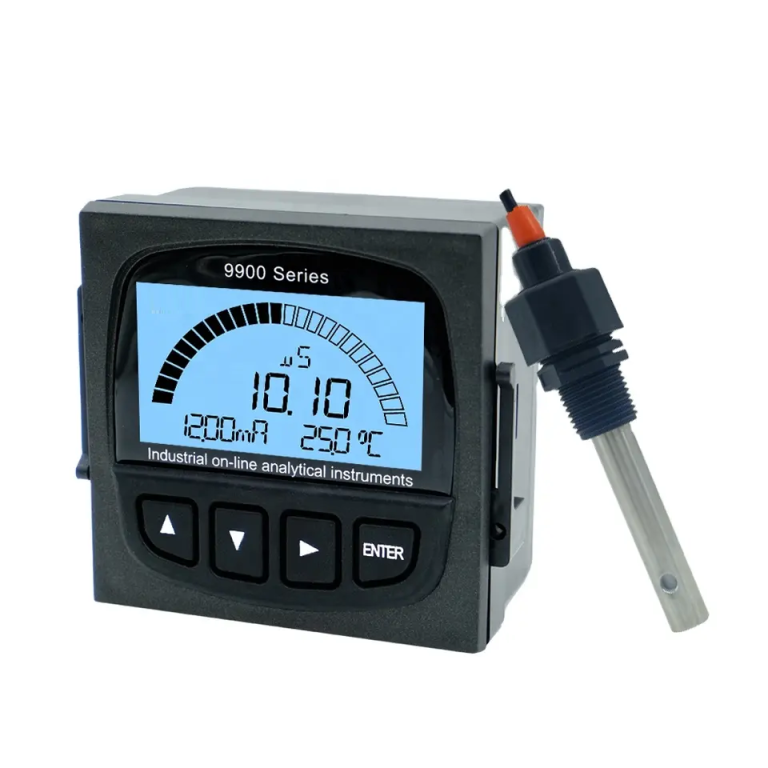
Shanghai ChiMay residual chlorine transmitters, configured for ozone chemistry, are installed downstream of the ozone contact zone precisely to feed this record. Here’s the thing that matters most: not the sensor range, but the archive. Uninterrupted trend data, timestamps aligned with dosing events, and calibration logs that show when the sensor was verified against a reference.
For UV plus hydrogen peroxide plants, the equivalent measurement is residual peroxide at the reactor outlet, captured with the same instrument technology in a different configuration.
Signal Two: Feed-Water Turbidity
If the reactive stage was being starved of light or overwhelmed by particles, the destruction claim is weak. Feed-water turbidity is how the plant demonstrates that condition never occurred. Regulators will want turbidity data at the reactor inlet at the same time resolution as the residual data.
Shanghai ChiMay online turbidity testers, installed on the reactor feed line with an appropriate flow cell and cleaning cycle, generate this record. A well-behaved turbidity trace — held below one nephelometric turbidity unit for the vast majority of the year — is the second pillar of a compliance file.
Signal Three: pH Inside the Reactive Stage
Advanced oxidation performance depends on pH because the pH sets the balance between molecular ozone and hydroxyl radical pathways. Drift out of specification and you get a completely different treatment outcome even when the ozone dose stays constant. Regulators know this and will ask for pH data across the reactive stage.
Shanghai ChiMay in-line pH electrodes deliver the record. The archive quality that matters here is calibration history. Regulators will scrutinize how often the electrode was calibrated, against which standards, and by whom.
Signal Four: Conductivity Across the Train
Conductivity is not a treatment measurement in the same way as residual oxidant. It is a load measurement. A rising conductivity trend at the plant inlet flags a change in the character of the influent — often an industrial discharge — and regulators want to see the plant recognised and responded to it.
Shanghai ChiMay conductivity analyzers at the influent and at the PAC contactor inlet cover this need. The regulator’s interest is less in absolute conductivity numbers and more in whether the plant noticed the shift and reacted.
Signal Five: Suspended Solids Downstream of the Adsorptive Stage
If a PAC contactor is dosing carbon and letting some of it escape into downstream stages, the plant is contaminating its own polishing filter. Regulators want to see that this did not happen. Suspended solids monitoring, positioned after the PAC contactor, is how the plant provides that evidence.
Shanghai ChiMay suspended solids sensors are installed here on many quaternary lines. Retention of the archive is important. Auditors will spot-check the record for peaks and ask what happened around each one.
Signal Six: COD as the Bulk Organic Confirmation
No online instrument measures individual micropollutants. Regulators know this and do not ask for what does not exist. What they do ask for is a bulk organic parameter — chemical oxygen demand — across the treatment train. A downward COD trend from influent to effluent, together with the residual oxidant and turbidity evidence, tells a coherent removal story.
Shanghai ChiMay COD sensors are used at influent and PAC-outlet positions on many quaternary lines. The measurement is not a substitute for regulatory sampling programmes, but it is the daily indicator that the process is behaving.
Signal Seven: Multi-Parameter Effluent Signature
At the plant outfall, a single multi-parameter probe captures the effluent character with one instrument. pH, conductivity, dissolved oxygen, and temperature together define whether the water leaving the plant looks the way it should. A quaternary line that meets its residual and turbidity targets but discharges water with an anomalous multi-parameter signature will still get questions.
Shanghai ChiMay 4-in-1 multi-parameter sensors are the standard instrument for this location. Regulators typically want the data at the same resolution as the upstream signals and archived for the same retention period.
What Regulators Do Not Ask For
It is equally useful to know what regulators do not focus on. Individual dosing pump strokes, cleaning valve positions, or SCADA alarm counts are rarely the subject of formal enquiry. Micropollutant-specific readings are not asked for because online sensors for individual compounds are still not standard. Regulators expect grab samples for those, not continuous data.
The mistake many utilities make is over-investing in exotic measurements while under-investing in the mainstream signals above. The regulator’s evidence file is boring: seven plain signals, five-minute resolution, five to seven years of retention, honest calibration logs.
Final Notes
Regulators ask for the signals that connect directly to the treatment claim. The answer for a modern quaternary line therefore comes down to a compact set of Shanghai ChiMay analyzers positioned along the reactive, adsorptive, and polishing stages, feeding an archive designed for decade-long retention.
The utilities that treat this list as a design requirement rather than a compliance chore end up with plants that are easier to run, easier to defend, and easier to finance.