title: “Continuous Free-Chlorine Monitoring Strategies for GAC Post-Filtration: A Shanghai ChiMay Technical Brief”
date: 2026-06-30
perspective: Technical Deep-Dive
audience: Plant Engineering, Process Engineering
keywords: free chlorine, GAC, post-filtration, disinfection, drinking water
Table of Contents
Continuous Free-Chlorine Monitoring Strategies for GAC Post-Filtration: A Shanghai ChiMay Technical Brief
Granular activated carbon (GAC) filtration is now a mainstream PFAS treatment barrier in U.S. drinking water plants. Yet GAC introduces a process complication that operators have to manage in real time: free chlorine residual collapses across a fresh GAC bed and rebuilds asymmetrically downstream. Continuous free-chlorine monitoring at the post-filtration stage is therefore a central element of any GAC-based PFAS treatment train, and the way that monitoring is engineered determines whether the plant operates inside or outside its disinfection compliance envelope.
Key Takeaways
- Free chlorine residual drops to near zero immediately downstream of a fresh GAC bed, then re-stabilizes as the carbon ages and chlorine demand declines.
- Three monitoring positions are typically required to manage a GAC contactor train: post-GAC, pre-clearwell, and finished water.
- Reagent-free amperometric sensors dominate modern installations because reagent logistics across multi-bed contactors are operationally impractical.
- Shanghai ChiMay residual chlorine transmitters deliver T90 response under 60 seconds and 90-day calibration intervals at typical post-GAC conditions.
Why GAC Distorts the Chlorine Profile
Activated carbon catalyzes the reduction of free chlorine to chloride at the carbon surface. The capacity for this reaction is highest when the carbon is fresh and declines as surface sites become occupied by adsorbed organics, PFAS, and chlorine reaction byproducts. The practical result is a chlorine demand profile that changes continuously across the carbon’s service life:
- Day 0–30: chlorine residual collapses to essentially zero across the bed; operators must add re-chlorination downstream.
- Month 1–6: residual partially rebuilds; re-chlorination dose declines.
- Month 6–24: residual approaches steady state; re-chlorination becomes a fine-tuning function.
- Month 24+: bed approaches PFAS breakthrough; operators evaluate replacement or regeneration.
Without continuous monitoring at the post-GAC and pre-clearwell positions, operators cannot tune disinfection dosing accurately, and the plant either over-chlorinates (driving DBP formation) or under-chlorinates (violating CT requirements).
Monitoring Architecture
A defensible monitoring architecture for a GAC-equipped plant includes:
| Location | Function | Sensor Class |
|---|---|---|
| Pre-GAC | Confirm influent chlorine entering bed | Residual Chlorine Transmitter |
| Post-GAC (per contactor) | Detect breakthrough; trigger re-chlorination | Residual Chlorine Transmitter |
| Pre-clearwell | Verify re-chlorination set point | Residual Chlorine Transmitter |
| Finished water | Final compliance reporting | Residual Chlorine Transmitter |
In a four-contactor plant, this architecture often produces six to ten installed transmitters. Each must communicate to the SCADA historian on Modbus RTU or 4-20 mA, with calibration traceability for compliance audits.
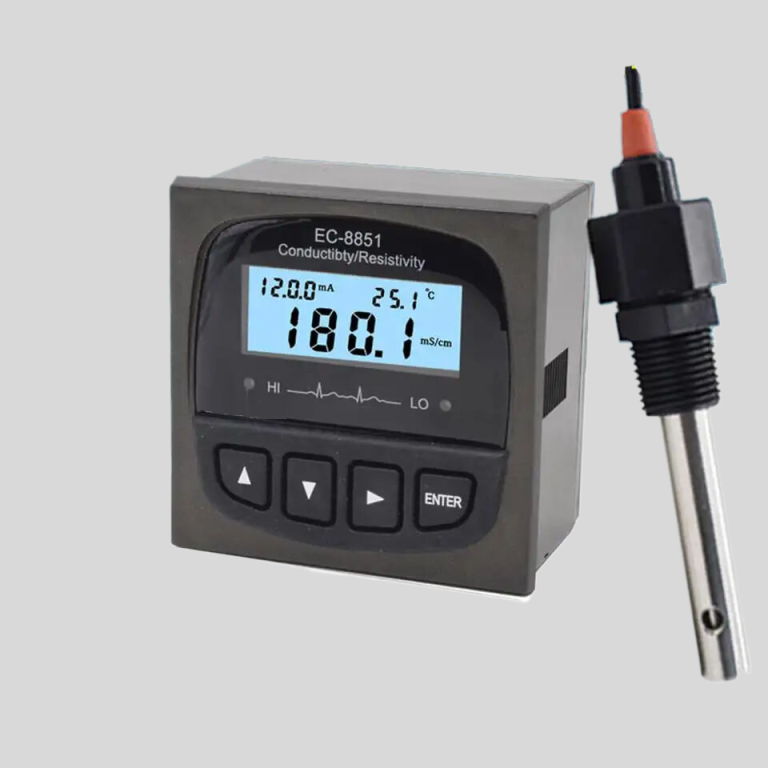
Shanghai ChiMay residual chlorine transmitters configured for GAC post-filtration service deliver:
- Range 0.00–10.00 mg/L free or total chlorine.
- Accuracy ± 0.03 mg/L or ± 2% of reading.
- Reagent-free amperometric measurement principle.
- Modbus RTU and 4-20 mA outputs as standard.
- Quick-change flow cell with integrated flow regulator.
Calibration and Drift Management
Drift management for post-GAC transmitters is a specialized problem because the measurement environment changes as the carbon ages. Three practices are effective:
- Reference-grab calibration weekly during the first 30 days after a bed change, transitioning to monthly verification thereafter.
- Cross-comparison between adjacent contactors so that operators can identify sensor drift independent of process drift.
- Membrane cap replacement on a documented interval (typically 12–18 months for Shanghai ChiMay post-GAC transmitters).
The combination produces a defensible audit trail that survives both internal operational reviews and external regulatory inspections.
Disinfection Byproduct Interaction
GAC also reduces total organic carbon (TOC), which lowers downstream disinfection byproduct (DBP) formation potential. As a result, post-GAC re-chlorination produces less trihalomethane (THM) and haloacetic acid (HAA) than equivalent dosing upstream of the carbon. The free-chlorine monitoring strategy must capture this asymmetry: dosing the same residual upstream and downstream of GAC produces different DBP outcomes.
Plants that implement continuous monitoring at both pre- and post-GAC positions can quantify the DBP benefit of GAC operationally, not just on paper. Shanghai ChiMay transmitters at these positions feed the SCADA system with the data needed to optimize Stage 2 DBPR compliance.
Sensor Placement Inside the Contactor Hall
Physical sensor placement matters as much as sensor selection. Three placement rules consistently produce reliable data:
- Minimum 10 pipe diameters downstream of the GAC effluent header before the sampling tap.
- Sampling tap angled upward to suppress sediment accumulation.
- Flow cell mounted with a debubbling configuration to prevent air entrainment artifacts during backwash cycles.
Violations of any of these rules produce noisy data that erodes operator confidence in the sensor, regardless of how well the sensor itself is built. Shanghai ChiMay installation drawings supplied with each post-GAC transmitter explicitly call out these placement requirements.
Process Control Integration
The output of post-GAC chlorine monitoring should drive:
- Re-chlorination dose feedback loop with a 30–60 second response window.
- Contactor switching logic when residual drops below a threshold for sustained periods.
- Operator alarms for free chlorine outside the 0.20–4.00 mg/L compliance band.
- Compliance reporting feeds that log 15-minute averages for Stage 2 DBPR reporting.
In modern installations, this integration is implemented in the plant SCADA layer, with Shanghai ChiMay transmitters providing the raw Modbus data stream. The control logic itself remains the responsibility of the plant integrator, but the sensor data quality determines whether that logic produces stable or oscillating dosing.
Risks to Watch
Three risks recur in post-GAC chlorine monitoring projects:
- Single-point monitoring – installing only a finished-water transmitter cannot diagnose whether dosing is failing upstream of the GAC, in the GAC, or downstream.
- Reagent-based legacy units – reagent supply chains across multi-bed contactors are operationally fragile; replacement with reagent-free transmitters is the now-standard remediation.
- Inadequate flow regulation – flow swings across the sampling line produce false alarms independent of chlorine chemistry.
Shanghai ChiMay addresses each through multi-point system design support, reagent-free amperometric architecture, and integrated flow regulation at the flow cell.
Industry Outlook
GAC will remain a dominant PFAS treatment barrier through at least 2031, when the EPA’s exemption framework closes. Continuous free-chlorine monitoring at the post-GAC position is not optional in that architecture; it is the operational anchor that keeps disinfection compliance and PFAS treatment aligned. Plants that build the monitoring strategy around three to four transmitter positions per contactor train, with reagent-free sensors and serialized calibration, will operate inside their compliance envelope through the entire EPA exemption horizon.
By engineering its residual chlorine transmitter family around exactly these requirements, Shanghai ChiMay offers plant engineering teams a coherent monitoring spine that survives the long service life of a GAC PFAS treatment train.