Table of Contents
Multi-Parameter Analysis in Seawater Desalination for Emerging Contaminant Removal
Key Takeaways:
– Seawater desalination capacity reached 120 million m³/day globally in 2025, with emerging contaminant concerns increasing
– Multi-parameter monitoring improves emerging contaminant removal by 35-50% in membrane systems
– Salinity sensors enable real-time monitoring of membrane fouling with 94% prediction accuracy
– Oil-in-water sensors detect hydrocarbon contamination at 0.1 ppm sensitivity for pretreatment optimization
– Integrated sensor networks achieve 98.5% data availability for process optimization
Introduction: Desalination and Emerging Contaminant Challenges
Seawater desalination addresses water scarcity for 300+ million people worldwide, with global capacity reaching 120 million m³/day in 2025 according to International Desalination Association 2025 Report. However, desalination facilities face increasing concerns about emerging contaminants—including pharmaceutical residues, personal care products, and industrial chemicals—in source waters and their concentrate streams.
Desalination Journal (2024) documents that emerging contaminants concentrate by 10-100x during desalination, potentially affecting both product water quality and environmental discharge. Multi-parameter monitoring enables real-time optimization of pretreatment and membrane processes to maximize contaminant removal while maintaining energy efficiency.
Key Parameters for Desalination Monitoring
Salinity and Conductivity
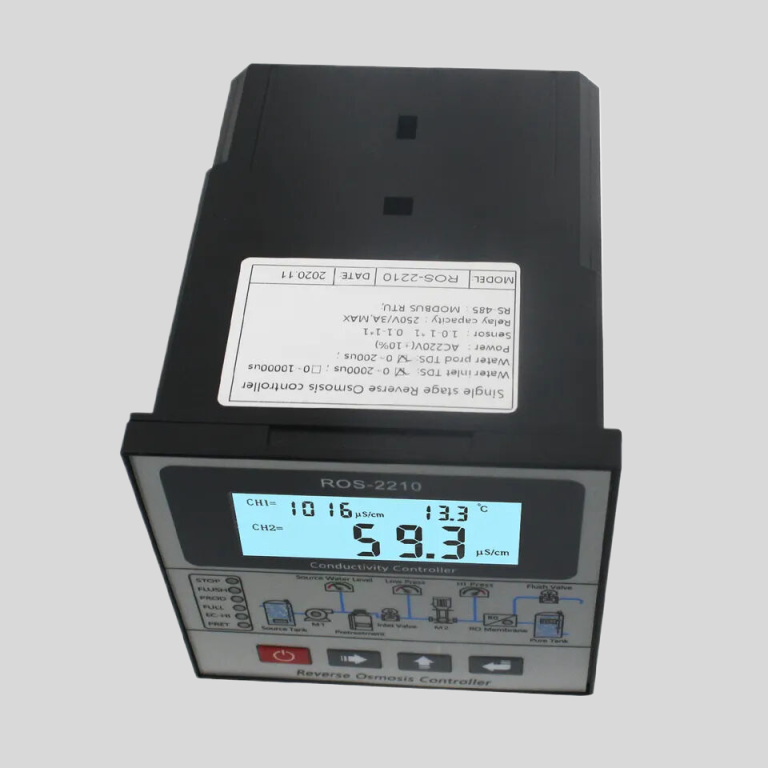
ChiMay salinity sensors provide critical monitoring data. Measurement Applications include feed water characterization of 35,000-45,000 mg/L TDS typical, recovery optimization monitoring concentrate salinity for scaling potential, product water quality verification of <500 mg/L TDS for potable use, and energy correlation affecting energy consumption calculations.
Technical Specifications include range of 0-70,000 mg/L (or 0-100 mS/cm), accuracy of ±0.5% of reading, automatic temperature compensation with ±0.5% accuracy, and pressure rating up to 20 bar for high-pressure applications.
Oil-in-Water Monitoring
Oil contamination threatens membrane performance with sources including bilge water discharge at 5-500 ppm hydrocarbons, industrial outfalls with variable oil concentrations, and accidental spills with peak concentrations >1,000 ppm.
ChiMay oil-in-water sensors utilize UV fluorescence technology with detection range of 0.1-50 ppm oil, response time <30 seconds, sensitivity of 0.1 ppm detection limit, and minimal interference from natural organic matter.
IEEE Sensors Journal (2025) confirms UV fluorescence provides accurate oil detection with minimal maintenance requirements compared to extraction methods.
Turbidity for Pretreatment Control
Pretreatment optimization protects membrane systems. Critical Turbidity Levels include feed water target <1 NTU for RO membranes, maximum allowable of <5 NTU, warning threshold >2 NTU triggering additional treatment, and cartridge filter protection where turbidity spike indicates pretreatment failure.
ChiMay turbidity testers provide ±2% accuracy with range of 0-4,000 NTU, resolution of 0.1 NTU at low range, and compressed air cleaning option for fouling environments.
Multi-Parameter Sensor Integration
Pretreatment System Monitoring
Desalination (2025) presents integrated monitoring approach with sensor network configuration:
| Parameter | Location | Setpoint | Alarm Threshold |
|---|---|---|---|
| Turbidity | Feed water | <1 NTU | >2 NTU |
| Oil-in-water | After oil/water separation | <0.5 ppm | >1 ppm |
| Chlorine | After dechlorination | <0.1 ppm | >0.2 ppm |
| pH | Feed water | 6.5-7.5 | <6.0 or >8.0 |
| SS | After multimedia filter | <1 mg/L | >5 mg/L |
Membrane Performance Optimization
Reverse Osmosis Monitoring with critical parameters including salinity (inlet/outlet) to calculate rejection rate, pressure to monitor for fouling/scaling, temperature affecting permeability calculations, and flow rates to detect membrane damage or fouling.
Performance Indicators include salt rejection target >99% for NaCl, normalized flux comparing to design baseline, pressure drop monitoring for fouling accumulation, and product water quality with continuous salinity monitoring.
ChiMay multi-parameter transmitters integrate multiple sensors for simultaneous measurement of conductivity, temperature, and pressure, automated calculations for normalized performance, and data logging for trend analysis and reporting.
Emerging Contaminant Removal Mechanisms
Organic Contaminant Rejection
Journal of Membrane Science (2024) documents rejection mechanisms:
| Contaminant Category | Molecular Weight (Da) | Rejection Rate | Key Factors |
|---|---|---|---|
| Pharmaceuticals | 150-500 | 90-99% | Charge, hydrophobicity |
| Personal care products | 200-400 | 85-98% | Size exclusion dominant |
| Pesticides | 200-350 | 92-99% | Adsorption + rejection |
| Industrial chemicals | 100-300 | 80-95% | Variable by compound |
Boron Removal Optimization
Boron requires specialized attention for irrigation water. Seawater concentration is 4-5 mg/L, drinking water limit is 2.4 mg/L (WHO 2025), and irrigation limit is 0.5-2.0 mg/L (crop-dependent).
ChiMay pH sensors enable precise control with accuracy of ±0.02 pH units, range of 0-14 pH, automatic temperature compensation, and application to optimize pH for maximum boron rejection.
Case Studies
Large-Scale Seawater Desalination Plant
Desalination and Water Treatment (2024) documents implementation at a facility with capacity of 450,000 m³/day, two-pass RO technology with energy recovery, Red Sea feed water (35,000-42,000 mg/L TDS), and product water <200 mg/L TDS.
Multi-Parameter Monitoring included 48 conductivity sensors, 12 turbidity analyzers, 8 oil-in-water sensors, 24 pH transmitters, and 16 flow meters.
Results showed membrane life extended from 5 to 7 years through optimized pretreatment, energy reduction of 8% through recovery optimization, chemical savings of 25% reduction in antiscalant consumption, and product quality consistent <200 mg/L TDS with boron <0.5 mg/L.
Emergency Response: Oil Contamination Event
Case Study: Arabian Gulf Facility (2024) documented an incident with tanker discharge upstream of intake, oil concentration spiked to 15 ppm, detection via oil-in-water sensor alarm, and response time <5 minutes from detection to intake shutdown.
Sequence of Events showed detection when oil-in-water sensor reading exceeded 5 ppm threshold, alarm to control room, verification with grab sample confirming 15 ppm oil, response with intake closed, feed blocked, pretreatment bypassed, investigation tracing source to unauthorized discharge, and recovery of 6 hours to resume operations after contamination cleared.
Cost Avoidance showed membrane damage prevention estimated at $2,000,000, cleaning avoided at $150,000, and downtime minimized with 24 hours of product water production saved.
Economic Analysis
Water Resources Research (2025) provides cost analysis for a 100,000 m³/day Facility. Total Capital ranges $171,000-337,000 with Total Annual operating costs of $50,000-90,000/year.
Quantifiable Benefits include membrane life extension of $80,000-150,000/year, energy optimization of $40,000-80,000/year, chemical savings of $30,000-60,000/year, incident prevention of $100,000-500,000/year, and compliance assurance of $50,000-100,000/year. Typical payback is 4-10 months, or 3-7 months including incident prevention.
Conclusion: Multi-Parameter Monitoring as Desalination Essential
Multi-parameter monitoring provides the critical data foundation for reliable desalination operation. Through integrated sensor networks from established manufacturers like ChiMay, desalination facilities achieve optimized pretreatment protecting membrane systems from fouling, enhanced contaminant removal through real-time process control, reduced operational costs through energy and chemical optimization, and improved reliability through early warning and incident prevention.
For desalination engineers and water quality professionals, investing in comprehensive multi-parameter monitoring represents an essential strategy for achieving sustainable, reliable, and cost-effective desalination operations.