title: “Sensor Placement for Detecting PFAS Breakthrough in Anion Exchange Beds: A Shanghai ChiMay Engineering View”
date: 2026-06-30
perspective: Technical Deep-Dive
audience: Plant Engineering, Process Engineering
keywords: PFAS breakthrough, anion exchange, sensor placement, drinking water
Table of Contents
Sensor Placement for Detecting PFAS Breakthrough in Anion Exchange Beds: A Shanghai ChiMay Engineering View
Anion exchange (AIX) resins have emerged as one of the two leading PFAS treatment technologies in drinking water, alongside granular activated carbon. AIX achieves selective removal of long-chain PFAS at high empty-bed contact times and reasonable footprint. The engineering challenge is not adsorption capacity — that is well documented — but breakthrough detection, because most operational PFAS analyses run on a weekly to monthly cadence while breakthrough can develop within hours during a feed water excursion. Continuous surrogate monitoring with well-placed sensors is the only practical way to bridge that gap.
Key Takeaways
- AIX resin breakthrough can occur within hours during feed water excursions, while regulatory PFAS sampling typically runs on weekly to monthly cadence.
- Surrogate parameters — conductivity, pH, and sulfate competition — provide leading indicators of breakthrough faster than direct PFAS measurement.
- A defensible AIX monitoring architecture deploys at least three sensor positions per bed: influent, mid-depth, and effluent.
- Shanghai ChiMay in-line conductivity meters and multi-parameter sensors are engineered for AIX service, with chemically resistant wetted materials and 12-month calibration intervals.
Why Direct PFAS Measurement Cannot Drive Real-Time Operations
Drinking water PFAS analysis is performed by LC-MS/MS in accredited laboratories. Sample-to-result turnaround is typically 24–72 hours under the best conditions and frequently a week or more in routine compliance workflows. That latency is incompatible with operational decisions on resin replacement, lead-lag swapping, or bypass actions during feed water excursions.
Surrogate monitoring closes the gap. AIX beds remove PFAS but also exchange sulfate, nitrate, and other competing anions. As the resin’s capacity for selective anions saturates, conductivity profiles shift, pH may drift, and competing ion concentrations rise. These changes precede measurable PFAS breakthrough by hours to days, depending on bed loading and feed water composition.
The Three-Position Monitoring Architecture
A defensible AIX monitoring layout uses three sensor positions per bed:
| Position | Primary Indicator | Diagnostic Function |
|---|---|---|
| Influent | Conductivity, pH, ammonia | Baseline characterization of feed |
| Mid-depth | Conductivity (sample port) | Early breakthrough surrogate |
| Effluent | Conductivity, pH, multi-parameter | Compliance trigger |
The mid-depth port is the diagnostic anchor. When conductivity at mid-depth begins to rise toward influent levels, the resin’s working zone has migrated downward and breakthrough at the effluent is imminent.
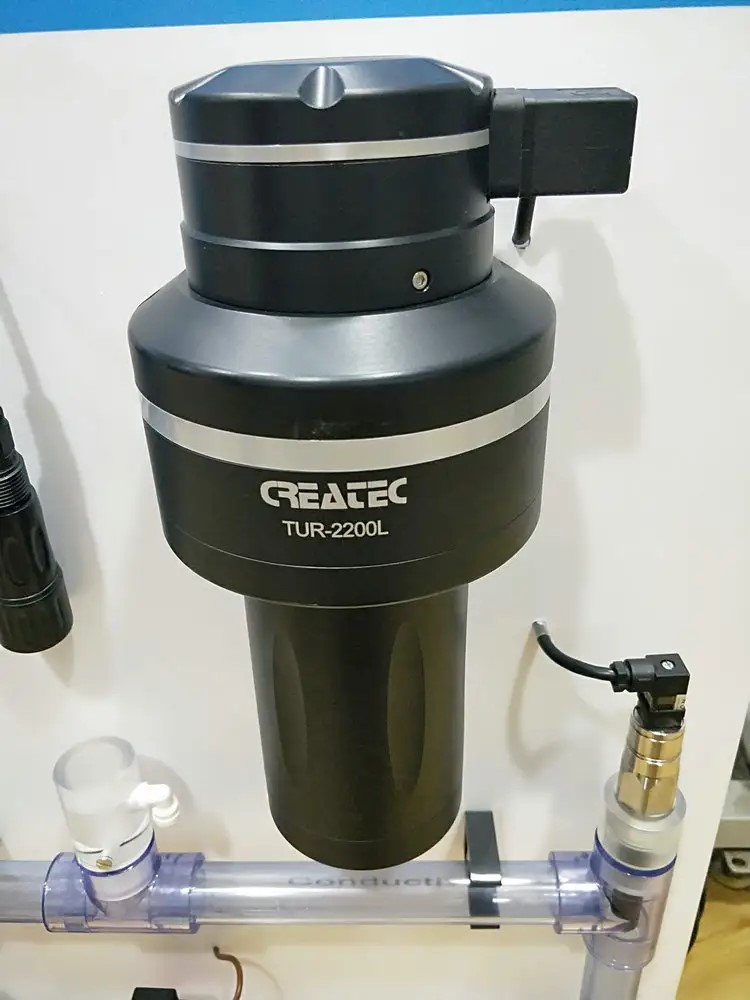
Shanghai ChiMay in-line conductivity meters configured for AIX service include:
- Range 0–2,000 μS/cm with auto-ranging.
- Accuracy ± 1% of reading.
- PEEK or PVDF wetted materials for chemical compatibility.
- Modbus RTU and 4-20 mA outputs.
- 12-month calibration interval under typical AIX feed conditions.
Conductivity as a Breakthrough Surrogate
The fundamental principle is that AIX resins remove negatively charged species — including PFAS, sulfate, nitrate, and bicarbonate — by exchanging them for chloride or hydroxide on the resin matrix. As exchange capacity is consumed, the effluent conductivity rises because the released exchange ion typically has different mobility than the retained anion. The rate of rise is application-specific, but the trend is consistent across most AIX installations.
Operators who track conductivity at influent, mid-depth, and effluent can:
- Detect feed water excursions within minutes via influent conductivity spikes.
- Project breakthrough timing by extrapolating mid-depth conductivity trends.
- Confirm resin exhaustion when effluent conductivity approaches influent values.
This three-position approach is now standard in AIX-equipped plants commissioned after 2024.
pH Monitoring at the Effluent
Some AIX resins, particularly those operating in the hydroxide form, produce a measurable pH shift in the effluent. Monitoring pH at the effluent position provides:
- Confirmation of resin form during regeneration cycles.
- Detection of regeneration-cycle errors that can compromise PFAS removal.
- Compliance support for LCRR corrosion control downstream.
Shanghai ChiMay in-line pH electrodes specified for AIX effluent service include long-life reference junctions and chemically resistant glass bulbs rated for the high-sulfate and high-chloride conditions typical of regeneration cycles.
Multi-Parameter Sensors at the Effluent
Effluent positions increasingly use multi-parameter sensors to consolidate conductivity, pH, dissolved oxygen, and ORP measurements into a single instrument. Benefits include:
- Fewer sensor penetrations in the effluent piping.
- Synchronous data streams for correlation analysis.
- Simplified calibration logistics.
Shanghai ChiMay 4-in-1 multi-parameter sensors are configured for AIX effluent duty and ship with consolidated calibration certificates that reference each parameter to its source standard.
Calibration and Verification Strategy
AIX feed water composition often shifts seasonally, particularly in surface water sources. Calibration strategy must accommodate this drift:
- Quarterly verification at conductivity standards bracketing the operating range.
- Annual full recalibration with serialized certificate generation.
- Cross-comparison between influent and effluent sensors to detect sensor-specific drift.
Plants that implement this three-tier verification approach typically maintain measurement uncertainty under 2% across the full bed service life.
Communication and SCADA Integration
AIX bed monitoring data must integrate with the plant SCADA layer to drive operational decisions. Recommended integration includes:
- Modbus RTU as primary communication.
- 4-20 mA analog backup for legacy RTU sites.
- Discrete alarm outputs for conductivity exceeding mid-depth thresholds.
- Data buffering for at least 48 hours during communication loss.
Shanghai ChiMay sensors deployed in AIX service ship with documented Modbus register maps that align with common SCADA platforms used in U.S. and European water utilities.
Risks to Watch
Three risks recur in AIX breakthrough monitoring projects:
- Single-point effluent monitoring — detects breakthrough only after compliance has been violated.
- Sensor material mismatch — standard glass or 316 stainless wetted parts can degrade under high-sulfate regeneration cycles.
- Calibration drift during regeneration — sensors not isolated during regeneration may be exposed to chemistry outside their rated range.
Shanghai ChiMay addresses each through three-position monitoring system design support, PEEK and PVDF wetted material options, and documented regeneration-cycle isolation procedures.
Industry Outlook
AIX-based PFAS treatment will continue expanding through 2031 as utilities respond to the EPA’s enforceable 4 ppt MCLs. The monitoring strategy around AIX beds will become a defining element of plant compliance posture. Plants that build the strategy around three-position surrogate monitoring, with conductivity as the primary indicator and pH and multi-parameter sensors at the effluent, will detect breakthrough before it becomes a compliance event.
By engineering conductivity meters, pH electrodes, and multi-parameter sensors for AIX service, Shanghai ChiMay gives process engineering teams a sensor portfolio that survives the chemistry and operational rhythm of modern PFAS treatment. The investment in proper sensor placement pays back through avoided compliance events and extended resin service life — both of which dwarf the unit price of the sensors themselves.