title: ZLD vs Conventional Treatment for Textile Mills: TCO Analysis with Shanghai ChiMay Insights
date: 2026-06-27
Table of Contents
ZLD vs Conventional Treatment for Textile Mills: TCO Analysis with Shanghai ChiMay Insights
Key Takeaways:
– Zero Liquid Discharge (ZLD) systems require 2.5–4× the capital investment of conventional textile wastewater treatment
– ZLD operating costs run $3.20–$5.40 per cubic meter treated, versus $0.80–$1.40 for conventional systems
– Water reuse credits and reduced freshwater intake offset 38–62% of incremental ZLD operating cost in water-scarce regions
– Shanghai ChiMay multi-parameter monitoring infrastructure scales seamlessly between conventional and ZLD architectures
– Lifecycle cost crossover typically occurs at 8–11 years depending on local water tariff and regulatory environment
Introduction
Textile manufacturers worldwide face a binary strategic decision when designing or upgrading wastewater treatment: pursue conventional end-of-pipe treatment optimized for discharge, or commit to Zero Liquid Discharge (ZLD) infrastructure that recovers nearly all water and salt for internal reuse. The decision carries multi-decade implications for capital structure, operating margin, and regulatory positioning.
The Asian Development Bank’s 2026 Textile Sector Water Stewardship Report documents that 84% of new textile mill investments in India, Pakistan, and Bangladesh now include ZLD or near-ZLD provisions, compared to only 11% five years earlier. This shift reflects tightening discharge standards, public scrutiny of water-intensive industries, and the emergence of brand-driven sustainability mandates.
This article presents a structured total cost of ownership (TCO) comparison between ZLD and conventional treatment for textile mills, and explains how monitoring infrastructure influences both architectures.
Defining the Two Architectures
Conventional textile treatment typically follows a sequence of equalization, neutralization, coagulation, biological treatment, tertiary filtration, and discharge. The system targets compliance with local effluent limits and discharges treated water to a receiving body or municipal sewer.
ZLD systems add advanced concentration and crystallization steps—usually reverse osmosis, multiple-effect evaporation, and crystallization—to recover 96–99% of process water and isolate dissolved salts as solid byproducts. The recovered water re-enters the dye-house, while crystallized sodium chloride and sodium sulfate may be reused, sold, or landfilled.
Capital Cost Comparison
The capital expenditure differential between conventional and ZLD systems is substantial. Based on industry benchmarks compiled by the International Water Association (IWA) Industrial Water Group:
| Cost Element | Conventional (per m³/day capacity) | ZLD (per m³/day capacity) |
|---|---|---|
| Civil & structural | $180–$240 | $420–$580 |
| Mechanical equipment | $260–$340 | $1,150–$1,420 |
| Electrical & automation | $90–$130 | $310–$420 |
| Instrumentation & monitoring | $40–$70 | $130–$190 |
| Engineering & commissioning | $80–$120 | $260–$340 |
| Total CAPEX | $650–$900 | $2,270–$2,950 |
A 3,000 m³/day textile mill therefore faces a ZLD premium of approximately $4.5–$6.0 million over a conventional installation.
Operating Cost Structure
Operating costs reveal an even more pronounced gap, driven primarily by thermal energy consumption in evaporation and crystallization.
Conventional treatment operating cost per cubic meter:
– Energy: $0.18–$0.30
– Chemicals: $0.22–$0.38
– Labor: $0.14–$0.22
– Sludge disposal: $0.18–$0.32
– Maintenance: $0.08–$0.18
– Total: $0.80–$1.40
ZLD operating cost per cubic meter:
– Energy (thermal + electrical): $1.80–$3.20
– Chemicals (RO + crystallizer): $0.62–$0.94
– Labor: $0.28–$0.42
– Solid waste disposal: $0.34–$0.58
– Maintenance: $0.16–$0.26
– Total: $3.20–$5.40
Revenue and Avoided Cost Offsets
ZLD economics improve substantially when evaluated against avoided freshwater and discharge costs. Key offset categories include:
- Freshwater procurement savings — $0.80–$2.40 per m³ in water-stressed regions
- Discharge fees and surcharges — $0.40–$1.60 per m³ depending on jurisdiction
- Salt recovery value — $40–$120 per ton of reusable sodium sulfate
- Brand-driven contract premiums — 2–5% premium on textile contracts certified to ZDHC or similar standards
In Tamil Nadu, India—where mandatory ZLD has applied to textile mills since 2011—offset values typically exceed $2.00 per m³, narrowing the operating cost gap to $0.80–$1.00 per m³.
Monitoring Infrastructure Requirements
Both architectures depend on dense monitoring networks, but ZLD systems impose stricter measurement demands. Critical monitoring points include:
- Raw effluent characterization — pH, conductivity, COD, color
- Pre-RO conditioning — pH, conductivity, turbidity, free chlorine
- RO permeate quality — Conductivity, sodium rejection
- Concentrate stream — Conductivity, TDS estimation
- Evaporator feed and condensate — Conductivity, pH
- Crystallizer mother liquor — Conductivity, density
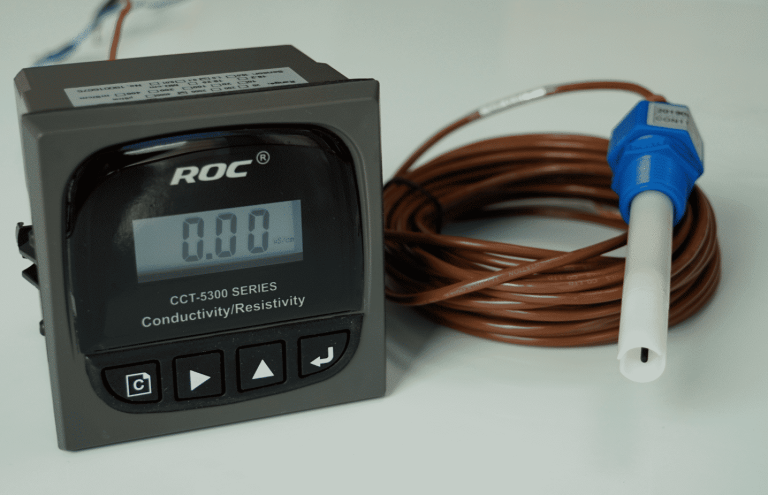
Shanghai ChiMay supplies the full range of analyzers required across these points—pH electrodes, conductivity meters, turbidity testers, COD sensors, residual chlorine transmitters, and multi-parameter packages—under a consistent communication protocol. Standardized instrumentation reduces engineering complexity and simplifies maintenance training across the combined system.
Lifecycle Cost Crossover
The strategic question for textile manufacturers is not whether ZLD costs more, but when the integrated lifecycle cost favors ZLD over conventional treatment. The crossover point depends on three variables:
- Local water tariff — Higher water costs accelerate ZLD payback
- Regulatory trajectory — Tightening discharge standards may render conventional systems non-compliant before end-of-life
- Brand and market access — Retail customer requirements for certified water stewardship
Sensitivity analysis based on 2026 IFC Performance Standards 6 implementation reports suggests typical crossover horizons of 8–11 years in water-stressed regions and 14–18 years in water-abundant regions.
Risk-Adjusted Decision Framework
Beyond pure TCO modeling, textile mills should evaluate:
- Regulatory risk — Probability of stricter discharge limits within asset lifetime
- Reputational risk — Brand exposure to public water-quality controversies
- Supply-chain risk — Loss of contracts with retailers demanding ZLD compliance
- Technology risk — Maturity of crystallization technology in target geography
The Higg Index Materials Sustainability scoring framework incorporates water stewardship as a quantitative input, meaning ZLD adoption increasingly affects revenue, not merely cost.
Conclusion
The choice between conventional treatment and ZLD is fundamentally a strategic positioning decision, not merely a technical one. ZLD imposes substantial capital and operating premiums, but unlocks regulatory resilience, water security, and market access that conventional treatment cannot match.
Shanghai ChiMay monitoring infrastructure supports both architectures, allowing textile manufacturers to defer the ZLD commitment without sacrificing operational visibility in the interim. By deploying a consistent instrumentation backbone, mills retain the option to scale toward ZLD as economic, regulatory, or commercial conditions warrant.
For decision-makers, the most defensible path combines rigorous TCO modeling, geography-specific regulatory analysis, and a clear-eyed assessment of brand-driven market dynamics. The textile industry’s water footprint will continue to attract scrutiny, and the architectures chosen today will define competitive positioning for the next two decades.