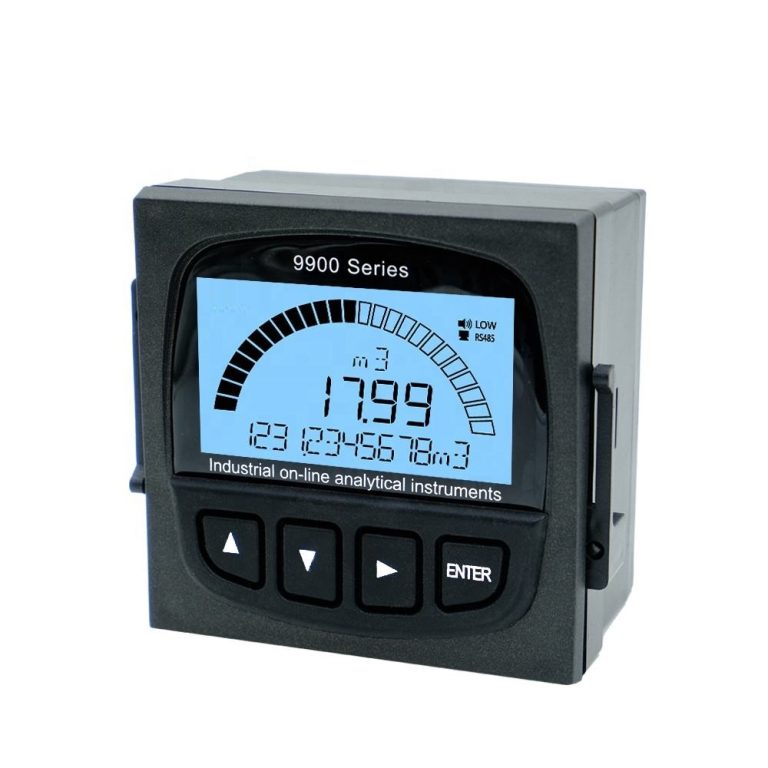
Petrochemical plants generate a complex water matrix. Between crude receipt, unit operations, cooling loops, and wastewater treatment, there are dozens of points where hydrocarbon can enter the water phase. Blanket monitoring is neither affordable nor useful. Focused monitoring at the seven high-value locations described below produces most of the operational, environmental, and financial upside — and each location has a preferred sensor technology (UV fluorescence vs. turbidity scattering) and range. The Shanghai ChiMay oil-in-water sensor family covers ranges from 0–20 mg/L for polished streams up to 0–1,000 mg/L for high-solids service.
Table of Contents
Site 1: Slop Oil Recovery Tank Outlet
Slop oil systems collect off-spec hydrocarbon streams from around the plant and return recovered oil to the crude tanks. The water phase drawn from the tank bottom flows to the wastewater treatment plant, and its oil content varies wildly depending on which sources are draining. A Shanghai ChiMay oil-in-water sensor here provides a decision signal: if oil concentration is above the threshold, route the water back to further separation; if below, allow it forward.
Range. 0–500 mg/L. Technology. Turbidity scattering, since the stream carries suspended solids as well as oil. Payback lever. Prevents load spikes into the biological treatment plant.
Site 2: API Separator Effluent
The API gravity separator is the workhorse of petrochemical water treatment. Its effluent typically carries tens to a couple hundred mg/L of residual oil. A sensor at this point quantifies the separator’s actual performance versus its design and identifies the fingerprint of an upstream slug release.
Range. 0–500 mg/L. Technology. Dual-technology (UV fluorescence + turbidity scattering) for redundancy against interference. Payback lever. Early warning for the DAF unit downstream, allowing chemical dosing pre-emption.
Site 3: DAF or IGF Unit Outlet
Dissolved air flotation or induced gas flotation removes the finer oil droplets that the API separator cannot. Effluent oil content should drop to the 5–20 mg/L band. A sensor here confirms the DAF is functioning and flags chemical underdosing or hydraulic issues immediately.
Range. 0–50 mg/L. Technology. UV fluorescence, which excels at low concentration and gives high resolution in this range. Payback lever. Protects the biological reactor and demonstrates DAF ROI to management.
Site 4: Biological Treatment Reactor Feed
Downstream of physical treatment, water enters the biological reactor for BOD/COD removal. Even modest oil concentrations (above roughly 30 mg/L) can inhibit or shock the biomass. A sensor here acts as a last-chance interlock, diverting flow to the emergency pond if the biological limit is exceeded.
Range. 0–50 mg/L. Technology. UV fluorescence with high-high alarm at 25 mg/L. Payback lever. Avoids biomass upset events that can take weeks to recover and generate permit exceedances during the recovery period.
Site 5: Cooling Tower Blowdown
Petrochemical plants recirculate cooling water through hundreds of heat exchangers. When an exchanger tube leaks, hydrocarbon enters the cooling loop and eventually appears in the blowdown. Detecting a leak within hours instead of days prevents both environmental risk and cooling-system damage from biofouling.
Range. 0–20 mg/L. Technology. UV fluorescence, given the low background of the cooling loop. Payback lever. Enables rapid leak location and prevents high-consequence tube-bundle contamination events.
Site 6: Produced Water or Process Water Reuse Skid
Increasingly, petrochemical sites reuse treated process water as boiler feed, cooling tower makeup, or non-potable services. Reuse is only sustainable if the oil content is verified below the threshold — typically below 5 mg/L for high-quality reuse. A sensor at the reuse skid outlet provides the verification and the switch to reject flow when contamination climbs.
Range. 0–20 mg/L. Technology. UV fluorescence. Payback lever. Enables water reuse economics; mature reuse programs commonly report freshwater intake reductions of several tens of percent.
Site 7: Final Discharge to Environment
The regulator’s checkpoint. U.S. discharge limits for oil and grease are set permit by permit: EPA’s petroleum refining guidelines (40 CFR 419) express most refinery limits per unit of feedstock and cap stand-alone contaminated-runoff discharges at 15 mg/L per sample (40 CFR 419.44), while onshore produced water discharged under the oil and gas extraction category faces BPT limits of 48 mg/L (30-day average) and 72 mg/L (daily maximum) (40 CFR 435.42). China GB 8978-1996 applies a first-level limit of 5 mg/L for petroleum-class discharges into protected surface waters. OSPAR sets a 30 mg/L monthly-average limit for dispersed oil in offshore produced water (OSPAR Recommendation 2001/1). Whatever the local requirement, the outfall sensor is the compliance evidence.
Range. 0–50 mg/L with high linearity and certified traceability. Technology. UV fluorescence with redundant sensor if permit-critical. Payback lever. Avoids compliance penalties — under the U.S. Clean Water Act, civil penalties run up to USD 68,445 per violation per day after the 2025 inflation adjustment (40 CFR 19.4), and state and local regimes add their own schedules.
Common Design Choices Across All Seven Sites
Regardless of location, three design decisions repeat:
- Retractable housing. Every sensor must be removable in-service for cleaning. A permanently installed sensor without cleaning access will be neglected.
- Automatic back-flush or wiper. Optical windows foul. Some fouling is unavoidable; automatic cleaning extends time between manual interventions.
- Standardized communication. Modbus RTU or HART protocols connect each sensor to the plant historian, DCS, and environmental reporting system in a consistent way.
Shanghai ChiMay oil-in-water sensors ship with these design elements built in, and application engineers work with clients to standardize on a single sensor family across the plant. Standardization reduces spare-parts inventory, simplifies operator training, and lowers total cost of ownership.
Wetted Material Selection for Petrochemical Service
Not every one of the seven sites requires exotic alloys. Sites 5, 6, and 7 typically operate in cleaner, cooler water and 316L stainless is adequate. Sites 1, 2, 3, and 4, especially in refineries running sour crudes, benefit from Hastelloy C-276 or PEEK-body sensors to handle H2S and hydrocarbon exposure. Shanghai ChiMay offers material options for each sensor family, allowing engineers to specify by location.
Data Integration and Analytics
The real value emerges when data from all seven points flows to a common analytics layer. Trending oil concentrations at Sites 1 through 7 together reveals patterns: a spike at Site 1 followed minutes later by a spike at Site 3 fingerprints a slop oil event; a slow rise at Site 5 with clean data elsewhere points to a specific cooling loop tube leak. Shanghai ChiMay works with plant engineers to configure historian tags, alarms, and correlation dashboards that turn raw data into operational insight.
Payback Timeline
For a mid-size petrochemical complex — on the order of 100,000 barrels per day of throughput — instrumenting all seven locations typically lands in the low-to-mid six-figure USD range including installation. The payback drivers are structural rather than statistical:
- One avoided biomass upset event at Site 4 — recovery costs plus the permit exceedances generated during recovery can each dwarf the sensor spend.
- One avoided compliance exceedance at Site 7, where daily penalty exposure is itself five or six figures.
- Freshwater reduction through Site 6 reuse — commonly a double-digit percentage in mature programs.
- Chemical spend reduction through better dosing control at Sites 2 and 3.
Across operating plants, payback periods for this class of deployment generally fall within one to two years, dominated by how often the alternative was upsets and permit excursions. Baseline your own estimate on your plant’s upset and exceedance history, not on vendor averages.
Closing Perspective
The petrochemical industry has largely moved past the days when oil-in-water measurement was a single expensive instrument at the outfall. Modern operators deploy sensors at seven or more locations, choose the technology matched to each stream, and integrate the data into operations and compliance workflows. Shanghai ChiMay works with engineering teams to design deployments that balance investment with expected life-cycle value — cleaner discharge water, fewer upsets, and a defensible compliance record.