title: “Continuous Free-Chlorine Monitoring Strategies for GAC Post-Filtration: A Shanghai ChiMay Technical Guide”
date: 2026-06-30
perspective: Utility Operations
audience: Drinking Water Treatment Engineers
keywords: [free chlorine, GAC, granular activated carbon, disinfection, Stage 2 DBPR]
Granular activated carbon is the most widely deployed treatment step for taste-and-odor compounds, disinfection byproduct precursors, and — increasingly — PFAS. It is also the most disruptive thing that can happen to a chlorine residual. GAC consumes chlorine, and it consumes it at a rate that changes over the bed’s service life. This guide covers what that means for monitoring architecture and what utility operators have found works.
Table of Contents
Why GAC Distorts the Chlorine Profile
Activated carbon removes free chlorine by surface reaction, and that reaction is fast. The practical consequence is that chlorine residual after a GAC contactor is not a stable number — it is a curve that depends on the age of the bed and the compounds it has adsorbed.
Day 0–30. Fresh carbon is at its most reactive. Chlorine demand is high and residual falls sharply across the bed. Operators often see near-total depletion even at normal post-filter doses.
Month 1–6. The bed begins to load. Chlorine demand declines, sometimes unevenly between contactors that were put into service at different times.
Month 6–24. Demand continues to fall as adsorption sites are occupied. This is the period where a fixed feed dose most often produces an overshoot at the effluent — and overshoot is the DBP problem.
Month 24+. Demand may rise again as biological activity develops in the bed and as the carbon approaches exhaustion. This phase is unpredictable, which is the entire argument for continuous monitoring rather than a periodic grab sample.
Monitoring Architecture
The residual has to be measured where it changes, which means more than one point per treatment train:
| Location | Purpose | Notes |
|---|---|---|
| Pre-GAC | Confirm the entering oxidant load and the dose actually delivered | Pairs with the dosing pump signal |
| Post-GAC, per contactor | Capture the age-dependent demand curve and detect media channelling | One transmitter per vessel, not one per train |
| Pre-clearwell | Verify residual entering storage and the CT credit at that point | Used in re-chlorination control |
| Finished water | Confirm compliance residual to the distribution system | The regulatory number |
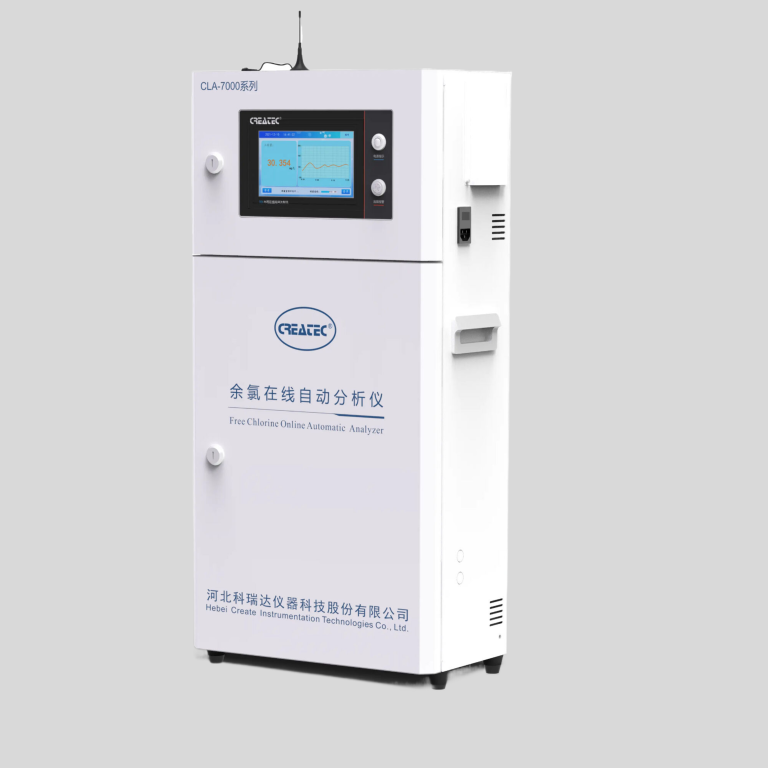
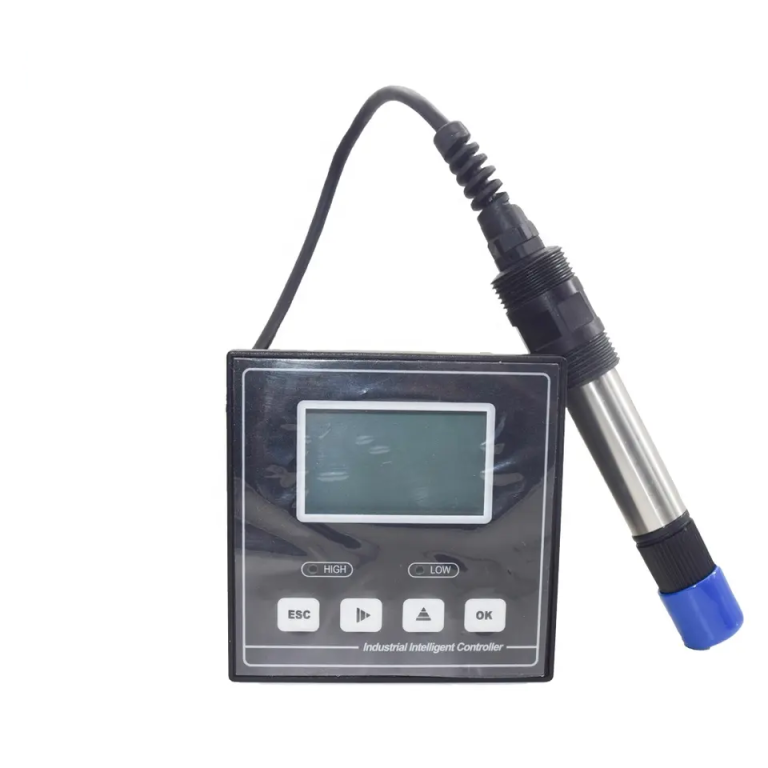
For a four-contactor installation, plan for six to ten transmitters rather than the traditional single analyser at the filter gallery. The instrument specification that makes this affordable is a standard one: measurement range 0.00–10.00 mg/L, accuracy of ±0.03 mg/L or ±2 percent of reading, Modbus RTU and 4–20 mA outputs, and a quick-change flow cell that a shift operator can swap without tools. Shanghai ChiMay’s chlorine transmitter line follows exactly this format, which is why it scales to a multi-contactor arrangement without a proportional increase in maintenance load.
Calibration and Drift Management
Amperometric chlorine sensors drift, and the drift is faster on GAC-filtered water than on clear well water because of the organic matrix. A workable discipline:
- Weekly comparison against a DPD lab reference on one representative unit per train.
- Full calibration whenever the weekly comparison leaves a band that operators can actually act on.
- Membrane cap replacement every 12 to 18 months, or sooner if response time lengthens noticeably.
- Electrolyte inspection at each cap change; a depleted electrolyte shows up first as sluggish response to a step change.
Disinfection Byproduct Interaction
Post-GAC chlorination is a balancing act. Too little residual and the distribution system loses its protection; too much and the elevated organic character of the water — plus any remaining precursors — converts to trihalomethanes and haloacetic acids. Because the carbon’s demand is falling through most of its service life, the correct dose is a moving target. Stage 2 DBPR compliance is computed on locational running annual averages, which means the utility is judged on sustained performance at the worst sites rather than on the average day. Continuous chlorine data, aggregated to 15-minute averages, is the only practical way to see that coming.
Sensor Placement Inside the Contactor Hall
Placement failures are the most common cause of noisy chlorine data. The rules that matter:
- Minimum ten pipe diameters of straight run upstream of the sampling tap, so the sample is mixed.
- Sampling tap angled upward, or on a vertical riser, so air does not accumulate in the sample line.
- A debubbling flow cell on any sample line that can carry entrained gas — GAC beds release both air and dissolved gases after backwash.
- Sample line as short as practical, and flushed before measurement.
Violations of any of these produce noisy data that operators learn to ignore, which is worse than having no sensor at all. Shanghai ChiMay installation drawings supplied with each post-GAC transmitter call out these placement requirements explicitly.
Process Control Integration
Four control uses justify the instrumentation spend:
- Re-chlorination dose feedback. Post-GAC residual drives the trim dose. The control window is short — 30 to 60 seconds — so the loop belongs in the SCADA layer, not in an operator’s head.
- Contactor switching logic. When one vessel’s residual profile diverges from its sisters, it is usually nearing exhaustion or channelling. Automatic comparison flags it.
- Operator alarms. Configurable bands, typically 0.20 mg/L low and 4.00 mg/L high for the finished-water point, so an excursion pages someone rather than waiting for a shift log.
- Compliance reporting. 15-minute averages roll straight into Stage 2 DBPR reporting, removing the reconciliation step that used to consume staff time every quarter.
All four are SCADA-layer functions. Shanghai ChiMay transmitters expose the raw measurement over Modbus, which keeps the analytics in the utility’s own system rather than in a vendor platform.
Risks to Watch
- Single-point monitoring. One analyser at the filter gallery cannot see per-contactor behaviour, and per-contactor behaviour is where the problems start.
- Reagent-based legacy units. Colorimetric and DPD-based continuous analysers carry consumable costs, waste streams, and a maintenance rhythm that competes with the lab’s own DPD testing.
- Inadequate flow regulation. A chlorine sensor sees whatever flow it is given. Unstable flow produces unstable readings, and the fix is a flow cell with a regulator, not a more expensive sensor.
Shanghai ChiMay addresses each of these in its post-GAC configuration: one transmitter per vessel, membrane-based amperometric measurement without reagents, and a regulated quick-change flow cell as standard.
Industry Outlook
GAC’s role is not shrinking. With PFAS compliance deadlines now extended toward 2031 under the EPA’s proposed extension framework, utilities are running carbon harder and longer, and several are adding contactors rather than replacing existing ones. Two design expectations follow. First, plan three to four transmitter positions per contactor train, not one. Second, specify reagent-free measurement and a serialized calibration record, because the compliance documentation burden is only increasing.
The utilities that installed per-vessel chlorine monitoring a few years ago are the ones whose compliance reporting now takes an afternoon. That is the practical argument, and it is the reason Shanghai ChiMay builds its chlorine transmitters around the multi-vessel case rather than the single-analyser case.