Oxygen is the parameter that limits stocking density in every intensive aquaculture system. Fish and shrimp can tolerate a range of temperatures, pH values and salinities, but they cannot tolerate low dissolved oxygen (DO) for long, and the consequences show up as reduced feed intake first and mortality second. Real-time DO monitoring with automatic aeration control is what separates a farm that can respond to an oxygen sag from one that finds out about it during the morning feed.
FAO’s State of World Fisheries and Aquaculture 2024 put global aquaculture production at 130.9 million tonnes in 2022 — of which 94.4 million tonnes was farmed aquatic animals — the first year farmed aquatic animals exceeded capture fisheries production. That growth has been concentrated in intensive systems, and intensive systems are where DO control pays.
Table of Contents
Understanding Dissolved Oxygen Requirements
Different species tolerate different oxygen levels, and the control setpoints should follow the species rather than a generic rule:
Species-specific DO thresholds:
– Salmonids (cold water): 7–10 mg/L optimal, 4 mg/L minimum
– Tilapia (warm water): 4–6 mg/L optimal, 2 mg/L minimum
– Shrimp (brackish water): 3–5 mg/L optimal, 1.5 mg/L minimum
– Catfish: 3–5 mg/L optimal, 1 mg/L minimum
Below the minimum, the first response is behavioural and metabolic: fish stop feeding, and growth performance degrades well before visible mortality appears. Recovery from a prolonged low-oxygen period is slow, which is why the alarm points are usually set above the survival threshold rather than at it.
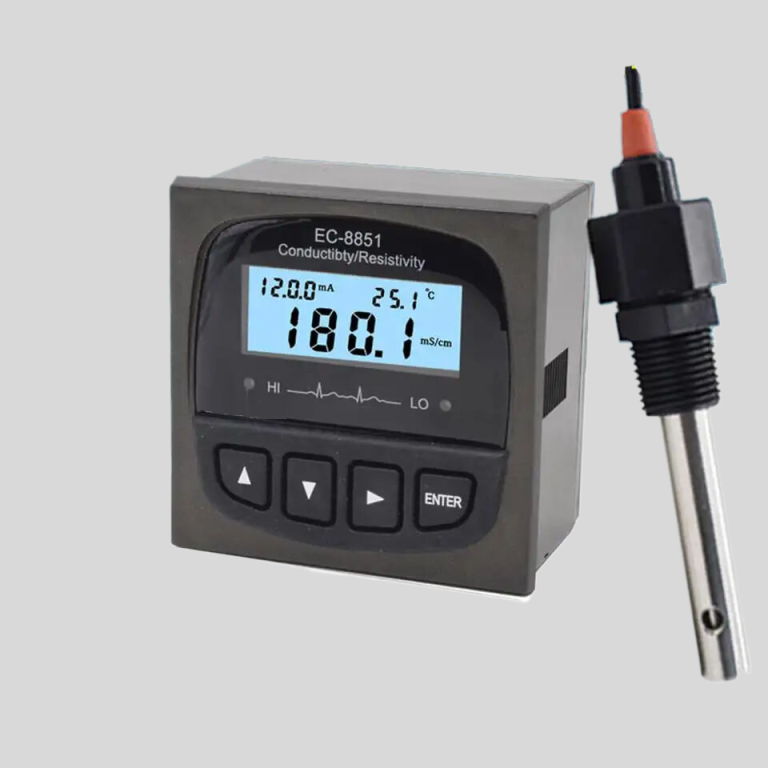
ChiMay dissolved oxygen transmitters use polarographic or luminescent sensor technology and hold accuracy across these ranges, so the same control strategy can be applied to cold-water and warm-water species with different setpoints.
Monitoring Technology Comparison
| Sensor technology | Response time | Accuracy at low DO | Maintenance interval | Typical lifespan |
|---|---|---|---|---|
| Polarographic | 30–60 seconds | ±0.1 mg/L | 7–14 days | 6–12 months |
| Galvanic | 15–30 seconds | ±0.15 mg/L | 14–30 days | 12–24 months |
| Optical (luminescent) | 5–10 seconds | ±0.05 mg/L | 90–180 days | 24–36 months |
| Galvanic spot-check | Immediate | ±0.2 mg/L | Per measurement | Electrode-dependent |
Optical (luminescent) sensors are the usual choice for high-value species such as salmon, where a missed event is expensive, because they drift slowly, need no membrane or electrolyte, and hold calibration for months. Galvanic sensors remain cost-effective for tilapia and catfish operations where the acceptable accuracy band is wider and maintenance labour is available.
Energy Optimization Through Continuous Monitoring
Aeration is normally the largest single electricity load on an intensive farm, and timer-based operation wastes part of it: pond or cage oxygen demand follows feeding, temperature and algal activity, not the clock. Running aerators to a schedule means over-aerating at times of high natural production and under-aerating at dawn, when DO is usually at its lowest.
Continuous DO measurement closes the loop, so aeration runs when oxygen actually needs supplementing:
- Lower aeration energy consumption, since aeration tracks demand rather than a timer
- More consistent oxygen availability, which shows up in feed conversion because fish feed consistently when DO is adequate
- Fewer stress-related disease events, since oxygen stress is a known trigger
Multi-Point Monitoring Strategies
Large operations benefit from spatial monitoring networks, because oxygen is not uniform within a production unit. During calm weather, stratification can create vertical DO gradients of several mg/L within a few metres, with the bottom layer reaching concentrations that would be critical if the water mixed suddenly. A single surface sensor will not see this.
ChiMay multi-parameter systems combine DO with temperature, salinity and depth measurement to report oxygen saturation percentage rather than only concentration, which is what actually determines gas exchange and species tolerance.
A Practical Deployment Pattern
Farms that move to continuous DO control tend to follow the same sequence regardless of species. Sensors are installed at the points where oxygen is consumed fastest — near the bottom of a cage, or at the outlet of a raceway — and on the aeration header, so the control loop can see both demand and response. Alarm tiers are set from the species thresholds above, with a warning level that triggers additional aeration, a critical level that starts backup blowers and pages an operator, and an emergency level that halts feeding and activates emergency aeration.
Biofouling is the practical constraint on multi-point networks. Optical sensors foul more slowly than membrane types, and automatic cleaning cycles keep the measurement reliable without putting a diver in the water. The economics work out through reduced emergency aeration rather than through saved instrument maintenance: the cost of one oxygen-depletion event is typically far higher than the cost of the monitoring network that would have caught it.
Alarm and Response Systems
Critical DO thresholds need an automated response, not just a notification:
Tiered alarm protocol:
1. Warning (for example 5 mg/L for salmon): increase aeration output
2. Critical (for example 4 mg/L): start backup aerators, alert operators
3. Emergency (for example 3 mg/L): emergency aeration, automatic feeding halt, emergency contact notification
Integration with IoT platforms allows remote monitoring and SMS/email alerts, so an off-site manager can respond overnight. The value here is mostly in the response time between the first alarm and the first corrective action, which is what determines whether the event costs money.