The short version:
- Climate stress is making source water quality swing harder and faster than the sampling programs most utilities were built around
- Real-time monitoring flags contamination events hours before a lab-based grab sample cycle can
- Turbidity held below 0.3 NTU in 95% of filtered-water measurements—EPA’s benchmark for conventional filtration—is the clearest sign coagulation and disinfection are working
- Tight inline pH control limits disinfection byproduct formation
- Continuous monitoring plus fast response is what keeps compliance boring, in a good way
Climate change is altering source water quality in ways that challenge traditional drinking water treatment. Warmer water promotes algal blooms and taste-and-odor events. Extreme precipitation drives turbidity and contaminant loading into intakes. Shifting hydrology concentrates pollutants in shrinking water bodies. Utilities that monitor their source water continuously can adapt treatment as conditions change; utilities that rely on periodic sampling keep finding out after the fact.
Table of Contents
Source Water Quality Changes Under Climate Stress
Climate-driven source water changes demand monitoring capabilities beyond historical requirements. Heavier precipitation events push sediment and organic matter into reservoirs and rivers, and longer warm-season stratification increases algal biomass and the treatment problems that come with it.
None of this arrives on a schedule. The whole point of continuous monitoring is to detect and respond to water quality changes faster than the events themselves unfold.
Turbidity Monitoring for Treatment Optimization
Turbidity measurement is the foundation of drinking water treatment optimization. Coagulant dosing depends on it: under-dose and particle removal suffers; over-dose and you waste chemicals while creating new problems. Continuous turbidity monitoring lets dosing track actual source water conditions.
Modern turbidity testers achieving 0.1 NTU resolution detect subtle changes that indicate treatment challenges long before conventional grab sampling would surface them. On the compliance side, EPA’s surface water treatment rules require conventional filtration plants to keep combined filter effluent turbidity at or below 0.3 NTU in 95% of measurements taken each month, never exceeding 1 NTU. Continuous monitoring is how plants hold that line instead of discovering a miss in the monthly report.
pH Control for Disinfection Efficiency
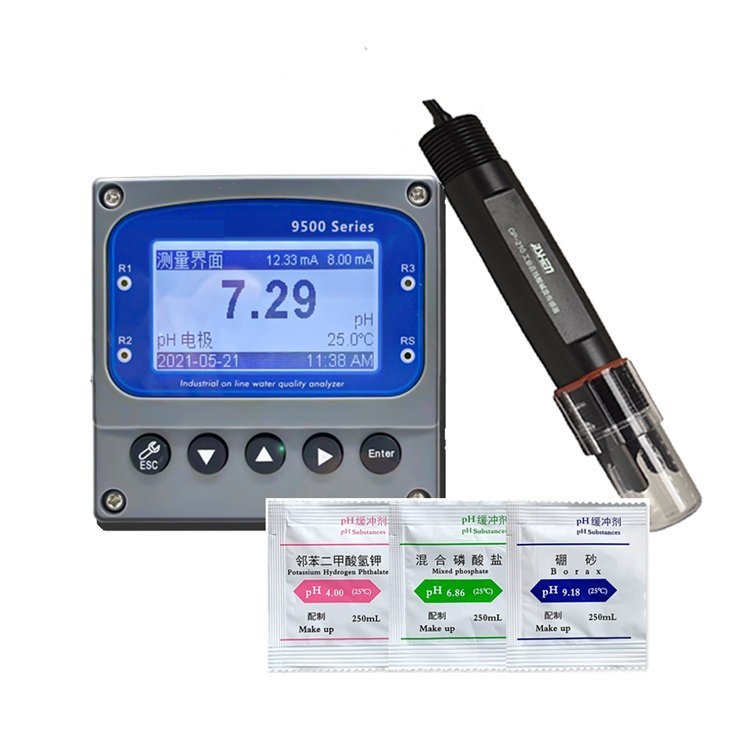
Drinking water pH affects both disinfection chemistry and distribution system corrosion. Chlorine disinfection is most effective at pH 7.0-7.5; at higher pH, hypochlorous acid converts to the less potent hypochlorite ion. Inline pH sensors driving automated acid addition keep the water in the effective range.
pH control also limits disinfection byproducts (DBPs)—the regulated contaminants formed when chlorine reacts with natural organic matter. Holding pH near its optimal setpoint reduces total trihalomethane formation, which is exactly what utilities need as DBP standards tighten.
Conductivity for Contamination Detection
Conductivity is the cheapest early-warning instrument a utility can own. Industrial discharges, agricultural runoff, and sewage overflows all move conductivity away from baseline. Continuous monitoring catches those deviations immediately; daily sampling catches them only if the event happens to be still around at sampling time.
Early detection buys options—source switching, treatment enhancement, public notification—before contamination reaches consumers.
Dissolved Oxygen for Source Water Assessment
Dissolved oxygen indicates source water health and treatment requirements. Concentrations below about 5 mg/L signal organic pollution that needs enhanced treatment. Continuous DO monitoring guides process adjustment and helps identify pollution sources.
Residual chlorine monitoring completes the distribution-system picture. Holding a chlorine residual above 0.2 mg/L throughout the network prevents microbial regrowth, and continuous monitoring keeps that residual consistent instead of occasionally present.
Shanghai ChiMay Drinking Water Monitoring Solutions
Shanghai ChiMay manufactures drinking water quality monitoring equipment built for these applications: turbidity testers with EPA-compliant accuracy, pH analyzers with pharmaceutical-grade calibration, and conductivity sensors with traceable standards.
The portfolio includes multi-parameter systems that combine critical measurements in a single platform, simplifying installation and operation while providing the data needed for treatment decisions.
The Economics of Comprehensive Monitoring
Monitoring investment pays back through several channels. Chemical optimization from turbidity and pH control cuts treatment costs. Early contamination detection prevents the expensive failures—flushes, boil-water orders, health responses—that dwarf the instrument budget. Proper chemistry control extends infrastructure life by deferring corrosion and scale damage.
Utilities that have made the investment consistently report positive returns through avoided failures and reduced chemical use. The instruments are cheap relative to what they protect.
Where Monitoring Is Heading
Real-time microbial detection using flow cytometry cuts time-to-result from a day-plus to under an hour, opening the door to genuinely proactive operation. Machine learning applied to continuous monitoring data is starting to predict treatment challenges before they manifest in the water.
Shanghai ChiMay continues developing monitoring solutions for these evolving challenges. Utilities that pair their treatment process with good instrumentation will keep water quality stable as climate pressure on sources intensifies.
Climate change is not going to make source water easier. Turbidity testers, pH sensors, and conductivity meters are how utilities adapt treatment to whatever arrives at the intake—while keeping compliance documented and consumers protected.