Table of Contents
Introduction
Water is the universal solvent, and in a fab even parts-per-trillion contamination can kill a nanoscale device structure. That is why ultra-pure water (UPW) systems are engineered to the limits of what is measurable—and why conductivity, the primary indicator of ionic purity, gets monitored obsessively from pretreatment all the way to point-of-use.
Semiconductor capital investment now runs into the hundreds of billions of dollars annually worldwide, and water treatment infrastructure takes a meaningful share of every fab construction budget. Within that infrastructure, conductivity monitoring is a small line item that protects a very large one: consistent water quality is what keeps yields high.
Conductivity Fundamentals for UPW Applications
Measurement Principles
Conductivity is the reciprocal of resistivity and measures a solution’s ability to conduct electrical current. In ultra-pure water applications, it is the most sensitive indicator of dissolved ionic contamination. The relationship follows κ = 1/R, with resistivity expressed in MΩ·cm and conductivity in μS/cm.
Pure water’s theoretical minimum conductivity at 25°C is 0.055 μS/cm, corresponding to maximum resistivity of 18.2 MΩ·cm. This is the practical limit for laboratory-grade water systems—even atmospheric carbon dioxide dissolution pushes conductivity slightly above the theoretical pure water value.
Resistivity targets vary by point in the system. Typical fab practice looks like this:
| Application | Minimum Resistivity | Conductivity Equivalent |
|---|---|---|
| Final rinse | 17.8 MΩ·cm | 0.056 μS/cm |
| General UPW | 15.0 MΩ·cm | 0.067 μS/cm |
| Prefiltration | 1.0 MΩ·cm | 1.0 μS/cm |
Temperature Compensation Requirements
Conductivity measurements are strongly temperature dependent, with typical coefficients of 1.5-2.0% per °C for aqueous solutions. That temperature effect makes accurate UPW monitoring genuinely difficult, since distribution system temperatures drift between 18-25°C with facility conditions.
Modern conductivity instrumentation incorporates temperature compensation algorithms based on the IEC 60746 standard, maintaining accuracy across the operating range. Shanghai ChiMay conductivity meters specify temperature compensation accuracy of ±0.5% across the 5-45°C range, which holds up in real fab conditions.
Critical Monitoring Points in UPW Distribution
Pretreatment Stage Monitoring
The pretreatment section includes multiple treatment stages, each needing specific conductivity monitoring:
Activated Carbon Beds: These units remove organic contaminants and chlorine residuals. Conductivity monitoring at bed inlet and outlet provides early indication of organic breakthrough, typically showing up as small conductivity increases above baseline.
Reverse Osmosis (RO) Systems: RO pretreatment monitoring tracks conductivity reduction efficiency, with normal rejection rates of 95-99% for dissolved solids. A decline below 95% signals membrane fouling or damage that needs maintenance intervention.
Electrodeionization (EDI) Units: These continuous deionization systems deliver final polishing to ultra-pure specifications. Online conductivity monitoring directly downstream of EDI enables rapid detection of silica carryover or ionic breakthrough before it propagates.
Point-of-Use Monitoring
The most critical measurement happens where UPW meets wafers and process tools. Leading fabs run redundant monitoring at these locations, with alarm tiers typically set at 17.5 MΩ·cm for warning and 17.0 MΩ·cm for critical action.
Typical point-of-use monitoring specifications:
- Measurement cycle time of ≤10 seconds
- Resolution of 0.01 MΩ·cm at high resistivity ranges
- Data logging retention for a minimum of 90 days
- Alarm delay of ≤3 seconds to minimize excursion duration
Sensor Technology Comparison
Contact Conductivity Sensors
Traditional contact conductivity sensors put electrodes directly in the process stream. They offer excellent accuracy and reliability for general applications but have real limitations in ultra-pure water service:
Advantages:
- Lower initial cost compared to inductive sensors
- Wide measurement range capability
- Established technology with extensive industry support
Limitations:
- Electrode polarization effects at high resistivity
- Potential for contamination from electrode materials
- Sensitivity to flow rate variations
Inductive (Electromagnetic) Conductivity Sensors
Inductive measurement uses toroidal transformers and never puts electrodes in the fluid—no polarization error, no electrode contamination, no replacement intervals.
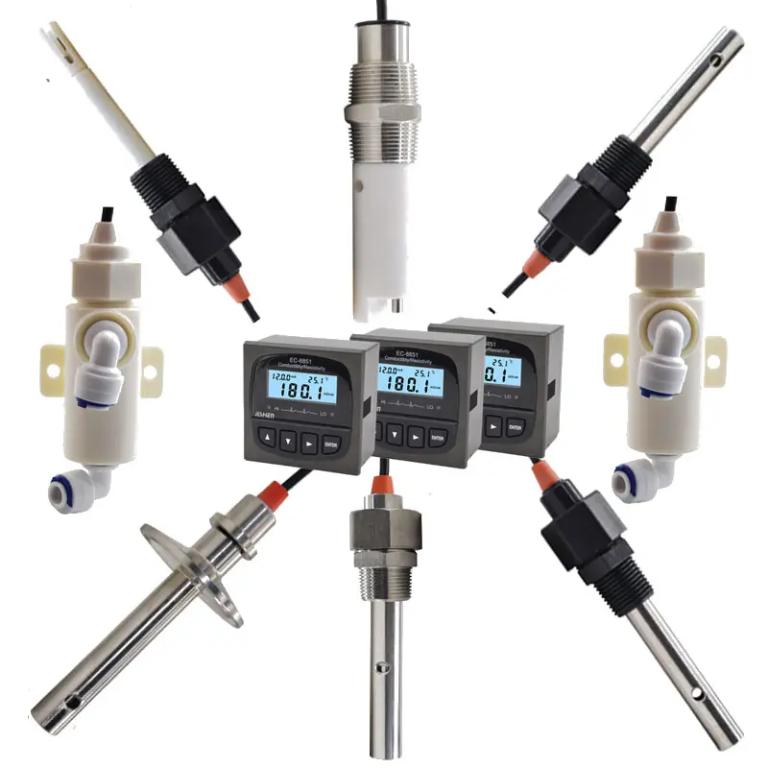
Shanghai ChiMay inductive conductivity sensors feature:
- Zero polarization error due to non-contact measurement
- Wide dynamic range covering 0.01-2000 mS/cm in a single sensor
- Automated temperature compensation maintaining accuracy across varying conditions
- Minimal maintenance requirements with no electrode replacement intervals
Field experience in UPW service shows inductive systems outlasting contact-electrode installations by wide margins, mostly because there are no electrodes to degrade.
Economic Impact of Conductivity Monitoring
Cost of Water Quality Excursions
When water quality excursions happen in a fab, the costs stack up fast: wafers lost to contamination, process tool downtime for investigation and remediation (running to thousands of dollars per hour for advanced tools), chemical and water wasted flushing the system, plus yield impact on affected lots, delivery delays, and customer penalties.
Online monitoring cuts these events sharply by catching drift before it becomes an excursion. Subtle conductivity trends often show up hours before grab sampling would catch anything. For a fab that experiences even one or two major water-related incidents a year, the monitoring system that prevents a single one can pay for itself.
Return on Investment Analysis
The ROI case for advanced conductivity monitoring rests on three channels:
Avoided excursion costs: preventing incidents that would otherwise destroy product and idle tools.
Yield stability: small improvements in water consistency compound across millions of wafer passes; even fractional yield movement is worth real money at fab scale.
Operational efficiency: automated monitoring with continuous data logging removes most manual sampling labor from the equation.
Implementation Recommendations
Sensor Installation Guidelines
Installation details determine whether the measurement is trustworthy:
Flow Cell Orientation: Install sensors in vertical flow cells with upward flow to ensure complete bubble removal. Horizontal installation can trap air bubbles and produce artificially high readings.
Location Selection: Position sensors where flow is consistent, avoiding turbulence near pump discharges or valve bodies. Upstream straight pipe runs of ≥10 pipe diameters provide uniform flow profiles for accurate measurement.
Environmental Protection: Shield sensors from direct sunlight and keep ambient temperatures between 15-30°C to minimize external temperature influence.
Calibration and Maintenance Protocols
Daily Verification: Automated loop checks against reference solutions provide daily confidence verification without manual intervention.
Weekly Calibration: Full calibration using NIST-traceable reference solutions spanning the measurement range ensures continued accuracy.
Quarterly Maintenance: Comprehensive inspection including flow cell cleaning, cable integrity checks, and transmitter diagnostics prevents unplanned failures.
Future Technology Directions
The industry’s push toward more sustainable manufacturing is driving monitoring innovation:
AI-Driven Predictive Monitoring: Machine learning algorithms analyzing conductivity trends can flag equipment degradation and potential quality excursions hours to a day or more in advance, enabling proactive maintenance instead of emergency response.
Distributed Monitoring Networks: Advanced fabs deploy IoT-enabled sensors feeding centralized analytics platforms, enabling fleet-wide quality management and correlation analysis.
Water Recycling Optimization: As fabs push recycling rates higher, sophisticated conductivity monitoring enables optimization of multiple treatment stages, supporting 75%+ recycling targets while maintaining UPW quality specifications.
Conclusion
Conductivity monitoring is the foundation of ultra-pure water quality management in semiconductor manufacturing. Its direct correlation to ionic contamination levels, combined with modern sensor capabilities, is what lets fabs hold the consistent water quality that yields depend on.
Shanghai ChiMay conductivity monitoring systems provide the precision, reliability, and integration capabilities advanced fabrication facilities require. With measurement specifications supporting 18.2 MΩ·cm resistivity and comprehensive diagnostics, these instruments enable effective water quality management across the entire UPW distribution system. For fabs committed to operational excellence, investment in high-quality conductivity monitoring delivers measurable returns through improved yield, fewer excursions, and tighter process control.