Understanding the Principles of a Water Flow Sensor
Water flow sensors are essential devices used in various industries and applications to measure the flow rate of water. These sensors play a crucial role in ensuring efficient water usage, monitoring water consumption, and detecting leaks in pipelines. Understanding how a water flow sensor works is essential for anyone looking to utilize this technology effectively.
At its core, a water flow sensor operates based on the principle of measuring the movement of water through a pipe or channel. The sensor typically consists of a sensing element, which is in direct contact with the flowing water, and a transducer that converts the physical movement of the water into an electrical signal.One common type of water flow sensor is the turbine flow sensor. This sensor features a rotor with blades that spin as water flows through the pipe. The speed of the rotor’s rotation is directly proportional to the flow rate of the water. A magnetic pickup or Hall-effect sensor is used to detect the rotation of the blades and generate an electrical signal that corresponds to the flow rate.
Ultrasonic flow sensors are another popular choice for measuring water flow. These sensors use ultrasonic waves to determine the velocity of the water passing through the pipe. By measuring the time it takes for the ultrasonic waves to travel upstream and downstream, the sensor can calculate the flow rate of the water accurately.
| Instrument model | FET-8920 | |
| Measurement range | Instantaneous flow | (0~2000)m3/h |
| Accumulative flow | (0~99999999)m3 | |
| Flow rate | (0.5~5)m/s | |
| Resolution | 0.001m3/h | |
| Accuracy level | Less than 2.5% RS or 0.025m/s.whichever is the largest | |
| Conductivity | >20μS/cm | |
| (4~20)mA output | Number of channels | Single channel |
| Technical features | Isolated,reversible,adjustable, meter/transmission dual mode | |
| Loop resistance | 400Ω(Max), DC 24V | |
| Transmission accuracy | ±0.1mA | |
| Control output | Number of channels | Single channel |
| Electrical contact | Semiconductor photoelectric relay | |
| Load capacity | 50mA(Max), DC 30V | |
| Control mode | Instantaneous amount upper/lower limit alarm | |
| Digital output | RS485(MODBUS protocol ),Impulse output1KHz | |
| Working power | Power supply | DC 9~28V |
| source | Power Consumption | ≤3.0W |
| Diameter | DN40~DN300(can be customized) | |
| Working environment | Temperature:(0~50) ℃; Relative humidity: ≤85%RH(none condensation) | |
| Storage environment | Temperature:(-20~60) ℃; Relative humidity: ≤85%RH(none condensation) | |
| Protection grade | IP65 | |
| Installation method | Insertion pipeline installation | |
Another type of water flow sensor is the paddlewheel sensor, which features a paddlewheel that spins as water flows through the pipe. The rotation of the paddlewheel is detected by a sensor, such as a magnetic pickup or optical sensor, to determine the flow rate of the water.
One of the key advantages of water flow sensors is their ability to provide real-time data on water usage and flow rates. This information is crucial for monitoring water consumption, detecting leaks, and optimizing water distribution systems. By integrating water flow sensors into a networked system, users can remotely monitor and control water flow in real-time, leading to improved efficiency and cost savings.
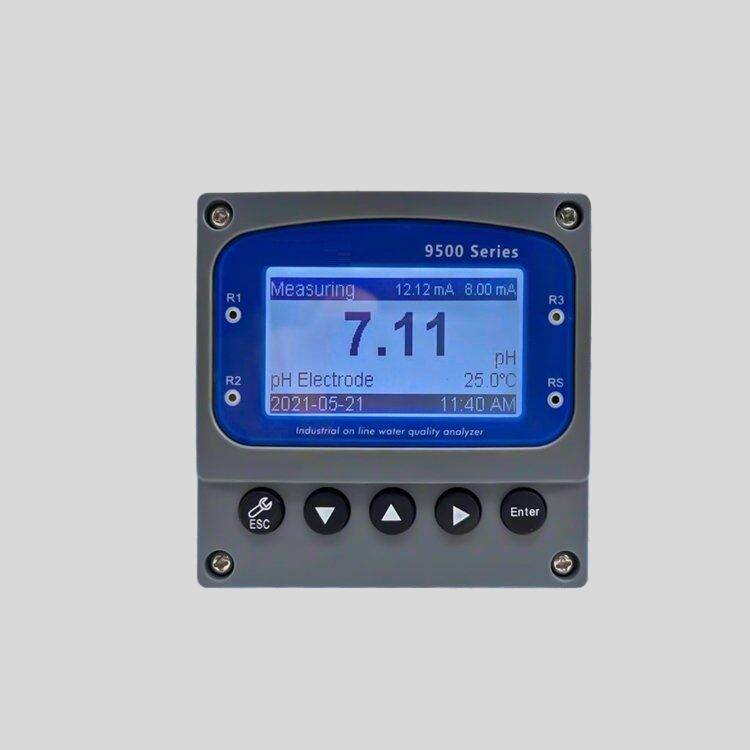

Water flow sensors are also used in various applications, such as irrigation systems, HVAC systems, industrial processes, and water treatment plants. In irrigation systems, water flow sensors help ensure that crops receive the right amount of water, leading to improved crop yields and water conservation. In HVAC systems, these sensors help optimize the flow of water for cooling and heating, improving energy efficiency and reducing operating costs.
| Model | pH/ORP-3500 pH/ORP Meter |
| Range | pH:0.00~14.00 ; ORP: (-2000~+2000)mV; Temp.:(0.0~99.9)°C (Temp.Compensation: NTC10K) |
| Resolution | pH:0.01 ; ORP: 1mV; Temp.:0.1°C |
| Accuracy | pH:+/-0.1 ; ORP: +/-5mV(electronic unit); Temp.: +/-0.5°C |
| Temp. compensation | Range: (0~120)°C; element: Pt1000 |
| Buffer Solution | 9.18; 6.86; 4.01; 10.00; 7.00; 4.00 |
| Medium Temp. | (0~50)°C (with 25°C as standard) manual/automatic temp. compensation for selection |
| Analog output | Isolated one Channel(4~20)mA, Instrument/Transmitter for selection |
| Control Output | Double relay output (single contact ON/OFF) |
| Working Environment | Temp.(0~50)℃; relative humidity <95%RH (non-condensing) |
| Storage Environment | Temp.(-20~60)℃;Relative Humidity ≤85%RH (none condensation) |
| Power Supply | DC 24V; AC 110V; AC220V |
| Power consumption | <3W |
| Dimension | 48mmx96mmx80mm(HxWxD) |
| Hole Size | 44mmx92mm(HxW) |
| Installation | Panel mounted, fast installation |
In conclusion, water flow sensors are essential devices that play a crucial role in measuring and monitoring the flow rate of water in various applications. By understanding the principles of how these sensors work, users can effectively utilize this technology to improve water efficiency, detect leaks, and optimize water distribution systems. With advancements in sensor technology, water flow sensors continue to evolve, providing more accurate and reliable data for better water management.