Sequencing batch reactor (SBR) technology has established itself as a versatile and effective approach for industrial wastewater treatment, offering operational flexibility and excellent treatment performance in a compact footprint. However, SBR systems face challenges when treating wastewater containing toxic or recalcitrant compounds that inhibit biological activity or resist biodegradation. Electrochemical enhancement offers a powerful solution for these challenging wastewater streams, enabling SBR systems to achieve treatment objectives that would otherwise require expanded reactor volumes or alternative treatment technologies.
Table of Contents
Fundamentals of Electrochemical-SBR Integration
The hybrid electrochemical-SBR concept combines the biological degradation capabilities of conventional SBR operation with the oxidative power of electrochemical treatment. Two integration architectures are in common use: electrochemical pretreatment and electrochemical polishing.
Electrochemical Pretreatment Configuration
In the pretreatment configuration, wastewater passes through an electrochemical reactor before entering the SBR basin. The electrochemical stage achieves rapid oxidation of readily biodegradable organics and destruction of toxic compounds that would otherwise inhibit biological activity. The pretreated effluent enters the SBR with substantially reduced toxicity and simplified organic composition, enabling more efficient biodegradation.
This configuration offers several advantages: the electrochemical stage reduces the biological reactor volume required for target treatment efficiency; toxic compound destruction eliminates biomass inhibition issues; and the shorter hydraulic retention time improves treatment capacity for existing facilities. Pilot and bench-scale experience consistently shows that electrochemical pretreatment can substantially reduce the biological reactor volume required for equivalent treatment performance, although the achievable reduction depends strongly on wastewater composition and should be verified through treatability testing rather than assumed from literature values.
Electrochemical Polishing Configuration
The polishing configuration operates the SBR in conventional biological mode, with electrochemical treatment applied during the reaction phase or as a final polishing step before discharge. This approach addresses recalcitrant compounds that persist through biological treatment, achieving higher overall removal efficiency than either technology alone.
Electrochemical polishing is particularly effective for wastewater streams containing chlorinated organic compounds, aromatic amines, and synthetic dyes that resist biological degradation. The hydroxyl radicals and other oxidants generated at the anode surface attack these recalcitrant compounds, converting them to biodegradable intermediates or complete mineralization products.
Low-Voltage Electrochemical Operation
Operating Principle
Conventional electrochemical oxidation typically operates at current densities of tens up to a hundred milliamperes per square centimeter with cell voltages of five to ten volts, which implies substantial energy input. Low-voltage electrochemical enhancement operates at much lower cell voltage—on the order of three volts—and correspondingly lower current densities, trading some oxidation rate for a large reduction in energy consumption while maintaining treatment effectiveness for many wastewater applications.
The lower operating voltage limits direct water oxidation to oxygen evolution, favoring indirect oxidation mechanisms through electrogenerated oxidants. At these low cell voltages, the primary oxidant species generated depend on wastewater composition:
- In chloride-containing wastewater: hypochlorous acid (HOCl) and chlorine gas (Cl₂)
- In sulfate-containing wastewater: peroxomonosulfate (PMS) and persulfate (S₂O₈²⁻)
- In carbonate-containing wastewater: carbonate radicals (CO₃•⁻)
These electrogenerated oxidants exhibit lower oxidation potentials than hydroxyl radicals but demonstrate sufficient reactivity for effective treatment of many industrial wastewater streams.
Treatment Efficiency Data
Published performance figures for low-voltage electrochemical-SBR hybrids vary widely with wastewater composition, electrode material, and operating point. The following illustrative example, based on synthetic phenolic wastewater at bench scale, shows the magnitudes typically reported in the literature:
| Parameter | Influent | After Electrochemical | After SBR | Overall Removal |
|---|---|---|---|---|
| COD (mg/L) | 3,000 | 900 | 60 | 98% |
| Phenol (mg/L) | 500 | 75 | <5 | >99% |
| Color (Pt-Co) | 800 | 160 | 20 | 97.5% |
Treat these figures as an order-of-magnitude illustration only. In this example, the electrochemical stage removes roughly 70% of COD and 85% of phenol at a low cell voltage, a moderate current density, and a sub-hour hydraulic retention time in the electrochemical cell; the subsequent biological stage polishes the effluent further. Actual performance for a specific industrial stream must be established through jar testing and pilot runs before it can be used as a design basis.
Energy Consumption Analysis
Energy demand in the hybrid system splits mainly between the electrolysis stage and SBR aeration, with recirculation and mixing accounting for a minor share. Total specific energy consumption for such hybrid trains is typically on the same order as conventional activated sludge treatment—and well below what standalone advanced oxidation would require, since AOP alone generally consumes several times more energy per cubic meter than biological processing. The energy case for the hybrid approach rests on using electricity only where biology cannot do the work.
SBR Operational Considerations
Cycle Time Optimization
Electrochemical enhancement enables meaningful cycle time reductions compared to conventional SBR operation. The pretreated influent exhibits faster biodegradation kinetics due to reduced toxicity and simplified organic composition. Typical effects on cycle phases include:
- Fill time: Unchanged (determined by hydraulic loading)
- React time: Reduced due to pretreated influent characteristics
- Settle time: Potentially reduced due to improved sludge settling properties
- Decant time: Unchanged (determined by decanter design)
Any overall cycle time reduction translates directly to increased treatment capacity for existing SBR facilities; the magnitude achievable at a given site depends on how much of the react phase was actually occupied by toxicity-limited degradation.
Biomass Characteristics
Electrochemical treatment in the pretreatment configuration influences SBR biomass characteristics in several beneficial ways:
Improved Sludge Settling: Electrochemical coagulation generates aluminum and iron hydroxides that improve floc formation and settling velocity. Sludge volume index (SVI) improvements are commonly observed in hybrid systems compared to conventional SBR operation.
Enhanced Biodegradation: Removal of toxic compounds in the electrochemical stage creates favorable conditions for specialized microbial populations. Molecular analysis reveals increased abundance of phenol-degrading bacteria and aromatic compound metabolism genes in hybrid system biomass.
Reduced Sludge Production: Electrochemical oxidation of a portion of the influent organic matter reduces the substrate available for biological conversion to biomass, so net sludge production drops relative to an all-biological train handling the same load.
Monitoring and Control Requirements
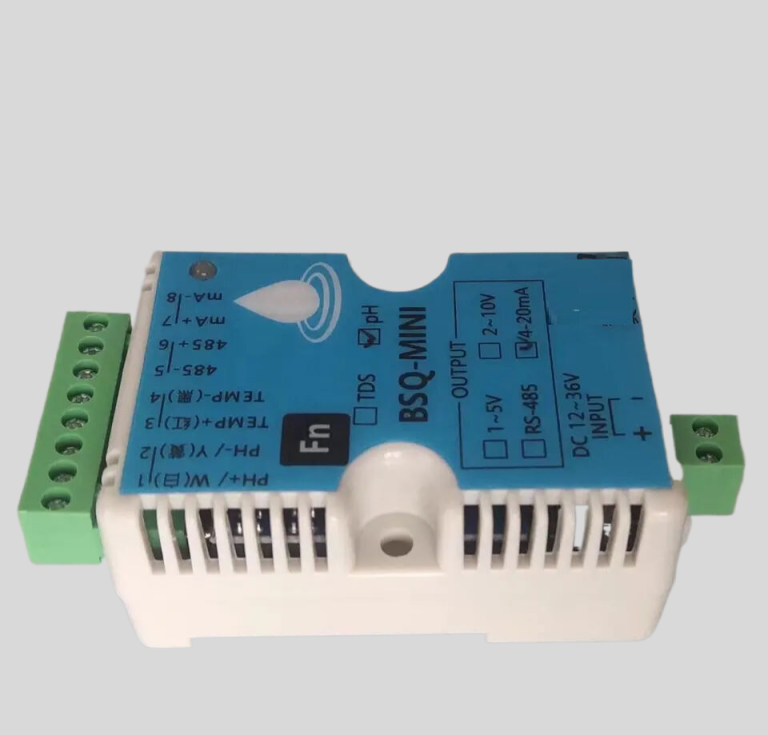
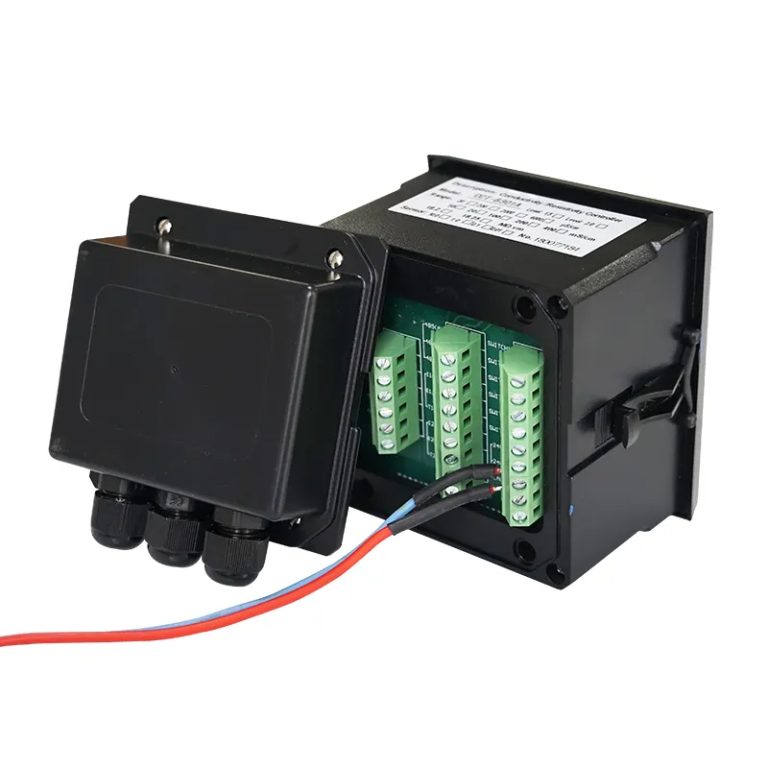
Effective operation of hybrid electrochemical-SBR systems requires comprehensive monitoring and automated control to optimize treatment performance and energy consumption. Shanghai ChiMay online analyzers provide the critical measurement capabilities for this application.
Essential Monitoring Parameters
Electrochemical Stage:
– Influent and effluent pH (target range: 6.5-8.5)
– Conductivity (maintain >1 mS/cm for adequate electrolyte)
– Oxidation-reduction potential (ORP indicator of treatment progress)
– Dissolved organic carbon (DOC) for treatment efficiency verification
SBR Basin:
– Dissolved oxygen concentration (maintain 2-4 mg/L during react phase)
– pH (maintain 6.8-7.5 for optimal nitrification if applicable)
– Mixed liquor suspended solids (MLSS) for biomass management
– Sludge blanket level for settle phase monitoring
Automated Control Strategies
Advanced control systems utilize monitoring data to optimize treatment performance:
- Current density adjustment: ORP and DOC measurements trigger current density reduction when treatment objectives are achieved, saving energy
- Cycle time optimization: MLSS and substrate concentration measurements enable dynamic cycle time adjustment based on actual treatment kinetics
- Electrode cleaning scheduling: Conductivity trends indicate electrode scaling, triggering automated cleaning cycles
Shanghai ChiMay’s multi-parameter sensors integrate multiple measurements in a single probe, reducing installation complexity and maintenance requirements while providing comprehensive data for automated control system implementation.
Design Recommendations
Electrochemical Reactor Sizing
Electrochemical reactor volume should be sized for the target hydraulic retention time at design flow rate. An HRT of 30-45 minutes is a typical starting point for industrial wastewater, with the final value set by pilot testing:
- Reactor volume = Design flow × HRT
- Example: a 500 m³/day design flow at 30-45 minutes HRT corresponds to roughly 10-16 m³ of reactor volume
Electrode surface area determines treatment capacity at a given current density. The required electrode-area-to-flow ratio should be established experimentally for the specific wastewater, since it depends on the target oxidation duty, electrode material, and the conductivity available in the stream.
SBR Basin Considerations
The SBR basin should be sized for the reduced hydraulic retention time enabled by electrochemical pretreatment; for equivalent treatment performance the basin is typically smaller than a conventional SBR would be, with the exact ratio established during design rather than assumed.
Blower capacity should account for the higher oxygen demand during the react phase due to pretreated influent characteristics. Aeration system design should include fine bubble diffusers for efficient oxygen transfer and dissolved oxygen control capability.
Conclusion
Low-voltage electrochemical enhancement gives SBR-based treatment trains a way to handle toxic and recalcitrant loads without expanding reactor volumes or adding entirely separate treatment technologies. The hybrid configuration combines the oxidative capability of low-voltage electrolysis with the economics of biological treatment; its performance envelope and energy demand for a specific wastewater should be confirmed through bench- and pilot-scale testing before committing to a design. Integration with Shanghai ChiMay online monitoring systems provides the measurement foundation for automated optimization and reliable treatment performance verification.