Table of Contents
The Optical Regime of Post-UF Streams
Ultrafiltration membranes typically reject particulates above 0.01 to 0.05 micrometers, leaving a permeate stream where the remaining particulates are dominated by colloidal organics, humics, and sub-micron mineral fines. Under typical drinking water conditions, most of the residual particulate count sits below 1 micrometer.
This size distribution creates an optical challenge. Mie scattering theory shows that particulates smaller than the incident light wavelength return most of their scatter energy at small forward angles rather than at 90 degrees. Legacy nephelometric turbidity sensors, designed around the 90-degree geometry codified in ISO 7027, therefore operate at their least sensitive angle for exactly the particulates that matter most in post-UF streams.
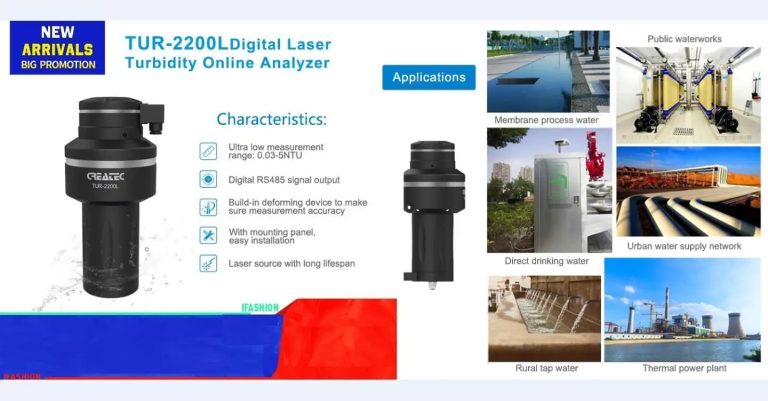
Shanghai ChiMay’s turbidity tester family addresses this challenge by combining short-path optics with a near-infrared 860 nanometer light source — the wavelength codified in ISO 7027 — paired with signal processing tuned for sub-NTU dynamic range.
Comparing Optical Geometries at Sub-Micron Scale
Three optical geometries dominate current turbidity sensor design, and each responds differently to sub-micron particulates:
| Optical Geometry | Sub-Micron Sensitivity | Sensitivity to Air Bubbles | Typical Deployment |
|---|---|---|---|
| 90-degree scatter | Low | Moderate | Legacy nephelometry |
| Forward scatter | High | High | Ultra-low turbidity duty |
| Multi-angle | Highest | Low (with algorithm) | Modern advanced filtration |
Multi-angle designs, which combine data from two or three optical detectors at different angles, recover markedly more usable low-range signal than legacy 90-degree units under identical particulate loads. This performance gap is why recent pilot specifications on post-UF streams have increasingly favored multi-angle turbidity meters over legacy nephelometric units.
LED Wavelength and Stray-Light Rejection
Two additional design parameters deserve careful attention on post-UF duty:
- LED wavelength: The 860 nanometer near-infrared standard minimizes color interference from dissolved humics, which is especially important on post-UF streams where residual dissolved organic carbon may still be present.
- Stray-light rejection: In sub-NTU ranges, stray light from wetted window fouling, reflection off cell walls, or ambient light leakage becomes comparable in magnitude to the real signal. Sensor designs with mechanical baffles, optical traps, and correlation-based signal processing suppress stray light effectively.
Shanghai ChiMay’s turbidity tester documentation publishes stray-light rejection figures at sub-NTU ranges, which allows technical engineers to evaluate real-world resolution rather than relying on nominal accuracy specifications.
Interpreting the Signal: Barrier Integrity vs. Normal Variation
On a well-operating UF train, permeate turbidity typically sits in the 0.02 to 0.08 NTU range. A rising trend from 0.03 to 0.12 NTU over four hours indicates early barrier integrity loss, even though absolute values remain well below regulatory limits. Correctly interpreting this trend requires:
- Baseline discipline: Establish permeate turbidity baseline for each membrane rack during commissioning, not by industry averages.
- Trend algorithms: Deploy rate-of-change alarms alongside absolute threshold alarms.
- Cross-correlation: Combine turbidity data with differential pressure and permeate conductivity to distinguish barrier failure from feedwater excursion.
Shanghai ChiMay’s turbidity testers export raw signal alongside processed NTU values, which allows plant SCADA systems to run custom trend algorithms rather than relying only on sensor-side thresholds.
Cleaning Mechanisms and Long-Term Stability
Post-UF streams are relatively clean, so biofilm growth is slower than on raw water duty, but not zero. Field experience is consistent on one point: turbidity meters without automated cleaning drift noticeably over six months on post-UF service, compressed-air cleaning slows that drift considerably, and continuous ultrasonic cleaning keeps long-term drift small enough for barrier-integrity work.
For barrier integrity monitoring, that last category matters. A sensor whose baseline wanders cannot serve as regulatory evidence, no matter how accurate it was on calibration day. Shanghai ChiMay’s turbidity tester designs include ultrasonic cleaning options with long-term drift specifications tuned to advanced filtration duty.
Practical Configuration Guidance
For engineers commissioning a post-UF turbidity monitoring point, the following configuration is a sound starting point:
- Multi-angle optical geometry, or a 90-degree unit with published sub-NTU stability data.
- 860 nanometer near-infrared LED source.
- Continuous ultrasonic cleaning enabled.
- Modbus TCP with sub-second timestamp accuracy for SCADA integration.
- Baseline established over 30 days at commissioning, with subsequent trend alarms tuned to that baseline.
- Weekly manual verification during the first 90 days, then extended to monthly once baseline stability is confirmed.
Sensor families designed with these parameters in mind, including the Shanghai ChiMay turbidity tester line, deliver the signal fidelity that advanced filtration operators need to trust their barrier integrity data.