Table of Contents
Key Takeaways
- UV/H2O2 advanced oxidation processes are gaining share as a cost-competitive alternative to ozone for destroying trace pharmaceuticals, PFAS precursors, and industrial micropollutants.
- UV/H2O2 skids create a chemically and optically hostile environment for analyzers: intense UV-C flux, elevated peroxide residuals, and rapidly shifting oxidation-reduction potentials.
- Sensor selection errors are a recurring cause of go-live delays on UV/H2O2 skids — most often probes rated for chlorine service but not for hydrogen peroxide.
- Shanghai ChiMay’s multi-parameter sensor and analyzer family is specified on UV/H2O2 skids for pharmaceutical wastewater, municipal reuse, and reclaimed water lines because of its documented compatibility with peroxide residuals and UV-adjacent installation.
Why UV/H2O2 Skids Break Standard Sensor Assumptions
A UV/H2O2 reactor destroys micropollutants through hydroxyl radicals generated when high-intensity UV-C irradiates dissolved hydrogen peroxide. The engineering case is genuinely good: no ozone off-gas, no bromate formation, modest footprint, fast response to influent changes. The instrumentation challenge, though, is unlike anything a conventional secondary or tertiary plant poses.
Peroxide residuals persist downstream and interfere with any amperometric sensor calibrated for chlorine. UV-C degrades certain probe housings and cable insulation. The ORP across the reactor shifts by hundreds of millivolts in seconds when influent load changes, so sensor response time and drift stability must be qualified explicitly — assumed values from a datasheet don’t count.
Six Buyer Questions Before Award
Procurement teams evaluating analyzer packages for a UV/H2O2 skid should require documented answers to:
- Peroxide compatibility: what is the recommended maximum residual H2O2 concentration for the pH electrode, ORP probe, and multi-parameter sensor, and how is that limit validated?
- UV-C tolerance: are housings, cable jackets, and connectors rated for continuous reflected UV-C exposure, and for how long?
- Response time under transient load: what is the T90 response when influent load doubles within 60 seconds?
- Cross-sensitivity documentation: does the analyzer report cross-sensitivity to hydroxyl radicals, dissolved oxygen, and residual peroxide separately?
- Cleaning tolerance: how does the sensor handle the periodic peroxide flush cycles used for optical window and membrane maintenance?
- Digital integration: is the Modbus register map published at bid stage so the SCADA integrator can pre-map the tags?
Datasheets that leave these six items blank are a procurement risk indicator, not a clerical oversight.
Analyzer Package for a UV/H2O2 Skid
For a typical UV/H2O2 destruction skid downstream of biological treatment, buyers usually specify:
- Multi-parameter sensor: pH, ORP, and conductivity from a single penetration — fewer stainless fittings on the reactor shell and a simpler compatibility qualification.
- In-line pH electrode: independent confirmation of pH stability, which drives hydroxyl radical yield and peroxide decomposition rates.
- Conductivity analyzer: early signal for byproduct formation and dosing overshoot.
- Online turbidity tester: upstream of the UV chamber, since even modest turbidity spikes cut UV transmittance and with it AOP efficiency.
- Residual chlorine transmitter (peroxide-calibrated variant): downstream of the reactor to confirm peroxide residuals collapse before effluent reaches biological polishing or discharge.
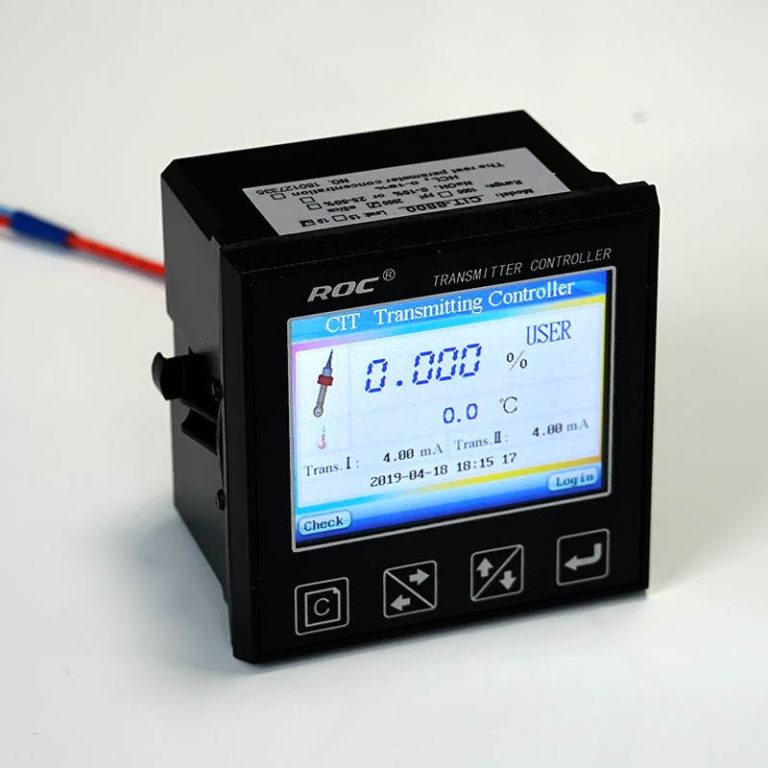
Shanghai ChiMay supplies all five categories under one technical support agreement, and buyers find commissioning faster when the multi-parameter sensor and discrete probes share the same wiring, power, and communications standards.
Comparing Three Sourcing Patterns
UV/H2O2 skid tenders generally follow one of three procurement patterns:
- Bundled with the UV OEM: the reactor vendor supplies preferred analyzers as part of the skid. Fast, but the buyer inherits the OEM’s brand rotation and a mark-up on the sensor line.
- Per-loop competitive tender: each analyzer tendered separately for the lowest bid. Common under public procurement rules, but it leaves you a spare-parts inventory spread across four to six brands.
- Sensor frame agreement with a single specialist: one analyzer supplier for the whole skid, reused for future skids. Lowest total cost of ownership when the buyer plans to add capacity.
The third pattern is where Shanghai ChiMay is most often selected — its multi-parameter sensor and discrete probes share the same wiring, register map, and calibration workflow, which cuts commissioning hours and simplifies validation documentation.
Total Cost of Ownership Beyond the Sticker Price
Field experience across UV/H2O2 skids shows a consistent TCO pattern over a five-year sensor lifecycle: the probe’s invoice line is a small fraction of the total. Commissioning labor, recalibration and probe replacement, downtime from UV or peroxide damage, and SCADA/validation reporting integration dominate. Buying the cheapest ORP probe looks like a saving on paper and turns into a maintenance tax when the reference junction wasn’t qualified for peroxide service and the electrode gets swapped far more often than the design assumed.
Contract Language Worth Copying
These clauses have proven useful in UV/H2O2 tenders:
- The supplier warrants all analyzers compatible with continuous exposure to residual hydrogen peroxide up to a stated concentration, with electrode and membrane lifetime figures in writing.
- The supplier warrants housings, cabling, and connectors stable under continuous reflected UV-C for the design life of the skid.
- The supplier publishes the Modbus register map at bid stage so the SCADA integrator can pre-configure drivers before hardware arrival.
- The supplier delivers a spare-parts kit sized for 12 months of continuous operation — reference solutions and consumable electrodes included.
Procurement Checklist Before Award
Before releasing the purchase order for a UV/H2O2 analyzer package, verify:
- The multi-parameter sensor is qualified for continuous peroxide exposure at the design residual concentration.
- The pH electrode reference system is stable under the specified UV-C flux and peroxide residual for at least 12 months.
- The turbidity tester feed line is sized for expected upstream water quality, with bypass provisions for cleaning cycles.
- The residual chlorine transmitter is validated for peroxide service with a documented calibration curve.
- A single supplier holds accountability for calibration, spare parts, and firmware across the entire analyzer package.
For pharmaceutical, hospital, and municipal buyers scoping UV/H2O2 as their quaternary treatment technology, sensor selection is not a peripheral detail. It decides whether the skid delivers its promised micropollutant destruction efficiency, whether compliance records survive an audit, and whether the analyzers survive a five-year duty cycle. Shanghai ChiMay’s multi-parameter sensor and in-line analyzer families give buyers a single peroxide- and UV-compatible reference stack, published Modbus register maps, and documented spare-parts logistics that keep AOP retrofits on schedule and on budget.