Table of Contents
Key Takeaways
—
Water as a Strategic Asset: The Case for Smarter Management
Water is the world’s most underpriced strategic resource — and industrial facilities are increasingly paying the hidden price of treating it as an afterthought. The global water crisis has escalated from an environmental concern to a material business risk: 40% of the world’s population lives under water stress conditions, and water-intensive industries — chemicals, pharmaceuticals, food and beverage, semiconductors, and energy — face mounting pressure from tightening discharge regulations, rising utility costs, and the reputational risk of visible environmental incidents.
The smart water management market — valued at $24.7 billion globally in 2025 and growing at 25.9% CAGR (per MarketsandMarkets) — reflects the scale of investment flowing into technology solutions for industrial water management. At the center of this market is a simple proposition: better measurement data, delivered faster and more reliably, enables better decisions that pay back faster than they cost.
—
Quantifying the ROI of IoT-Enabled Water Monitoring
Return on investment for IoT-enabled water quality monitoring flows from three distinct categories: cost avoidance (preventing bad outcomes), efficiency gains (reducing resource consumption), and revenue protection (keeping production systems running).
Cost Avoidance
The most immediate and measurable ROI component comes from avoiding the costs associated with water quality failures that go undetected until they cause damage.
Membrane damage avoidance: As documented in industry data compiled by the American Membrane Technology Association (AMTA), facilities with continuous online conductivity monitoring experience 55–70% fewer membrane scaling and fouling events than facilities relying on periodic sampling. With each RO membrane cleaning cycle costing $15,000–$82,000 and each unplanned membrane replacement costing $80,000–$200,000, the avoided cost for a facility operating 6 RO trains is substantial: $175,000–$350,000 annually.
Chemical overdose avoidance: Continuous monitoring enables precise dosing that eliminates the safety margins built into manual or time-scheduled dosing approaches. The Water Research Foundation documented chemical savings of 23–41% from continuous monitoring adoption — translating to $45,000–$180,000 in annual chemical cost reduction for a mid-size industrial facility.
Regulatory penalty avoidance: Continuous monitoring data provides a defensible compliance record. Facilities with continuous monitoring report 60–75% fewer enforcement actions related to discharge exceedances than facilities relying on grab sampling, saving $12,500–$85,000 per avoided enforcement event.
Efficiency Gains
Energy optimization through ammonia-based aeration control (ABAC): Municipal and industrial wastewater facilities implementing ABAC with continuous ammonia monitoring consistently report 15–25% reduction in aeration energy consumption. For a 10 MGD wastewater treatment facility with annual aeration energy costs of $400,000, this represents $60,000–$100,000 in annual energy savings.
Water reuse optimization: Facilities implementing water reuse programs — recycling cooling tower blowdown, process rinse water, or RO permeate — require continuous water quality monitoring to ensure reuse water meets process specifications. Without continuous monitoring, reuse programs are either constrained by conservative estimates or run the risk of process contamination. IoT-enabled monitoring unlocks reuse rates of 40–70%, reducing raw water procurement costs by $30,000–$150,000 per year depending on facility size and water utility rates.
Revenue Protection
Unplanned production downtime: In continuous manufacturing processes — chemical plants, semiconductor fabs, pharmaceutical manufacturing — water quality excursions that trigger process shutdowns cost $15,000–$500,000 per hour in lost production, depending on the industry. Facilities with continuous IoT-enabled water quality monitoring reduce unplanned downtime by 35–55% through early warning alerts that enable preventive intervention before excursions reach process-critical thresholds.
> “We invested $180,000 in IoT-enabled water quality monitoring across our main process cooling and boiler feedwater systems. In the first 18 months, we avoided three potential membrane failures, reduced chemical spending by $140,000, and prevented one unplanned production stop that would have cost us $380,000. The ROI exceeded 300% within the first two years.” — Operations Director, Specialty Chemicals Manufacturer, Netherlands
—
Technology Stack for IoT-Enabled Water Monitoring
Implementing IoT-enabled water monitoring requires integration across four technology layers:
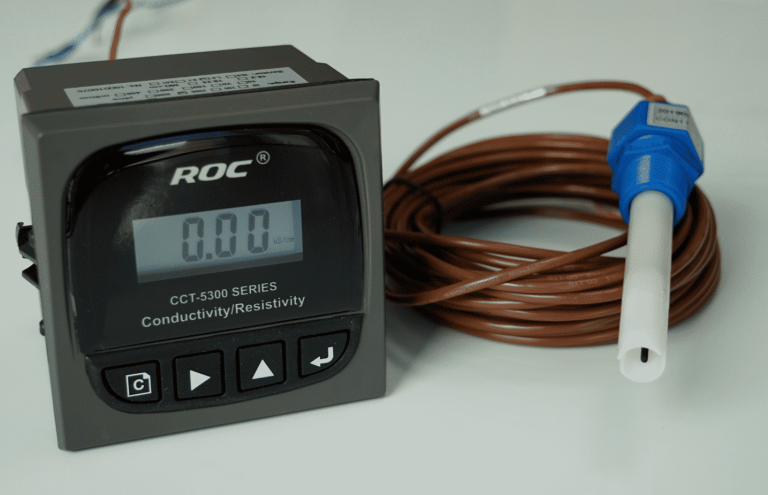
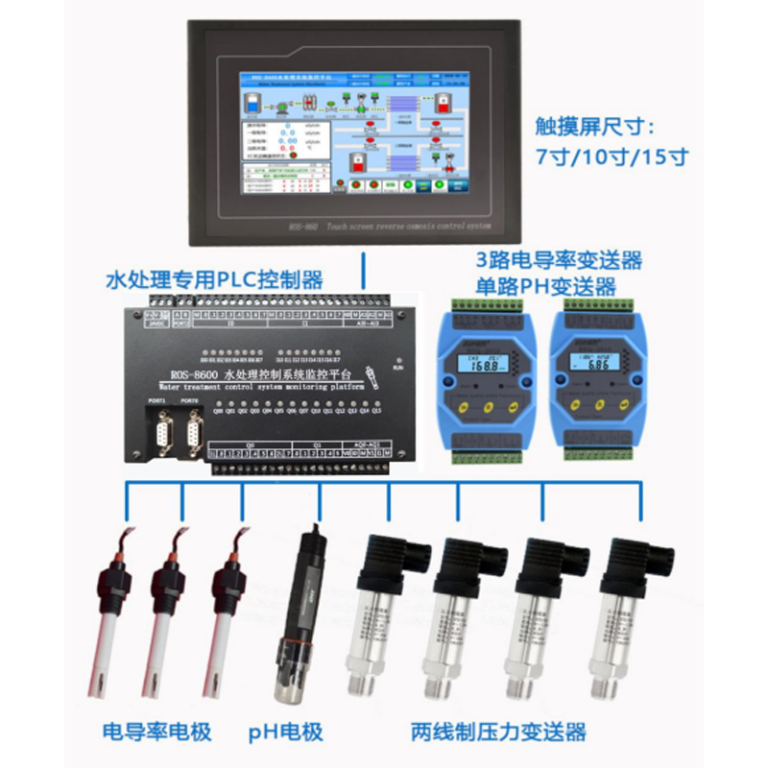
1. Field instrumentation: Sensors that measure water quality parameters and communicate via digital protocols. ChiMay online instruments support Modbus RTU/TCP natively and can be equipped with edge gateway devices that bridge to MQTT or OPC-UA for cloud integration.
2. Edge computing: Local data preprocessing — alarm filtering, data validation, compression — that reduces network bandwidth requirements and enables local control responses without round-trip latency to the cloud. Edge computing devices can run statistical process control (SPC) algorithms that detect measurement anomalies and sensor drift in real time.
3. Cloud or on-premise analytics platform: Time-series databases (e.g., InfluxDB, OSIsoft PI, or cloud-native platforms such as AWS IoT SiteWise) store and analyze water quality data, generating dashboards, reports, and predictive maintenance alerts.
4. Integration with enterprise systems: Connecting water quality monitoring data to ERP, CMMS, and MES systems closes the loop between measurement and action — automatically generating maintenance work orders when sensor diagnostics indicate impending failures or triggering process adjustments when water quality parameters trend toward specification limits.
—
Implementation Roadmap and Investment Tiers
For organizations evaluating IoT-enabled water monitoring investment, a phased implementation approach reduces risk and enables early wins that build organizational confidence:
Phase 1 — Foundation (Months 1–3): Deploy continuous monitoring on the 2–3 highest-risk water quality parameters in the most critical process loops. Target: demonstrate first measurable cost avoidance (chemical savings, process incident prevention). Typical investment: $40,000–$80,000.
Phase 2 — Expansion (Months 4–8): Extend monitoring coverage to all critical water systems. Integrate with SCADA for alarm management. Begin collecting the baseline data needed for analytics. Typical investment: $60,000–$120,000.
Phase 3 — Intelligence (Months 9–18): Deploy predictive maintenance algorithms, connect to cloud analytics platform, integrate with CMMS for automated work order generation. Target: transition from reactive response to proactive management. Typical investment: $40,000–$80,000.
Total 18-month investment: $140,000–$280,000
Expected 3-year benefit: $420,000–$840,000
Average ROI: 147% within 36 months
The business case for IoT-enabled water quality monitoring is not theoretical. It is built on measurable, repeatable cost avoidance and efficiency gains that compound over time — making water monitoring one of the highest-return digital transformation investments available to industrial facilities today.