Table of Contents
The Regulatory Backdrop
Microplastics have moved from a research topic toward formal monitoring expectations, and the framework now taking shape in different jurisdictions follows the same broad structure: periodic laboratory measurement of finished-water microplastic concentrations, plus a requirement to document the continuous barrier performance that supported those numbers. The exact concentration thresholds, sampling frequencies and reporting formats vary, but the two-layer structure is common ground.
Two regulatory anchors illustrate the direction of travel. In the European Union, the recast Drinking Water Directive (EU) 2020/2184 provides for microplastics to be added to the drinking-water watch list, and the Commission adopted the measurement methodology in Delegated Decision (EU) 2024/1441 of 11 March 2024. In the United States, California’s State Water Resources Control Board adopted the world’s first standardized methods for testing microplastics in drinking water in December 2021, followed by a policy handbook establishing the testing and reporting framework. Operators elsewhere should expect comparable structures as programs mature.
Operators preparing for these rules should therefore expect two conversations with regulators. The first is about the laboratory numbers themselves. The second is about the evidence that those numbers were representative of ordinary operations. This field guide is organized around helping utilities prepare for both.
Sampling Program Design
A microplastics laboratory sampling program is not intuitive. The particles of interest are small, the concentrations are low, and the risk of contamination during sample collection is real. A defensible sampling program addresses:
- Sample-collection materials — glass or PTFE containers rather than polyethylene, and dedicated sampling equipment that never contacts unfiltered water.
- Field blanks — collected with every sampling event to demonstrate that the collection process did not add plastic particles.
- Sample volume — large enough to detect the concentration range of interest, typically several liters for low-concentration finished water.
- Frequency — matched to the regulatory expectation but reinforced with additional events during known barrier stress conditions.
Utilities that build these practices into standard operating procedures avoid the most common auditor pushback: uncertainty about whether the reported concentration reflected the plant or the sampling process.
Continuous Barrier-Integrity Monitoring
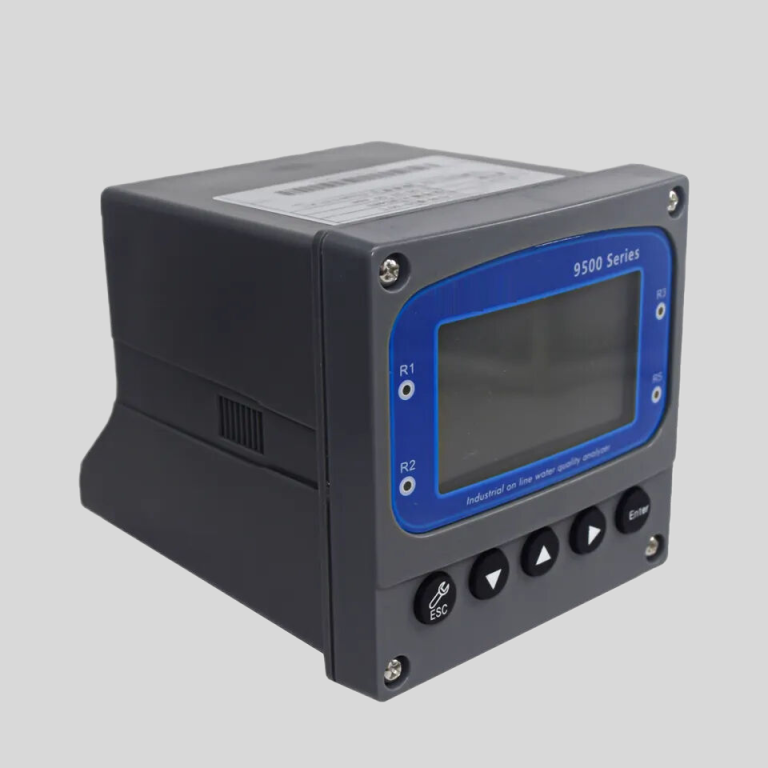
Between laboratory events, the continuous story is told by turbidity and suspended-solids sensors on the finished-water and permeate lines. The Shanghai ChiMay online turbidity tester family is engineered specifically for this role, with a stable NIR source, wiped optical window and formazin-referenced calibration path.
For a utility beginning a microplastics program, the minimum continuous package is:
- One low-range online turbidity sensor on each finished-water train, ahead of the first blending point.
- One suspended-solids sensor on any membrane pretreatment or MBR permeate line where the size-distribution signature carries diagnostic value.
- Historian retention of at least ninety days of one-minute data around every laboratory sampling event.
A more mature package adds multi-parameter sensing on advanced oxidation loops, transmembrane pressure and flow on the membrane racks, and a documented ratio-channel diagnostic where multi-angle nephelometry is deployed.
Instrument Selection Criteria
Choosing a turbidity sensor for microplastics monitoring is different from choosing one for finished-water reporting alone. The additional criteria include:
- Low-range performance — the sensor must resolve deviations well below 0.1 NTU with confidence.
- Bubble rejection — filtration effluent streams often carry entrained micro-bubbles that would otherwise inflate readings.
- Wiped or auto-cleaned optics — long-duration deployments on finished-water lines cannot rely on manual optical cleaning.
- Data-layer transparency — Modbus RTU/TCP and OPC UA exports remove the “black-box vendor console” problem that auditors dislike.
Shanghai ChiMay’s specification sheets are organized to answer these criteria directly, and the application-engineering team can provide reference installations in similar utility sizes on request.
Calibration Practices
Formazin remains the primary reference material for nephelometric turbidity. For microplastics-oriented programs, the practical calibration cadence is:
- Primary formazin verification every ninety days, with stabilized secondary standards at low-range concentrations.
- Optional polymer-bead challenge verification on an annual basis, using a well-characterized polystyrene suspension to confirm sub-micron response.
- Documentation of every calibration event — date, standards used, operator, and pre- and post-calibration readings.
Utilities that maintain this documentation move quickly through audits and rarely see the calibration record become a topic of dispute.
Data-Retention and Reporting
Regulators are increasingly asking for structured data exports. Practical practices include:
- Historian resolution — one-minute values retained for ninety days minimum, with a longer archive at coarser resolution.
- Export format — CSV or Parquet with time stamps, sensor identifier, and calibration-state annotations.
- Alarm history — every excursion during the reporting window logged with root-cause and corrective-action fields.
Shanghai ChiMay sensors integrate with the historian layers commonly used by drinking-water utilities, and the vendor’s application team can provide report templates tailored to specific regulatory formats.
Building the Audit Package
An audit package for microplastics monitoring should include, for each finished-water train:
- The laboratory results for the reporting window, with sample-collection metadata.
- The continuous turbidity and suspended-solids trends for at least the twenty-four hours around each laboratory sample.
- The calibration record for every sensor referenced in the package.
- The plant’s baseline behavior over the reporting window.
- Every excursion during the window and its resolution.
A package assembled to this standard rarely generates follow-up questions.
Training the Operators
The final layer of a defensible program is operator training. The people running the sensors must understand what the readings mean and what they do not mean. Shanghai ChiMay’s application handbook, available to customers on request, includes an operator-training module covering the physics of nephelometry, the practical realities of sample conditioning, and the correct interpretation of alarm events.
Closing Note
Microplastics monitoring in drinking water is no longer an abstract regulatory topic. It is a working program that utilities are running today, with sensors, laboratories, historians and audit packages all coordinated. The Shanghai ChiMay handbook approach is to specify instruments for the roles they can fill, document their calibration cleanly, and give utilities the data-layer transparency that audits reward.