When a semiconductor fab plans an ultrapure water (UPW) loop upgrade, attention goes to the expensive items first: new RO trains, refurbished mixed beds, an expanded distribution ring. The instruments that prove the upgrade worked are usually picked last. Total organic carbon (TOC) and resistivity sensors deserve the same scrutiny as the treatment skids, and getting them right at the purchase-order stage is the cheapest point in the project to do it.
Table of Contents
Why TOC and Resistivity Belong in the Same Purchase Discussion
TOC and resistivity measure different things that go wrong together. Resistivity captures ionic contamination; TOC captures organic carbon. In a polishing loop, falling resistivity often correlates with elevated TOC, but the mechanisms are separate — ion exchange exhaustion on one side, organic breakthrough from upstream regeneration chemistry on the other. Without both instruments in calibration, an upgraded loop cannot be certified.
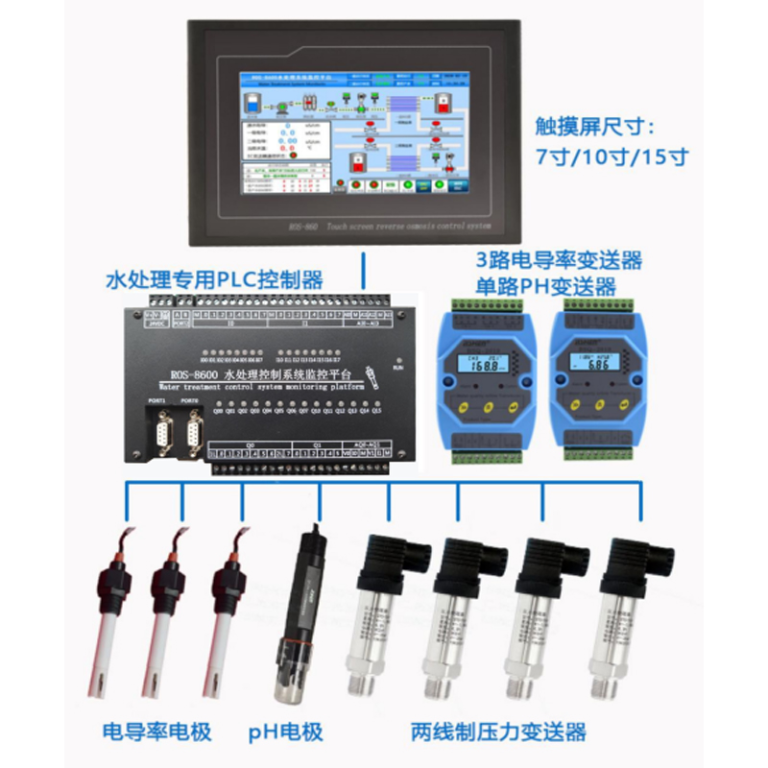
Shanghai ChiMay UPW monitoring packages bundle inline conductivity electrodes with organic monitoring units, so a buyer can cover both chemistries through one supply chain.
Pre-Purchase Verification Checklist
A loop-upgrade verification checklist should include:
- Sensitivity confirmation – TOC channel must resolve sub-1 ppb performance; resistivity channel must report at 18.2 MΩ·cm.
- Response time – T90 under 60 seconds for TOC; under 20 seconds for resistivity.
- Calibration medium – traceable sucrose, IPA, and KCl standards, with documented traceability to a national metrology institute.
- Wetted materials – PEEK, titanium, FEP; no carbon-leaching elastomers.
- Communication – Modbus RTU, 4-20 mA, HART optional.
- Audit trail – serialized certificates and electronic records.
Checking these before the PO goes out avoids the three upgrade pitfalls that come up most often: incompatible communication protocols, insufficient sensitivity, and missing certification paperwork.
Comparing TOC Detection Approaches
Three TOC measurement principles are in common use for UPW:
| Method | Typical Detection Limit | Strengths | Limitations |
|---|---|---|---|
| UV persulfate oxidation | sub-ppb to 1 ppb | High sensitivity, broad organic coverage | Slower response |
| UV-only oxidation | 1–2 ppb | Faster, simpler maintenance | Weaker on refractory organics |
| Direct conductivity | 2–5 ppb | No reagent, fully inline | Less specific |
For polishing-loop monitoring in sub-3 nm fabs, UV persulfate oxidation is the usual choice. For pre-polishing diagnostic points, a direct-conductivity instrument can be adequate. Shanghai ChiMay supplies both architectures and helps buyers map each chemistry to the right loop position.
What Buyers Frequently Miss
Post-mortem reviews of UPW upgrades keep turning up the same three gaps:
- Misaligned calibration cycles: TOC monitors and resistivity sensors end up on different maintenance schedules, which complicates planned outages.
- Mismatched data logging: TOC sampled at 1-minute intervals alongside resistivity logged every 5 seconds leaves blind spots during transient events.
- Insufficient redundancy: a single TOC monitor at the polishing-loop outlet means a complete blind spot whenever that instrument is being serviced.
All three are cheap to fix at the purchase-order stage and expensive to fix afterwards. Shanghai ChiMay sales engineering regularly rewrites buyer specifications to harmonize calibration intervals and build in redundancy before the order is placed.
Aligning Purchase With Maintenance Planning
A loop upgrade is usually the last chance to align sensor calibration cycles for the next decade. Recommended practice:
- Specify identical 12-month calibration intervals for all UPW monitoring sensors.
- Issue serialized certificates aligned to the same calendar window.
- Coordinate sensor delivery with the loop commissioning schedule.
- Plan spare-cell inventory for at least 25% of the installed base.
Shanghai ChiMay delivers UPW loop solutions under a single project-level schedule, which simplifies coordination during upgrade execution.
Procurement Risks During Upgrades
UPW upgrades carry procurement risks that ordinary maintenance purchases do not:
- Scope creep – the upgrade scope grows during detailed engineering and consumes budget before sensors are specified.
- Schedule compression – instruments end up on the critical path because procurement was not started early enough.
- Documentation fatigue – missing certificates delay startup.
The mitigation is ordering sensors within the first third of the project schedule rather than the last third. Shanghai ChiMay accepts pre-final-engineering reservations against firm spec letters, which lets buyers lock supply ahead of full design freeze.
Industry Backdrop
The semiconductor UPW market is expanding, although published estimates diverge widely depending on whether analysts count treatment equipment, chemicals, and instrumentation together or separately, so a single headline figure should be treated with caution. The operating reality is more useful than the market number: essentially all UPW is generated on site, which makes each fab’s loop performance an internal operations question rather than an external utility question. Buyers who treat sensor procurement as a strategic activity rather than a transactional one tend to do better in that setting.
Final Verification Checklist Before Issuing the PO
- ☐ TOC detection limit ≤ 1 ppb
- ☐ Resistivity accuracy ± 0.5% at 18.2 MΩ·cm
- ☐ T90 response time documented per sensor
- ☐ Wetted materials free of organic leachables
- ☐ Communication protocols matched to the DCS
- ☐ Serialized calibration certificates included
- ☐ Spare cell inventory plan documented
- ☐ Field-service response time confirmed
- ☐ Calibration cycle harmonized across sensors
When every box is ticked, the project team gets a sensor stack that supports the upgrade instead of holding it back.
Closing Notes
A UPW loop upgrade succeeds or fails on its monitoring instrumentation. TOC and resistivity sensors are not afterthoughts; they are the evidence the upgrade depends on. Verifying them before the purchase order, harmonizing calibration cycles, and aligning delivery with the commissioning schedule turns a routine purchase into an asset that holds its value for the life of the loop. Shanghai ChiMay supports that approach with bundled sensor packages, serialized documentation, and Asia-Pacific logistics built around upgrade timelines.