Scale is the deposit that forms when dissolved minerals in water come out of solution and attach to a surface. In industrial piping and heat transfer equipment, it accumulates where the water is hottest and the flow is slowest, and because its thermal conductivity is a small fraction of that of steel or copper, even a thin layer changes how the system performs. This article covers what scale is made of, which conditions cause it to form, how it is detected, and what actually works to prevent it.
Table of Contents
What Scale Is
Scale is the crystalline deposit that forms when dissolved minerals in water come out of solution and attach to a surface. The mechanism sits in the basic chemistry of hard water:
Ca²⁺ + 2HCO₃⁻ ⇌ CaCO₃↓ + CO₂↑ + H₂O
The reaction moves to the right when temperature rises (calcium carbonate becomes less soluble in hot water, unlike most salts), when pH rises, and when dissolved carbon dioxide is stripped from the water. Those three conditions are all present in a cooling tower, a heat exchanger, and a boiler feedwater system, which is where most scaling problems occur.
Which Minerals Form Scale
| Deposit type | Main constituents | Conditions that form it |
|---|---|---|
| Carbonate scale | Calcium carbonate, magnesium carbonate | Hard water, elevated temperature, higher pH, carbon dioxide stripping |
| Sulfate scale | Calcium sulfate, barium sulfate | High sulfate water, temperature rise, evaporation |
| Silica deposits | Amorphous silica, magnesium silicate | High silica water, alkaline pH |
| Iron deposits | Iron oxides and hydroxides | Iron-bearing water, oxygen ingress, corrosion products |
| Phosphate deposits | Calcium phosphate | Phosphate treatment programs, high pH, hard water |
| Mixed deposits | Combinations of the above | Most real systems, with organics and corrosion products incorporated |
Carbonate scale is the most common and the most straightforward to prevent. Sulfate and silica deposits are harder: they form under conditions that conventional softening does not address, and they can require different chemistry or a change in operating limits rather than a treatment chemical.
Where Scale Forms
Temperature, pH, and flow velocity decide where a deposit appears. The practical pattern in industrial systems:
- Hot surfaces first. Scale appears on heat exchanger tubes, boiler watersides, and the hottest part of any wetted surface, because calcium carbonate solubility falls with rising temperature.
- Low-velocity zones. Settling and deposition both increase where flow is slow: dead legs, header ends, horizontal runs with poor drainage, and the low points of piping systems.
- Points of turbulence and pressure change. Valve seats, pump casings, strainers, and fittings create local conditions where dissolved gas is released and where the deposit nucleates.
- Evaporative systems. Cooling towers and evaporators concentrate dissolved minerals by design, so scaling is a function of the cycles of concentration the system is run at.
The engineering response follows from the same list: keep velocities up, eliminate dead legs, and control the concentration cycles that decide how saturated the water becomes.
How Scale Affects System Performance
Heat Transfer Loss
Scale is a poor conductor of heat, and heat transfer performance degrades as the layer thickens. The relationship between deposit thickness and efficiency loss is a function of the deposit type and the equipment, and it is the reason that scale in boilers and heat exchangers is treated as an energy problem rather than a housekeeping issue. US Department of Energy materials on boiler waterside heat transfer surfaces describe the effect in concrete terms: a scale layer of only 1.6 mm on a firetube boiler can increase energy costs by roughly 10%, because the deposit forces a higher flue gas temperature to deliver the same steam output.
Flow Restriction and Pumping Cost
Deposits reduce the effective internal diameter of a pipe, and head loss in a pipe varies approximately with the inverse 4.87 power of diameter for turbulent flow (the Hazen-Williams relationship). The practical consequence is that a modest reduction in bore has a large effect on pumping energy and on the flow a given pump can deliver—deposits that look superficial on inspection can be responsible for a measurable loss of pumping capacity and a matching increase in electricity consumption. Deposits also raise the risk of under-deposit corrosion, since the metal under the deposit is protected from the inhibitor while differential aeration cells form around it.
Equipment Life and Maintenance Cost
The end result is more frequent cleaning, higher chemical consumption, and shorter equipment life. Descaling a plate heat exchanger or retubing a condenser is planned work; the under-deposit corrosion underneath is not.
Detection: Measuring Scale Before It Becomes a Problem
Scale is detected by looking for the conditions that produce it and for the early performance effects, not by inspecting pipework:
The Langelier Saturation Index is the standard tool for predicting calcium carbonate behaviour. It compares the measured pH with the pH at which the water would be saturated with calcium carbonate:
| LSI value | Interpretation |
|---|---|
| Negative (< 0) | Water is under-saturated; it will tend to dissolve existing carbonate deposits, and can be corrosive |
| Near zero (±0.5) | Water is approximately at equilibrium |
| Positive (> +0.5) | Water is over-saturated; carbonate deposit formation is likely |
The index applies to carbonate chemistry only and is a prediction, not a measurement of how much deposit will actually form, but it remains the most practical indicator for cooling water and process water systems.
Monitoring parameters and their use:
| Parameter | Monitoring frequency | Control action |
|---|---|---|
| Conductivity | Continuous | Controls blowdown; sets the cycles of concentration |
| pH | Continuous | Sets carbonate chemistry and deposit type |
| Calcium hardness | Weekly | Determines whether softening is required |
| Total alkalinity | Weekly | Feeds the LSI calculation |
| LSI | Calculated daily | Determines whether inhibitor dosing is adequate |
| Inhibitor residual | Daily | Confirms the programmed dose is present in the system |
Prevention Methods
Ion Exchange Softening
A strong acid cation exchange resin replaces calcium and magnesium with sodium:
2R-Na + Ca²⁺ → R₂-Ca + 2Na⁺
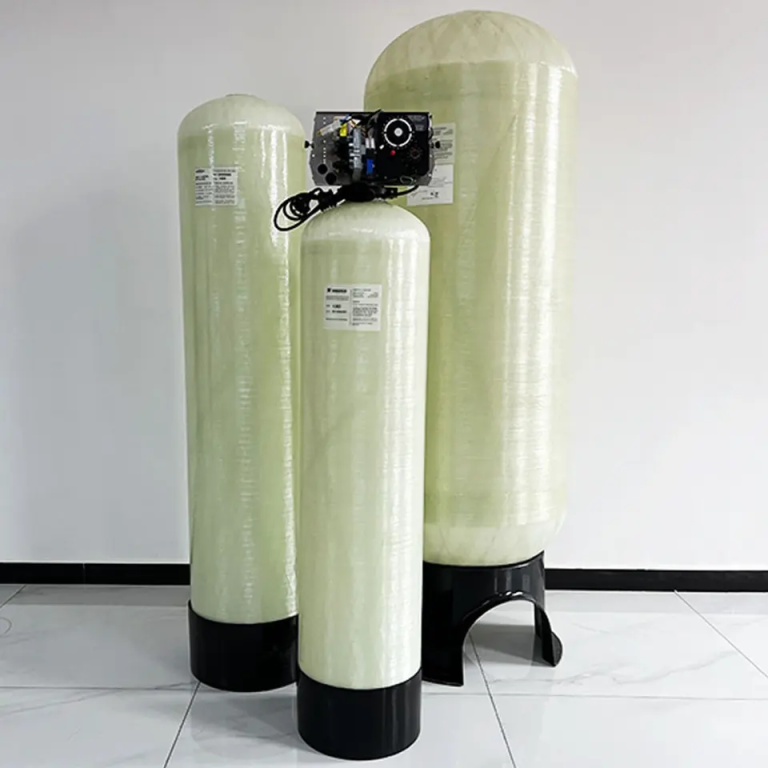
Softening is the most direct method of removing carbonate scale potential, because it removes the cation that forms the deposit rather than modifying its behaviour. Properly operated softeners remove the large majority of hardness—typically in the 95-99% range—and the measurement that confirms they are working is the outlet hardness, which should be monitored rather than assumed. Shanghai ChiMay supplies water softener control valves and softener monitoring instrumentation.
The limitation is regeneration: each cycle consumes salt and produces a brine discharge, so softening is not free from an environmental standpoint, and it does not remove silica or sulfate scale potential.
Chemical Scale Inhibitors
Inhibitors work by interfering with crystal nucleation and growth, so the minerals stay in suspension rather than attaching to surfaces:
- Phosphonates — ATMP (amino tris methylene phosphonic acid), HEDP (1-hydroxyethylidene-1,1-diphosphonic acid), and PBTC (phosphonobutane tricarboxylic acid) — are the workhorses of cooling water and boiler treatment. They adsorb onto crystal surfaces and prevent the crystals from growing into a deposit. Effective dosage is typically in the range of 2-10 ppm.
- Polymer dispersants — polyacrylates, polymaleates, and phosphinocarboxylic acid copolymers — keep particles dispersed so they are carried through the system rather than settling.
- Threshold treatment exploits the fact that a much smaller dose than stoichiometric is enough to keep scale-forming minerals in solution. Well-managed programs manage most of the scale-forming potential in the system, though their performance depends on the water chemistry and the control system, and on the inhibitor actually being present—which is why residual testing matters.
Phosphonate programs require attention to two practical issues: phosphonates can hydrolyse under high-temperature or high-pH conditions and lose effectiveness, and phosphorus discharge is regulated in many locations, so a switch to non-phosphorus polymers is sometimes required.
pH Control with Acid
Acid dosing converts bicarbonate alkalinity to carbon dioxide, which is then removed:
H₂SO₄ + 2NaHCO₃ → Na₂SO₄ + 2CO₂ + 2H₂O
This reduces the carbonate scaling potential, but it introduces sulfate to the system (which shifts the risk toward calcium sulfate scale), it produces a pH that can accelerate corrosion, and it demands reliable pH control because over-dosing creates a far more expensive corrosion problem than the scale it prevented. Acid programmes are generally applied where alkalinity is high enough to require removal and where softening alone is not sufficient.
Physical and Alternative Treatments
Magnetic and electronic water treatment devices have attracted attention for decades, and the evidence base remains mixed—reports of successful applications coexist with controlled studies showing no measurable effect, and the mechanism by which a magnetic field would permanently alter scaling behaviour is not well established. The reasonable position is to treat them as unproven and to test them on a fouling-prone exchanger before relying on them, rather than to install them as a substitute for established chemistry control.
Other options include filtration for the removal of suspended solids that act as nucleation sites, and the selection of materials—such as a slightly rougher surface or specific coatings—that resist adhesion.
Industrial Water Monitoring Solutions
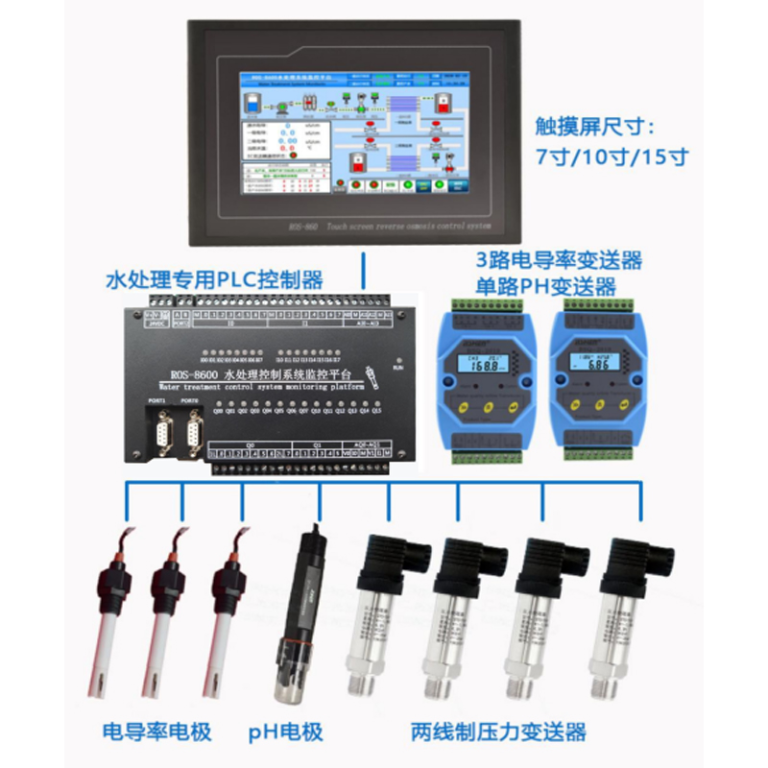
The common thread in every prevention method above is that it depends on measurement. Softening depends on outlet hardness. Inhibitor programs depend on residual testing and on pH and conductivity being within range. Acid dosing depends on reliable pH control. Cycles of concentration depend on conductivity control.
Shanghai ChiMay’s 4-in-1 multi-parameter sensors measure conductivity, pH, and other critical parameters in a single installation, which reduces the number of separate instruments, sample points, and wiring runs required to monitor a water system. Continuous data from these instruments is what allows a plant to hold a treatment program within its designed limits rather than discovering the excursion through an unexpected heat transfer loss or a failed exchanger inspection.
Conclusion
Scale is predictable. It forms where hot water carrying carbonate hardness meets a surface, and the conditions that cause it can be measured and controlled. A plant that manages hardness, controls pH and conductivity, holds cycles of concentration within the limits its water chemistry allows, and verifies inhibitor residuals has removed most of the risk.
The systems that still suffer from heavy scaling are usually the ones where measurement is intermittent and treatment is reactive. Continuous monitoring is not a substitute for a treatment programme; it is what tells you whether the programme is working.